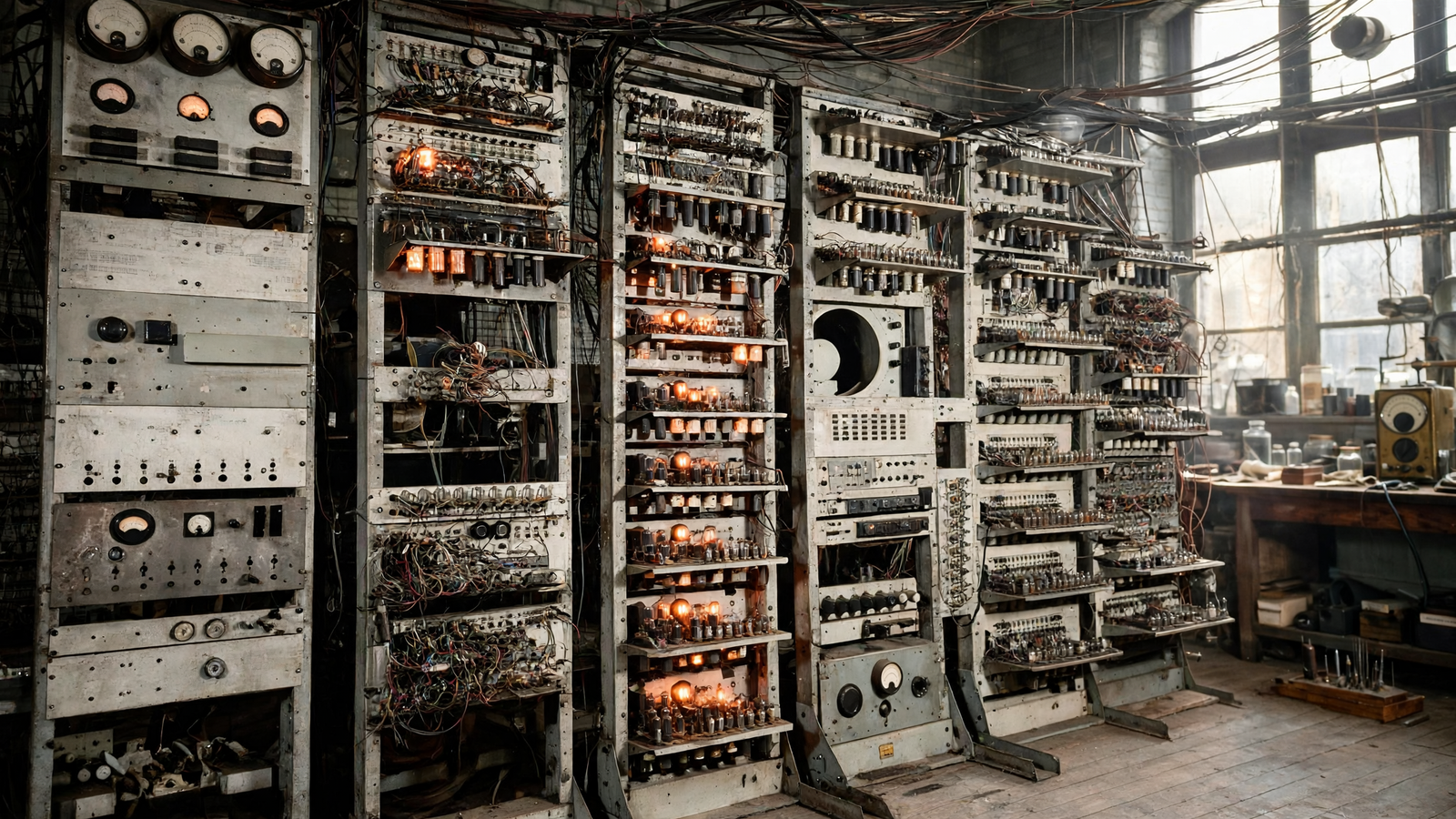
Before computers became things people carried in pockets, they were experimental machines assembled from valves, wires and improvised memory systems. In June 1948, one of those machines performed a short calculation in a laboratory at the University of Manchester. Its name was the Small-Scale Experimental Machine, though history remembers it more warmly as the Manchester Baby.
The Baby was not designed to be a practical office computer. It was a proof of an idea: a machine should be able to keep both its data and its instructions in memory, then change from one task to another without being physically rewired. That principle is now so familiar that it can be easy to forget how radical it once was.
A machine built to test a memory idea
The project grew from work by engineer Frederic Williams and mathematician Tom Kilburn, with assistance from Geoff Tootill. Their key innovation was a form of electronic memory based on the behavior of a cathode-ray tube. Electrical patterns could be written onto the tube’s screen and read back later, allowing the machine to retain information.
That memory was extremely limited by modern standards. The Baby worked with 32-bit words and had room for only 32 of them. Yet the arrangement was enough to demonstrate a major change in computer design. Instead of treating instructions as permanent physical connections, the machine could represent them as numbers stored alongside other information.
The first program
On June 21, 1948, the Baby ran what is widely recognized as the first program on an electronic stored-program computer. The program was written by Kilburn to search for the highest factor of a large number. It was a deliberately modest calculation, chosen to test whether the machine could repeatedly read instructions, perform operations and return results from memory.
The process was slow. The Baby’s electronic components and memory technology were experimental, and the calculation took many minutes. But speed was not the point. The successful run showed that a computer could follow a stored sequence of instructions without engineers having to rebuild its circuitry for every new problem.
From laboratory demonstration to computer industry
The Baby was soon followed by more capable machines at Manchester. The Manchester Mark 1 developed the stored-program concept into a usable research computer, and its design influenced early commercial systems. The work also helped establish Manchester as an important center of computer science.
The Baby itself was small only by comparison with the larger machines that followed. It filled a room and depended on technology that would soon be replaced by more reliable components. Its lasting importance came from what it proved rather than from what it could do.
Modern computers hold billions of instructions and operate at speeds that would have seemed impossible in 1948. Still, the basic pattern remains recognizable: instructions are placed in memory, retrieved, interpreted and executed. The Manchester Baby was one of the first machines to make that pattern work in practice.
Its story is a useful reminder that technological revolutions do not always begin with a polished product. Sometimes they begin with a deliberately limited experiment that answers one crucial question. In Manchester, the question was whether electronic memory could give a computer a flexible internal program. The Baby’s brief calculation supplied the answer.