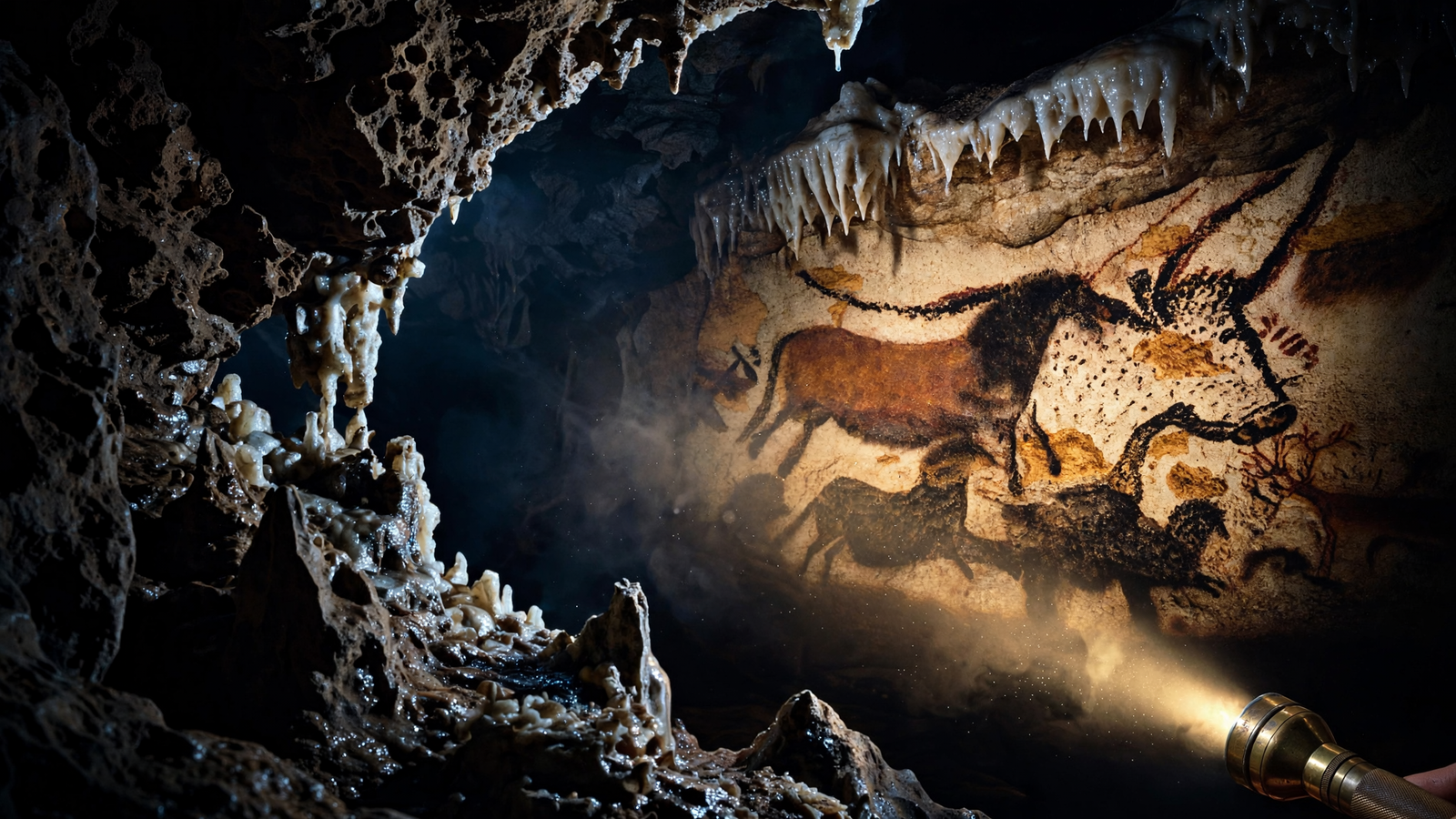
On a September afternoon in 1940, four teenagers exploring a wooded hillside near Montignac in southwestern France noticed an opening in the ground. The hole was narrow, dark and partly hidden. They returned with a lamp, crawled inside and followed a passage into the earth.
What they saw was not an ordinary cave. Across the walls and ceilings were hundreds of painted and engraved animals: powerful horses, long-horned cattle, deer, ibex and predators. Some figures stretched several metres across the rock. Others appeared in places so difficult to reach that the artists must have planned their work carefully, using the uneven surface of the cave as part of the image.
The discovery of Lascaux became one of the defining archaeological events of the twentieth century. It offered an extraordinary view of Ice Age imagination, but it also created a lasting conservation challenge. The cave showed how much could survive from the deep past—and how quickly even ancient evidence could be damaged by modern attention.
A discovery made by accident
The teenagers were Marcel Ravidat, Jacques Marsal, Simon Coencas and Georges Estrade. According to the historical record preserved by French cultural authorities, Ravidat first came across the opening while exploring the area with a dog. The group returned on September 12, 1940, and enlarged the entrance enough to enter.
The first chamber revealed paintings that were immediately striking. The boys told their teacher, who recognized that the images might be important. News spread locally, and the site soon attracted the attention of researchers, including the prehistorian Henri Breuil. Breuil visited the cave within days and helped establish that the paintings belonged to the distant prehistoric past rather than to a recent period.
The timing was extraordinary. France was living through the early months of the Second World War, and scientific work was taking place under difficult conditions. Yet the cave’s importance was clear enough that researchers began documenting its paintings and engravings. Lascaux was not simply a collection of pictures. It was a preserved archaeological environment containing traces of how people moved, worked and made meaning underground.
What the paintings show
Lascaux is often called a gallery, but that description can be misleading. The cave was not designed as a modern exhibition space. Its artists worked in chambers, tunnels and passages with irregular floors and ceilings. Some surfaces were easy to see; others were high above the ground or tucked into narrow recesses.
The animals dominate the visual record. Horses are especially numerous, while aurochs—large wild cattle now extinct—appear in some of the most memorable compositions. Deer, ibex and felines also occur. The artists used mineral pigments, including forms of iron oxide that produced red and yellow tones, along with darker materials for black marks. They applied color with brushes or tools, blew pigment onto surfaces, and sometimes used the natural contours of the stone to suggest bodies and movement.
One of the best-known scenes is in the so-called Shaft, a deep section of the cave. It includes a human figure near a wounded or falling bison, along with a rhinoceros and other elements. The scene has inspired many interpretations, but its exact meaning cannot be recovered with certainty. That uncertainty is important. Lascaux gives modern viewers access to Ice Age images, not a translation of the beliefs or stories behind them.
The cave also contains geometric signs and less easily identifiable marks. These details resist the temptation to reduce the site to a simple story about hunting. The people who made the art were not merely recording a list of animals around them. They were selecting subjects, arranging them in particular places and working within a visual system whose full meaning is now lost.
Older than a civilization, younger than the first cave art
Lascaux’s paintings are generally associated with the Upper Paleolithic period and are commonly described as approximately 17,000 years old. That places them near the end of the last Ice Age, when hunter-gatherer communities occupied parts of Europe.
The cave is not the oldest known site of human image-making. Earlier painted caves exist elsewhere, and the chronology of prehistoric art is continually refined through archaeological research. Lascaux matters because of the scale, quality and survival of its decoration, as well as the way the paintings appear together across a connected underground space.
Its importance was recognized internationally in 1979, when Lascaux became part of the UNESCO World Heritage listing for the Prehistoric Sites and Decorated Caves of the Vézère Valley. The designation covers a group of archaeological sites in the Dordogne, an area rich in evidence from the Paleolithic period. Lascaux is therefore best understood not as an isolated wonder, but as part of a wider prehistoric landscape.
When fame became a threat
After the war, Lascaux was prepared for public access. The cave opened to visitors in 1948, and thousands of people soon came to see the paintings. The attention was understandable: the site seemed to bring a distant human world into view with unusual force.
But a cave is a delicate environment. Visitors introduced heat, moisture and carbon dioxide. Changes in air circulation and the presence of large numbers of people disturbed conditions that had remained relatively stable for millennia. Algae and other growth began to appear, and the paintings faced biological and chemical threats.
Authorities closed the original cave to the public in 1963. The decision was disappointing, but it established a principle that has shaped the site ever since: access to a cultural treasure cannot be separated from the conditions that allow it to survive. Later conservation efforts worked to stabilize the cave’s climate and control microbial growth. The original chambers remain highly restricted, with research and monitoring continuing under specialist supervision.
Reproducing the experience without sacrificing the original
Lascaux’s caretakers eventually developed a different way for the public to encounter the art. Lascaux II, a detailed reproduction of major sections of the cave, opened in 1983. It allowed visitors to experience the scale and arrangement of the paintings without entering the original chambers.
Further reproductions and digital tools followed. The International Centre for Cave Art, known as Lascaux IV, opened in Montignac in 2016. Its full-scale replica and interpretive displays present the cave as an artistic and archaeological environment rather than as a collection of isolated images.
These reproductions do more than solve a practical problem. They also make the history of the discovery visible. Visitors can learn about the teenagers who entered the cave, the researchers who documented it, the artists who created the paintings and the conservation scientists who now work to protect them. The story becomes one of collaboration across time, even though the people involved lived thousands of years apart.
The lesson beneath the paintings
Lascaux is often remembered as a story of wonder: four young people find a hidden passage and discover a masterpiece beneath the earth. That is part of the truth, but it is not the whole story. The cave also reveals the consequences of treating fragile heritage as if it were indestructible.
The paintings survived because the underground environment protected them for an immense span of time. Modern visitors nearly changed that environment in a few decades. Closing the cave was therefore not a failure to share history. It was a recognition that preservation sometimes requires restraint.
Today, Lascaux continues to influence archaeology, art history, conservation and public education. Its animals remain vivid, but the larger discovery is just as powerful: people living in Ice Age Europe were capable of planning complex images, choosing materials, responding to natural surfaces and creating works that still command attention thousands of generations later.
The cave’s greatest message may be found in the balance between access and absence. We can study Lascaux, reproduce it and learn from it, but we cannot treat the original as an ordinary destination. The paintings endured because they were sheltered from us. Protecting them now means making sure that the next generation encounters their meaning without costing the past its remaining evidence.