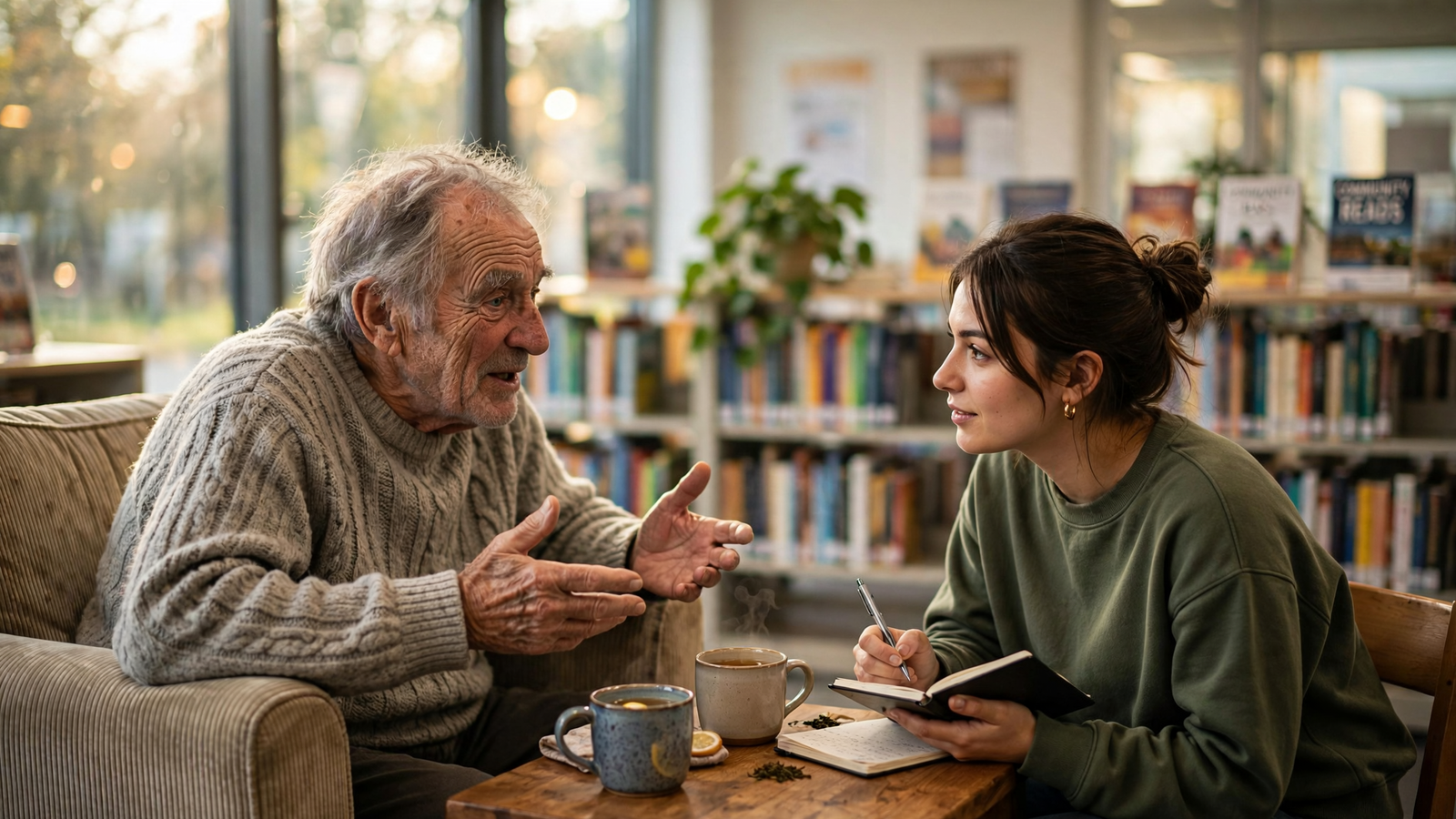
In an ordinary library, a visitor chooses a book from a shelf. At a Human Library event, the books are people.
Visitors can browse a catalog of volunteers who have chosen to share part of their lived experience. A “reader” then sits with a “book” for a conversation, asking respectful questions and listening to the answers. The subjects vary from event to event, but may include identity, disability, religion, migration, mental health, work, family, or other parts of life that are often misunderstood from a distance.
The idea began in Denmark in 2000, when organizers connected with the Stop the Violence movement created an event at the Roskilde Festival. Their experiment was simple but unusual: replace assumptions about unfamiliar people with the chance to meet one another directly.
A library built from lived experience
The Human Library does not treat personal experience as a spectacle. Volunteers decide what they want to share, how they want to describe their “book,” and which questions they are willing to answer. Readers are expected to approach the conversation with curiosity rather than confrontation.
That structure matters. A conversation about a difficult subject can easily become an argument when it happens online or in a large public debate. In a small conversation, people have more room to explain what they mean, ask follow-up questions, and discover that a label rarely tells a whole story.
Events generally include librarians or organizers who help match readers with books and explain the ground rules. Conversations are temporary, which makes participation manageable for both sides. A volunteer does not have to tell everything, and a reader does not have to arrive with perfect language or complete understanding.
From one festival to an international network
What started as a Danish festival project developed into an international nonprofit organization. The Human Library says its activities have reached more than 85 countries, with events hosted by libraries, schools, universities, workplaces, festivals, and community groups.
The model works because it is both modest and ambitious. It does not promise that one conversation will erase prejudice. Instead, it creates a setting where a person can replace an abstract impression with a real encounter. Someone who has only heard generalizations about a group may leave with a more complicated, and more human, understanding.
The format also gives people a constructive role in improving their communities. Volunteers are not presented as representatives of everyone who shares their identity. They are individuals telling their own stories. Readers, meanwhile, are invited to practice a skill that is easy to praise but harder to sustain: listening without rushing to correct, categorize, or win.
The kindness of making room
There is no technology at the heart of a Human Library event and no complicated equipment. Its most important resources are time, attention, and consent.
That may be why the idea continues to travel. In a world where people often meet one another through headlines, profiles, and arguments, the Human Library offers a quieter alternative: sit down, ask a genuine question, and allow another person to be more than a category.
It is a small act of kindness, but one with a wide reach. Every conversation makes room for someone to be heard—and for someone else to discover that understanding can begin with simply turning the page.