There is a quiet change taking place inside Arizona’s public libraries. It is easy to miss if you are looking only for books.
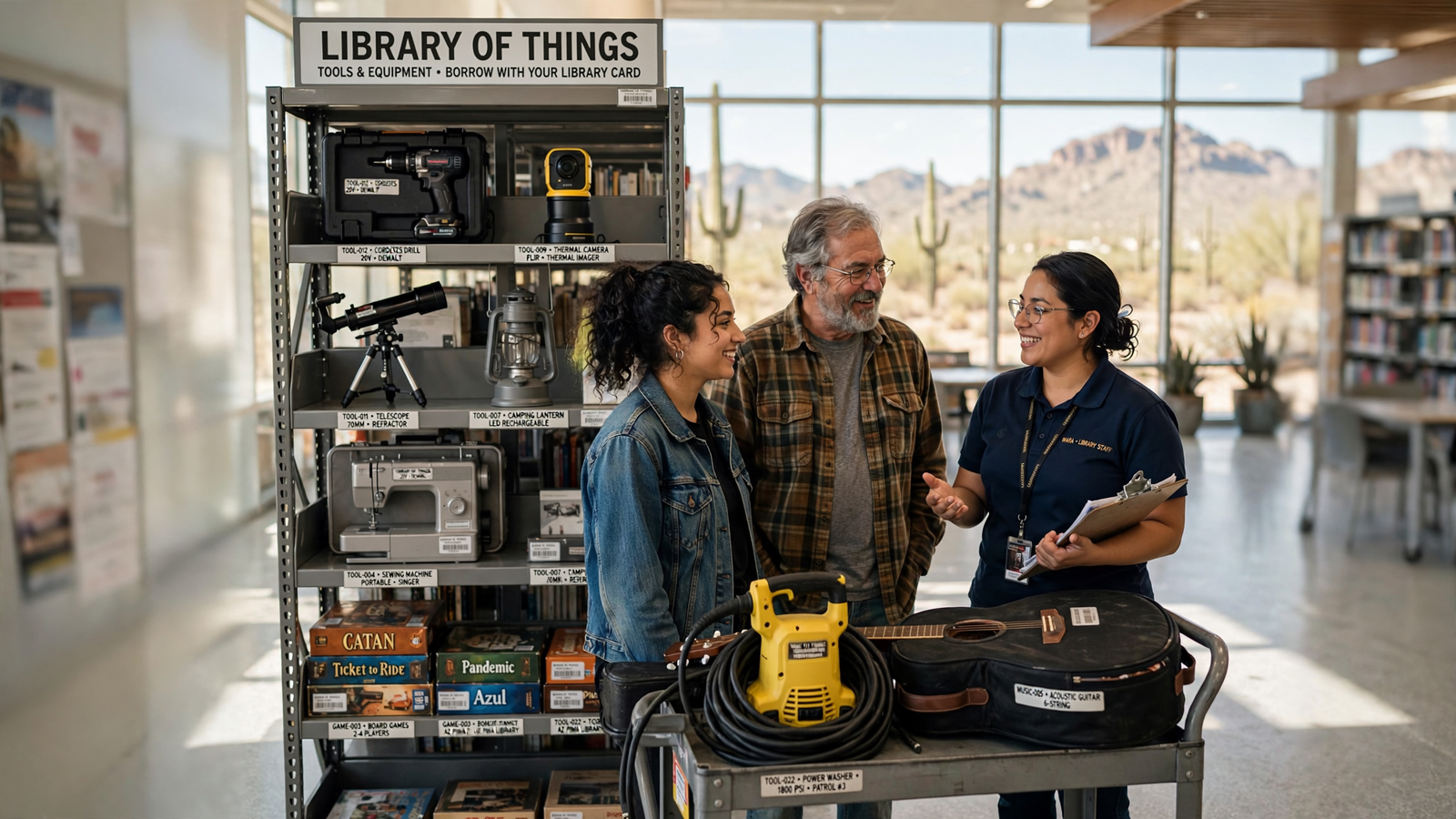
On shelves and in lending collections, libraries are making room for objects that help people learn, create, repair, explore and spend time together. Board games, technology, educational kits, musical instruments, hotspots and other practical resources are becoming part of what a library can offer.
The idea is sometimes called a “Library of Things.” Its central principle is simple: a community does not need to purchase every useful object individually when neighbors can share access through a trusted public institution.
In Arizona, that principle has taken shape in different ways at public libraries in Phoenix, Mesa and Scottsdale. The collections vary, and availability changes, but they point toward the same generous idea: a library can lend possibilities, not just pages.
A library built around access
Traditional library service already rests on a form of community sharing. Residents contribute through public funding, and the library uses that shared investment to make information available to everyone who has a card.
A Library of Things extends that arrangement to items that may be useful but expensive, difficult to store or needed only occasionally. A person might want to try an activity before buying equipment. A family might need a game for a weekend gathering. A student may benefit from technology or a learning kit. Someone working on a small project may need a specialized item for only a few days.
In each case, borrowing can remove a barrier. It can make experimentation less risky and participation more affordable. It can also reduce the pressure to own objects that spend most of their lives sitting unused.
That does not make these collections a replacement for stores, schools or community organizations. Their value is more modest—and more practical. They give people another way to try something, solve a problem or share an experience.
Phoenix puts the idea on a public shelf
The Phoenix Public Library’s Library of Things collection reflects this broader understanding of public service. Its catalog includes nontraditional lending materials alongside the books, movies and other resources people already associate with libraries.
Items and collections can include recreational materials, technology and kits designed to support learning or hands-on activities. Because the library’s online catalog is the current source for availability, residents can check individual listings, borrowing rules and the location connected to an item before making a trip.
The practical details matter. Nonbook items may have different loan periods, renewal rules or pickup requirements. Some may be available only at selected branches. Those policies help libraries keep shared materials circulating so that more than one household can use them.
But the deeper significance is not any single object. It is the message communicated by the collection: useful experiences should not be limited to people who can afford to buy all the equipment in advance.
Mesa treats borrowing as a way to try something new
Mesa Public Library also maintains a Library of Things collection. Its offerings show how the concept can support both recreation and learning.
A traditional library visit often begins with a question: What do I want to read? A Library of Things adds other questions: What do I want to make? What could my family play together? What skill would I like to practice? What might I borrow before deciding whether it belongs in my home?
That last question is particularly important. Many hobbies come with an intimidating entry cost. Cameras, instruments, games, electronics and specialized tools can all be expensive purchases when someone is still deciding whether an interest will last.
Borrowing creates a low-stakes first step. A child can encounter a new kind of learning. An adult can explore a hobby. A household can share an activity without adding another permanent item to a crowded closet.
Libraries also provide something online shopping cannot: a public place where access is organized around membership in a community rather than individual purchasing power.
Scottsdale adds another version of shared resources
Scottsdale Public Library is another Arizona system that has developed a Library of Things offering. Like the collections in Phoenix and Mesa, its catalog demonstrates that the model does not have to look identical everywhere.
That flexibility is part of the strength of the idea. A library can respond to local interests, available funding, storage capacity and community partnerships. One system may emphasize technology. Another may focus on games, educational materials or creative activities. The collection can grow according to what residents request and what staff can safely circulate.
For patrons, the experience remains familiar. Search the catalog, review the rules, place a hold when available and return the item so someone else can use it. A public library’s existing infrastructure—cataloging, lending policies, branch networks and staff guidance—makes the sharing system understandable.
More than a money-saving idea
The strongest case for a Library of Things is not simply that it can save people money. It is that shared resources can create shared experiences.
A board game can bring people around one table. A learning kit can turn an afternoon into a project. A musical instrument can give a beginner a chance to practice. A technology loan can help someone participate in school, work or creative life. A specialized item can help a resident complete a task without buying equipment that may never be used again.
These are small forms of connection, but public life is often built from small forms of connection. A library does not need to host a major event to strengthen a neighborhood. Sometimes it helps by making it easier for people to do something together.
There is also a quiet environmental benefit to sharing durable goods. When many people use the same item over time, fewer households need to purchase their own version. That does not eliminate manufacturing, transportation or waste, and libraries still have to replace worn materials. It does, however, encourage a more efficient pattern of use: access when needed, return when finished.
The kindness is in the system
Community kindness is often portrayed as a dramatic gesture. In public libraries, it can look more ordinary: a well-maintained collection, clear instructions, a convenient hold system and a shared agreement to return an item in usable condition.
That system depends on trust in both directions. Libraries trust patrons to care for materials and bring them back. Patrons trust libraries to make useful resources available without requiring a purchase. Each successful loan reinforces the idea that public goods can work when people treat them as belonging to everyone.
The model also recognizes that people’s needs are different. One household may have space for tools and equipment. Another may not. One person may be able to buy a device for a short-term need. Another may need a public borrowing option. A shared collection does not assume that every family has the same resources—or that ownership is the only path to participation.
How to use Arizona’s Libraries of Things
Residents interested in borrowing nonbook materials should begin with their local library’s website and search for “Library of Things,” “nontraditional items” or similar terms. The Phoenix, Mesa and Scottsdale library systems each provide collection information online.
- Check whether a library card is required and whether the card must be issued by that system.
- Read the item’s loan period, renewal policy and return instructions.
- Confirm which branch holds the material and whether a hold can be placed.
- Look for age requirements, usage instructions or limits on how many special-collection items may be borrowed.
- Return the item on time and with all of its parts so the next borrower receives the same opportunity.
Availability changes, and not every item will be on the shelf when someone wants it. That is normal for a shared collection. The point is not instant ownership; it is dependable access over time.
Arizona’s Libraries of Things offer a hopeful version of public service: neighbors helping neighbors through an institution designed for sharing. The gesture may be as simple as borrowing a game, trying a kit or using a piece of technology for a few days. Yet behind each loan is a larger promise—that a community can make more opportunities available when it chooses to share what it has.