Not every important public place announces itself with a grand entrance. Some are recognized by the way people return to them: for a short walk before dinner, a quiet hour beside the water, or a picnic that does not require a long expedition. For related reading, see Goldwater Lake: How Prescott Turned a Reservoir Into an Everyday Mountain Place.
Goldwater Lake, a small reservoir south of Prescott, belongs to that category. It is not the largest lake in Yavapai County, nor the most dramatic landscape in the region. Its importance is more practical and more intimate. The lake gives a mountain city a nearby place where water, forest, wildlife, and recreation meet in one manageable public setting. For related reading, see The Tucson Loop: How a Desert Trail Became Part of Everyday Life.
That role matters in a high-desert community. Prescott is surrounded by rugged terrain and nationally recognized outdoor destinations, but access to nature is not only about reaching a remote trailhead. It is also about whether residents can find a welcoming landscape close to home and return often enough for it to become part of daily life. For related reading, see Bashford Courts: The Prescott Place Where Downtown Keeps Making Room for New Life.
A reservoir with a local scale
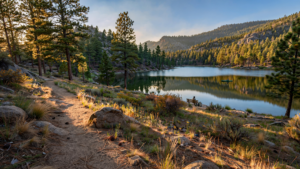
Goldwater Lake lies roughly four miles south of downtown Prescott on Senator Highway. The City of Prescott describes the reservoir as a 15-acre recreation area surrounded by forest and connected to a network of trails, picnic spaces, and shoreline access.
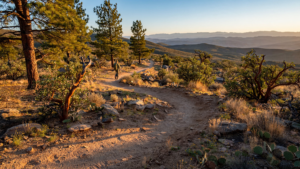
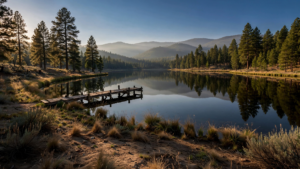
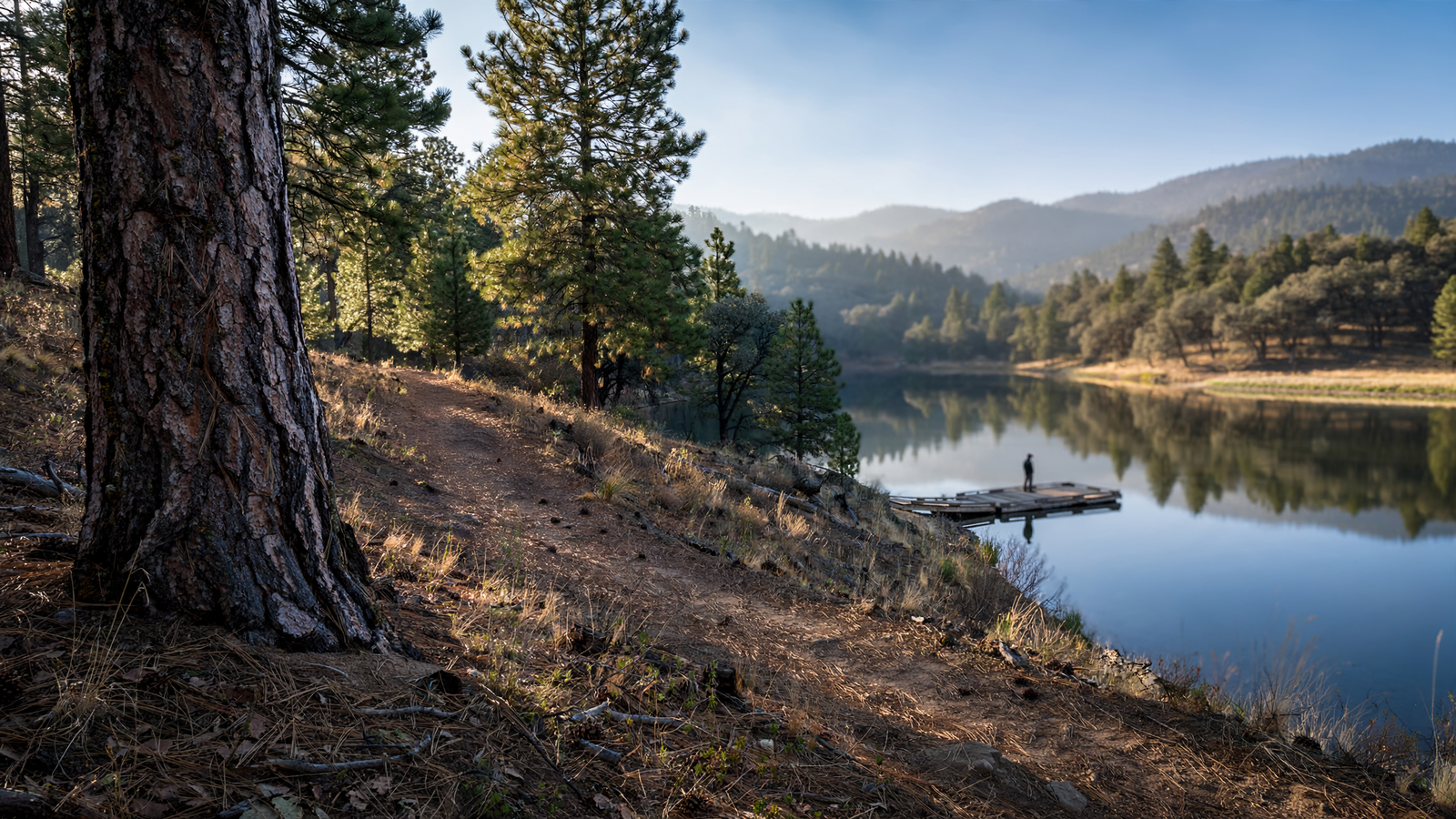
The setting is characteristic of the Bradshaw Mountains: ponderosa pine, exposed rock, dry slopes, and abrupt changes in elevation. Yet the lake itself softens that mountain environment. Along the shore, visitors encounter a landscape that feels slower than the surrounding roads and ridgelines. The water reflects the trees, anglers work the bank, and families can spend time outdoors without committing to an all-day hike.
That combination of accessibility and scenery is the lake’s defining strength. Goldwater does not need to compete with the Grand Canyon or the Verde Valley. It serves a different purpose. It is a close-to-town landscape, the kind of place that can support repeated visits rather than a single memorable stop.
How Prescott’s water landscape became public space
Goldwater Lake was created in the 1930s and later became part of Prescott’s public recreation system. Its name honors Morris Goldwater, a former Prescott mayor and civic leader whose family was connected to the city’s early development.
The lake’s history reflects a recurring pattern in the American West. Water infrastructure often begins with practical needs—storage, supply, or flood management—and later acquires a second life as a civic landscape. Once a reservoir is surrounded by roads, trails, shade, and gathering places, it becomes more than an engineering structure. It becomes somewhere people go.
At Goldwater, that transition is visible in the arrangement of the recreation area. The lake is supported by picnic facilities, a boat ramp for approved small watercraft, shoreline fishing, and walking routes. The result is not a wilderness experience in the strict sense. It is a public landscape shaped for repeated, low-barrier use.
A place built around small outings
The City of Prescott lists fishing, hiking, picnicking, and non-motorized boating among the area’s recreational uses. Arizona’s fishing regulations and stocking information provide the framework for anglers, who must follow current license and catch rules.
Those activities may sound modest, but their modesty is part of the point. A public lake does not have to offer a marathon trail or a spectacular overlook to become valuable. A child learning to cast, a couple walking the shoreline, or a group sharing lunch beneath the pines can all develop a connection to a place.
Short outings also make outdoor recreation more inclusive. People with limited time, families with young children, older residents, and visitors who are not prepared for a strenuous backcountry trip can all find ways to use the area. The lake’s public value comes partly from this range of possible experiences.
Its proximity to Prescott strengthens that role. Visitors do not need to plan a full day around the lake. They can combine a walk with errands in town, stop by for an hour, or make it the destination for a simple weekend afternoon. In a region where many celebrated natural areas require longer drives, that closeness is an asset.
Water in a dry landscape
Goldwater Lake also gives residents a direct view of one of the questions that shapes life in northern Arizona: how should communities live with limited and variable water?
The lake is a relatively small body of water, and its appearance changes with weather, runoff, and seasonal conditions. That variability is not a flaw in the landscape; it is a reminder that reservoirs in the Southwest exist within a larger hydrological system. Their levels depend on precipitation, snowpack, evaporation, watershed conditions, and the ways communities manage water over time.
Prescott’s surrounding forests and watersheds are therefore part of the lake’s story. Water does not begin at the shoreline. It arrives through the landscape, moving across slopes and channels before collecting behind the dam. The forested setting helps visitors see the connection between recreation and watershed stewardship more clearly than a utility bill ever could.
That connection is especially relevant as Arizona communities plan around drought and extreme heat. The National Drought Mitigation Center’s Arizona monitoring shows why water conditions can change quickly across the state. A local reservoir cannot solve regional water challenges, but it can make those challenges visible while giving the public a reason to care about the land that feeds it.
Wildlife without spectacle
Goldwater Lake is also useful as an everyday wildlife setting. Water in an otherwise dry environment attracts birds and other animals, while the surrounding pine forest provides cover and nesting habitat. The lake is not a zoo or a formally managed wildlife exhibit. Its appeal comes from the possibility of observing nature without knowing exactly what will appear.
That unpredictability changes the pace of a visit. A walk can become a lesson in bird behavior, seasonal vegetation, or the signs of animals moving between the shore and the forest. Even when wildlife remains hidden, the habitat itself is part of the experience.
Public recreation areas often do quiet conservation work by helping people notice ecological relationships. At Goldwater, the relationship is easy to read: forested slopes meet open water, and human use must fit within that shared setting. Staying on designated paths, keeping dogs under control, carrying out litter, and following fishing and boating rules are small actions, but together they help protect the place’s ability to serve both people and wildlife.
The value of maintenance
The most important current story at Goldwater Lake may be the continuing work of keeping an ordinary public place usable. That includes maintaining access roads, trails, picnic areas, restrooms, shoreline facilities, and safety information. It also means communicating conditions that can change with weather, water levels, fire restrictions, or seasonal closures.
Such work rarely receives the attention given to a new park or a major trail opening. Yet maintenance determines whether a public landscape remains part of community life. A beautiful place that is difficult to reach, poorly signed, or neglected gradually becomes less useful. A modest place that is cared for can become a dependable civic resource.
Goldwater Lake’s continuing significance rests on that dependability. It is close enough for routine visits, scenic enough to feel like an escape, and structured enough to welcome people who may not think of themselves as outdoor adventurers.
A quieter definition of a destination
Yavapai County contains places that draw visitors from around the world, but a healthy outdoor culture also depends on landscapes that serve local residents. Goldwater Lake represents that quieter side of the county’s geography.
Its story is not one of dramatic discovery or spectacular transformation. It is the story of a reservoir that became a shared place: a setting for fishing, walking, gathering, and noticing the relationship between a mountain forest and the water below it.
That may be enough. Public places do not always need to become famous to matter. Sometimes their success is measured by the number of ordinary afternoons they make possible—and by whether people leave with a stronger sense that the landscape around their town belongs to everyone willing to care for it.
Use: Primary source for the lake’s location, size, facilities, recreational activities, and city management information.
Use: Reference for current Arizona fishing regulations, licenses, and responsible angling information.
Use: Context for outdoor recreation and forest landscapes surrounding Prescott.
Use: Context for changing drought conditions and the wider water environment in Arizona.
City of Prescott — Goldwater Lake — https://www.prescott-az.gov/recreation-area/goldwater-lake/ — Primary source for the lake’s location, size, facilities, recreational activities, and city management information.
Arizona Game and Fish Department — Fishing — https://www.azgfd.com/fishing/ — Reference for current Arizona fishing regulations, licenses, and responsible angling information.
Prescott National Forest — Recreation — https://www.fs.usda.gov/r03/prescott/recreation — Context for outdoor recreation and forest landscapes surrounding Prescott.
U.S. Drought Monitor — Arizona — https://droughtmonitor.unl.edu/CurrentMap/StateDroughtMonitor.aspx?AZ — Context for changing drought conditions and the wider water environment in Arizona.