Long before smartphones put an encyclopedia in nearly every pocket, Americans had another way to reach a world of information: they walked through the doors of a public library. For related reading, see Luxembourg Made Everyday Travel Free—and Turned a Commute Into a Public Service.
Inside, a person might find a newspaper from another state, a novel, a technical manual, a children’s book, a map, or a quiet desk. The visitor did not need to own the books. In many libraries, the visitor did not even need to be wealthy, educated, or part of a private club. The public library made knowledge a shared civic resource. For related reading, see Congestion Pricing: How New York Turned Midtown Into a Different Kind of Everyday Place.
That idea developed gradually in the United States. Early subscription libraries required members to pay, while schools, churches, benevolent societies, and private donors created collections for particular communities. During the 19th century, reformers increasingly argued that a library supported the whole public in the same way that a park, school, or courthouse did. For related reading, see The Grand Canalscape: How Phoenix Turned an Old Waterway Into an Everyday Route.
From subscription rooms to free municipal libraries
Benjamin Franklin and other Philadelphia tradesmen established the Library Company of Philadelphia in 1731. It was a subscription library: members paid into the organization and gained access to its collection. Such institutions helped circulate books in a society where printed materials were expensive, but they were not yet free public libraries in the modern sense.
The idea of a tax-supported library took stronger shape in the 19th century. Boston Public Library, established in 1848 and opened to the public in 1854, became an important early example of a large municipal library supported by public funds. Its founders described access to books as part of the city’s educational mission rather than as a luxury for a small membership.
Boston’s model reflected a broader change in thinking. A library could offer more than entertainment. It could help workers learn a trade, give immigrants an opportunity to study English, provide children with books outside school, and allow citizens to follow public affairs. The library’s value was measured not only by the books on its shelves, but by the opportunities those books made possible.
The Carnegie building boom
The most visible expansion of American libraries came through the philanthropy of Andrew Carnegie. A Scottish immigrant who became a steel millionaire, Carnegie had used libraries as a young man in Allegheny, Pennsylvania. That experience shaped his belief that free access to books could help people improve their lives.
Beginning in the 1880s, Carnegie offered money for library buildings in communities that agreed to provide land, maintain the institution, and fund its operation. The arrangement mattered. Carnegie generally paid for construction, while local governments or community organizations had to demonstrate that the library would remain a working public institution.
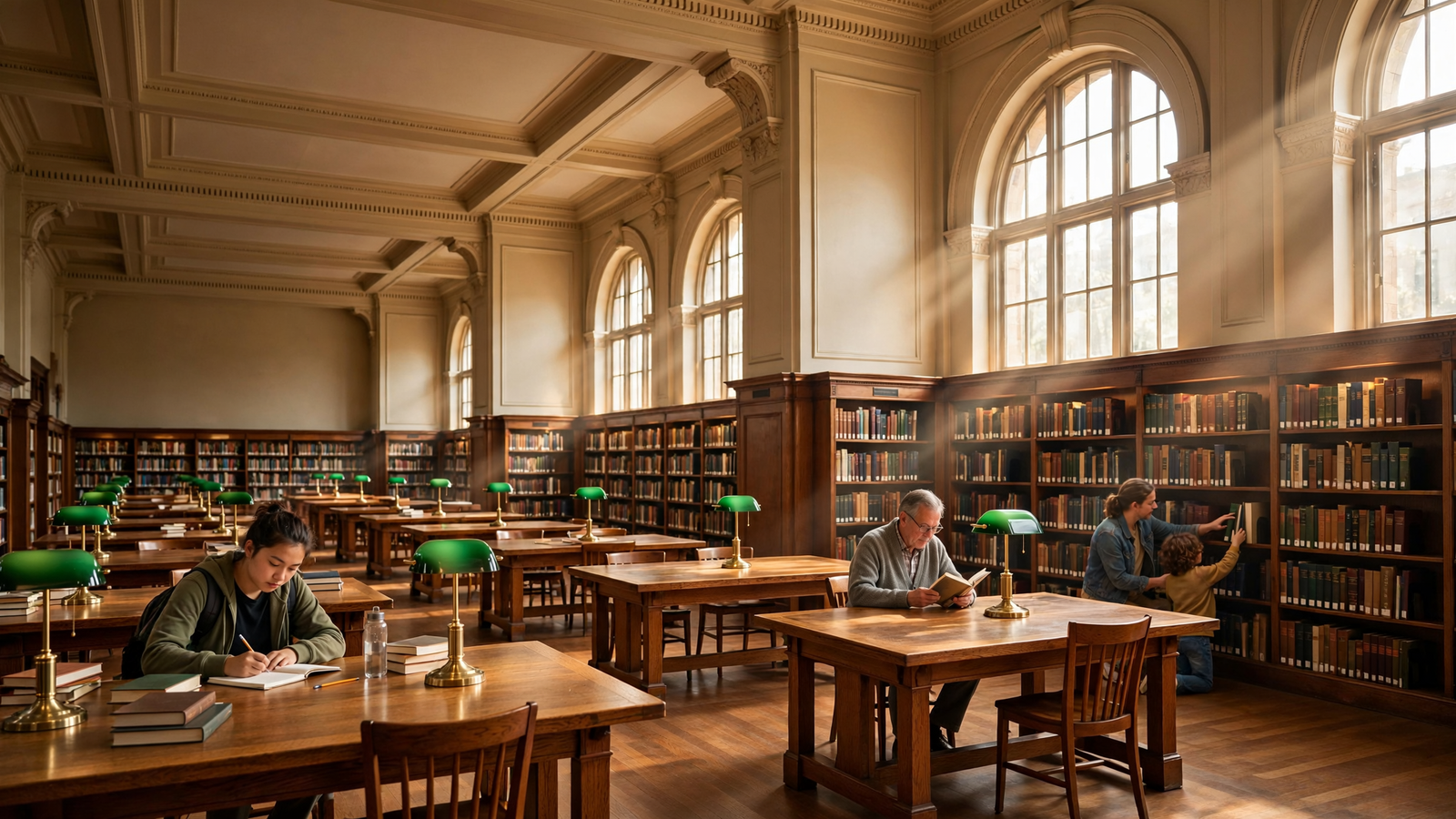
Between 1883 and 1929, Carnegie funding supported 2,509 library buildings around the world, including 1,689 in the United States, according to the Carnegie Corporation of New York. The buildings differed in size and style, but many shared a recognizable design: broad windows, a central entrance, reading rooms, high ceilings, and shelves arranged to welcome visitors inside.
These were not merely monuments to a donor. They became neighborhood infrastructure. A Carnegie library could sit near a courthouse or town square, close to shops and homes. In smaller towns, it might be one of the few public buildings where people of different occupations encountered one another for a common purpose.
What people did at the library
The public library changed ordinary routines in small, practical ways.
A child could select a story to take home. A student could consult reference works that were unavailable in the family’s house. A farmer could read about crops and machinery. A job seeker could study a trade directory or newspaper advertisements. A person newly arrived in the country could find language-learning materials and become familiar with local institutions.
Libraries also gave people a place to read without buying anything. That distinction was significant in an era when books, magazines, and newspapers could consume a meaningful share of a household budget. The library extended the life of each volume by allowing it to circulate from one reader to another.
Children’s rooms helped make reading a family habit. Librarians developed story hours, reading lists, and collections selected for younger visitors. These programs reflected a growing belief that the library was not a silent warehouse of books but an educational institution with a role in everyday life.
Reference services expanded that role. Librarians helped visitors locate information, understand catalogs, and navigate collections. Over time, libraries added lectures, exhibitions, public programs, music recordings, newspapers, and later films and digital resources. The central promise remained consistent: a person could arrive with a question and receive help finding a path toward an answer.
A public ideal with an incomplete history
The story of the public library is also a story of limits. Free access was not always equally free for everyone.
Many libraries opened in communities shaped by segregation and discrimination. In the South, Black Americans were often excluded from white libraries or offered separate and underfunded facilities. Black communities responded by building their own libraries, reading rooms, and educational associations, sometimes with support from philanthropists such as Julius Rosenwald and local organizers.
Women, immigrants, working people, and children could also encounter rules or social expectations that narrowed access even when the institution was formally public. Carnegie’s grants did not erase these inequalities. A building could represent democratic access while the society around it continued to deny equal treatment.
That tension is part of the library’s history, not a footnote outside it. Public libraries became more inclusive through pressure from the people they served, through new laws and professional standards, and through the work of librarians and community groups. The institution’s ideal—knowledge available to all—was often ahead of its practice.
The library as a shared place
One reason libraries endured is that they combine private concentration with public belonging. A reader can sit alone with a book, yet still feel part of a larger community. A parent can bring a child. A teenager can do homework. A retiree can read the news. A researcher can use local records. None of these activities requires a purchase.
That mixture made the library unusually adaptable. As reference collections grew, librarians learned to organize vast quantities of information. As media changed, libraries added recordings, films, computers, and internet access. When communities needed meeting space, libraries often provided it. The building continued to evolve because its purpose was broader than any particular format.
Even the library card became a small symbol of civic membership. It was not a bank card or a ticket to a private club. It represented permission to borrow, explore, and return—to take part in a system built on trust and shared use.
A legacy still visible on the block
Many Carnegie libraries have been renovated, expanded, or converted to other uses. Others remain active branches, their original reading rooms adapted to computers, children’s programming, community events, and modern accessibility needs. Their continued presence shows how a 19th-century institution can survive by changing its tools without abandoning its purpose.
The public library did not make knowledge effortless. Readers still had to visit, search, study, and think. What it changed was the starting point. Learning no longer depended entirely on the books a household could afford, the school it attended, or the private network it could enter.
In towns and cities across the United States, the library turned reading into an ordinary public act. It gave everyday people a place to borrow the world—and gave communities a durable way to share it.
Use: Background on the establishment and opening of Boston Public Library as a free municipal library.
Use: Context on Andrew Carnegie’s library philanthropy and the reported totals of Carnegie-funded library buildings.
Use: Broader historical context on American library collections, public access, and the role of libraries in civic and educational life.
Use: Historical context on Carnegie library buildings and their place in American communities.
Boston Public Library — History of the BPL — https://www.bpl.org/about-the-bpl/history/ — Background on the establishment and opening of Boston Public Library as a free municipal library.
Carnegie Corporation of New York — History of Carnegie Libraries — https://www.carnegie.org/interactives/founders-story-corporation/ — Context on Andrew Carnegie’s library philanthropy and the reported totals of Carnegie-funded library buildings.
Library of Congress — Libraries in the United States — https://www.loc.gov/collections/ — Broader historical context on American library collections, public access, and the role of libraries in civic and educational life.
National Park Service — Carnegie Libraries — https://www.nps.gov/articles/carnegie-libraries.htm — Historical context on Carnegie library buildings and their place in American communities.