On January 5, 2025, New York City began charging most vehicles entering Manhattan south of 60th Street. The change created the first permanent congestion-pricing program in a major U.S. city—and turned one of the country’s most familiar urban spaces into a real-time experiment in everyday movement. For related reading, see The Grand Canalscape: How Phoenix Turned an Old Waterway Into an Everyday Route.
The new charge is not simply a toll at a bridge or tunnel. It applies to a central part of Manhattan itself, a place where commuters, delivery drivers, residents, tourists, buses, taxis, cyclists and pedestrians compete for the same limited streets. The program asks a practical question with consequences far beyond New York: when too many people and vehicles need the same public space at the same time, can pricing make the place work better? For related reading, see The Public Library: How America Turned Reading Into an Everyday Civic Habit.
A fee for entering a crowded place
New York’s Congestion Relief Zone covers Manhattan below and including 60th Street, with some major roadways and connections excluded from the charge. Most passenger vehicles entering during the daytime pay a reduced introductory toll once per day. Larger vehicles, motorcycles, taxis and app-based car services follow different rules, while some drivers may qualify for discounts or exemptions. For related reading, see Goldwater Lake: How Prescott Turned a Reservoir Into an Everyday Mountain Place.
The Metropolitan Transportation Authority, which administers the program, describes the charge as a way to reduce traffic and raise money for the city’s transit system. The program was authorized through state legislation and approved after an extensive environmental review. Its goals are closely connected: fewer vehicles in the central business district, more reliable surface travel and a dedicated source of funding for subway, bus and commuter-rail improvements.
That combination makes the zone different from a conventional toll road. Drivers are not paying for access to a newly built bridge or highway. They are paying to use an intensely valuable piece of an already established city.
Why this part of Manhattan matters
Lower and Midtown Manhattan contain a dense mix of offices, apartments, stores, hotels, hospitals, theaters, schools and public institutions. The streets also carry an extraordinary volume of deliveries and commercial service trips. A vehicle that spends extra time sitting in traffic occupies the same scarce street space as a bus carrying dozens of passengers or a delivery truck serving a block of businesses.
That competition has long shaped the experience of the district. A short trip can become unpredictable. Buses may be delayed by traffic that is only a few lanes wide. Freight vehicles need curb access, but parked cars and passenger pick-ups often use the same space. Pedestrians encounter crowded crossings, idling engines and streets designed around movement that is not always moving.
Congestion pricing treats the problem as one of demand. The streets cannot easily be widened, and building more parking would consume land that could be used for housing, businesses or public space. A charge creates a financial reason to reconsider some trips, shift travel times, combine errands or choose transit.
The transit connection
The program’s revenue is intended to support the MTA’s capital plan. That plan includes work on subway signals, accessibility, station improvements, modernized rail infrastructure and the maintenance of a system used by millions of people across the region.
This link is central to the program’s logic. Congestion pricing is not meant to operate as an isolated traffic fee. It is designed to make driving into the busiest part of Manhattan more expensive while investing in the alternatives that make car-free travel practical.
That matters because a price can only change behavior when people have choices. A commuter with a frequent subway line, a bus connection or a nearby rail station may be able to adjust. Someone carrying equipment, transporting a person with a disability, working overnight or traveling from an area with poor transit connections may have fewer options. The program therefore includes exemptions and discounts, but the broader question remains: how evenly are those choices distributed?
A street-level change, not just a transportation policy
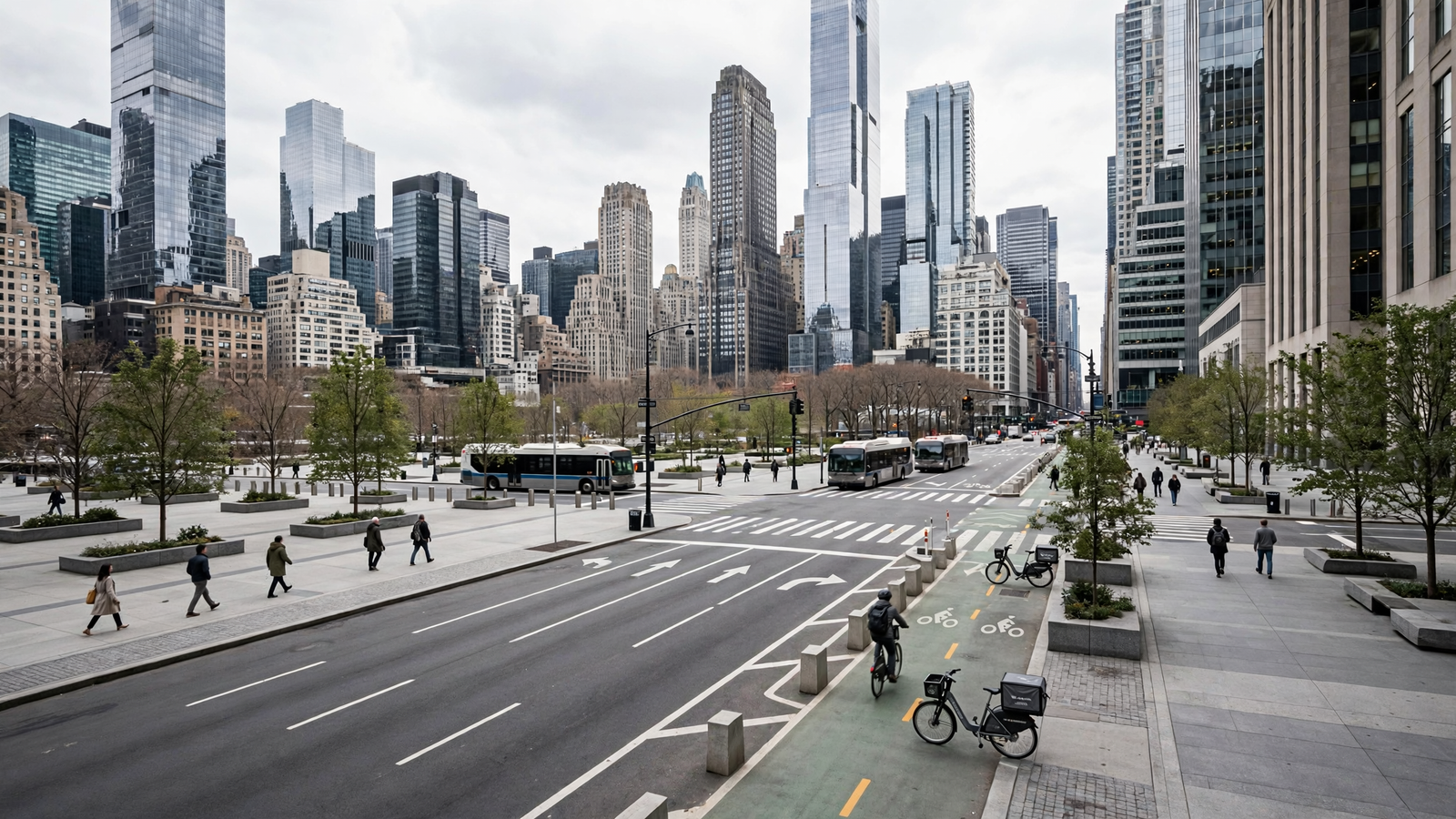
The most important effects of congestion pricing may be visible at street level rather than on a toll statement. If traffic volumes fall, buses may spend less time trapped behind private vehicles. A delivery driver may be able to complete a route more predictably. A pedestrian may have an easier time crossing an avenue. A taxi passenger may experience a quicker trip even while paying a surcharge connected to the zone.
Those possible improvements are incremental, but cities are built from incremental experiences. The quality of a neighborhood depends not only on its landmark buildings but also on whether people can reach work, move goods, wait for a bus, cross the street and spend time outdoors without constantly negotiating with traffic.
The program also changes how New Yorkers think about the street. A roadway is often treated as free space, even though it is expensive to build, maintain and regulate. Congestion pricing makes the cost of that space more visible. It turns a hidden collective problem—everyone delaying everyone else—into an explicit choice about who enters, when and at what price.
What the first months can—and cannot—show
Early results should be interpreted carefully. Traffic patterns change for many reasons, including weather, construction, transit service, work schedules and the broader economy. A short-term decline in traffic does not automatically prove that the program has solved congestion, just as a busy street does not prove that it has failed.
The MTA and New York City agencies are expected to track traffic, travel times, transit use, air quality and other effects. Those measurements will be especially important for communities around the zone’s edges. If vehicles avoid the charge by circling through neighborhoods just outside Manhattan’s core, the program could shift some burdens rather than reduce them. If traffic declines without meaningful improvements to bus and subway reliability, drivers may feel the cost more quickly than they see the benefit.
There is also a question of fairness. The same fee does not represent the same sacrifice for every household or worker. A well-paid office employee who switches to the subway may experience the change differently from a small contractor, a caregiver or a worker whose job requires a vehicle. Any successful version of the policy will need to be judged not only by average traffic speeds but also by who pays, who benefits and who has realistic alternatives.
Why other cities are watching
New York is not the first city to experiment with charging for access to a crowded center. London, Stockholm, Milan and Singapore have used forms of congestion pricing or road-use charging. But the New York program carries unusual weight in the United States because of the city’s size, its dependence on transit and the political visibility of Manhattan.
For other American cities, the lesson may not be that every downtown should copy New York. It may be that transportation policy works best when it treats roads, transit, housing, deliveries and public space as parts of one system. A toll without alternatives can feel punitive. Transit investment without a strategy for street congestion can struggle to deliver reliable service. A downtown improvement plan that ignores freight and accessibility will leave essential trips behind.
New York’s program therefore makes Manhattan more than a destination. It makes the district a test site for an increasingly common urban problem: how to preserve access to the places people depend on when the space available for movement is permanently limited.
An everyday experiment in public space
The significance of congestion pricing will ultimately be measured in ordinary moments. A bus arriving close to schedule. A delivery route completed without hours of delay. A parent reaching a clinic. A pedestrian crossing a busy avenue with less noise and uncertainty. A subway system gaining the resources to repair stations and make more trips accessible.
Those outcomes are not guaranteed by the toll itself. They depend on administration, enforcement, transparent measurement and sustained investment. But the program has already changed the terms of the conversation. New York has acknowledged that its most valuable streets are limited public spaces—and that everyday access to them has a cost.
Whether the experiment becomes a model or a warning will depend on what the city does with that acknowledgment. If the money improves transit and the streets become more dependable, the charge may come to seem less like a penalty and more like a tool for sharing a crowded place. If the benefits are hard to see or unevenly distributed, opposition will remain strong. Either way, Manhattan is now showing other American cities what happens when the price of street space becomes part of daily life.
Use: Program start date, zone overview, tolling structure and stated goals.
Use: Official information on vehicle categories, tolls, exemptions and discounts.
Use: City transportation context and official program information.
Use: Background on congestion pricing as a transportation-management strategy.
Metropolitan Transportation Authority — Congestion Relief Zone — https://congestionreliefzone.mta.info/ — Program start date, zone overview, tolling structure and stated goals.
Metropolitan Transportation Authority — Congestion Relief Zone Tolls — https://www.mta.info/tolls/congestion-relief-zone — Official information on vehicle categories, tolls, exemptions and discounts.
New York City Department of Transportation — Congestion Pricing — https://www.nyc.gov/html/dot/html/motorist/congestion-pricing.shtml — City transportation context and official program information.
Federal Highway Administration — Congestion Pricing — https://www.fhwa.dot.gov/ipd/tolling_and_pricing/congestion_pricing/ — Background on congestion pricing as a transportation-management strategy.