On the evening of November 2, 1920, a small room in East Pittsburgh became one of the most important places in American media history.
There was no television audience waiting for a polished studio show. No national radio network connected the country. The equipment was experimental, the signal was limited, and the people listening had to own or borrow a receiver capable of picking it up. Yet that evening, a Westinghouse station began sending election returns through the air.
The station was KDKA. Its broadcast did not create radio by itself, and it was not the first time anyone had transmitted sound wirelessly. But it helped demonstrate something new: radio could be organized as a public service, supported by a company, scheduled for a general audience, and woven into ordinary life.
Before broadcasting, radio was mostly a point-to-point tool
Early wireless communication was associated with ships, military operations, telegraphy, and specialized operators. Messages traveled without a physical wire, but the system was often understood as a form of wireless telegraphy rather than as a mass medium. Operators sent coded signals to a specific destination. The public did not usually sit down to listen to a continuing stream of speech, music, or news.
That distinction mattered. A telegraph message had a sender, a receiver, and a defined purpose. Broadcasting imagined something more open: one transmission reaching many listeners at once, including people the sender did not know.
The technical possibility had been developing for years. Engineers had learned how to transmit and receive voice and music over radio waves. The challenge was cultural and economic as much as scientific. Who would provide the programs? Who would pay for the equipment? Would people want to listen regularly? And could a business model support a service whose signal traveled to anyone within range?
Pittsburgh became an important testing ground because it was home to Westinghouse Electric and Manufacturing Company, a major electrical manufacturer with an interest in the future of wireless communication. For related reading, see Piggly Wiggly: How Self-Service Grocery Shopping Changed Everyday Life.
Frank Conrad helped make the idea practical
One of the figures behind the Pittsburgh experiment was Frank Conrad, a Westinghouse engineer who had built an amateur radio station at his home in the Pittsburgh suburb of Wilkinsburg. Conrad’s station, identified as 8XK, was used for experiments and broadcasts that included music.
Those informal transmissions offered a useful lesson. People were not only interested in sending messages; they were interested in receiving entertainment. Conrad reportedly learned that listeners would contact him about programming and even offer records for broadcast. The response suggested that wireless could become a kind of electronic meeting place.
Conrad’s work was not the only force shaping radio’s development. Inventors, amateurs, universities, newspapers, manufacturers, and government officials were all exploring the medium. But his experiments helped connect engineering with audience demand. A receiver was no longer merely a device for a trained operator. It could become an appliance for a household.
Westinghouse recognized that a regular broadcast service could also encourage people to buy radio receivers. The company had a reason to experiment with programming, but the experiment still required a public occasion large enough to attract attention.
An election night became a media experiment
The 1920 presidential election provided that occasion. Republican Warren G. Harding was running against Democrat James M. Cox, and election night offered a natural test for a technology that could distribute information quickly.
Westinghouse arranged a broadcast from its East Pittsburgh facility. The station used the temporary call sign 8ZZ for the election transmission; it soon became known as KDKA. The program included returns and election information, with music also part of the evening’s presentation.
The broadcast was modest by later standards. The signal did not reach an entire nation with equal strength. Many potential listeners had no receiver. Some receivers required considerable technical knowledge to operate, and early sets could be expensive or difficult to assemble. Still, the idea was powerful: people could gather around a machine and hear information arriving from elsewhere in close to real time.
The event is often described as the first commercial radio broadcast in the United States. That label needs some care. Radio broadcasting had been developing in several places, and other stations and experimenters had transmitted programs before or around the same period. “First” depends on how broadcasting is defined—regular service, licensed service, commercial operation, or a broadcast intended for a broad public.
What makes KDKA historically important is not that it single-handedly invented broadcasting. Its importance is that it became one of the earliest highly visible examples of a company deliberately establishing a scheduled radio service for a general audience. For related reading, see The Emergency Alert System: How Radio and Television Became America’s Public Warning Network.
From a one-night event to a daily habit
After the election broadcast, KDKA continued transmitting. The station’s programming helped establish a rhythm that would become familiar across American radio: scheduled news, music, talks, religious programs, lectures, sports, and special events.
This regularity changed the relationship between audience and technology. A demonstration could prove that a signal was possible. A schedule could make listening part of the day.
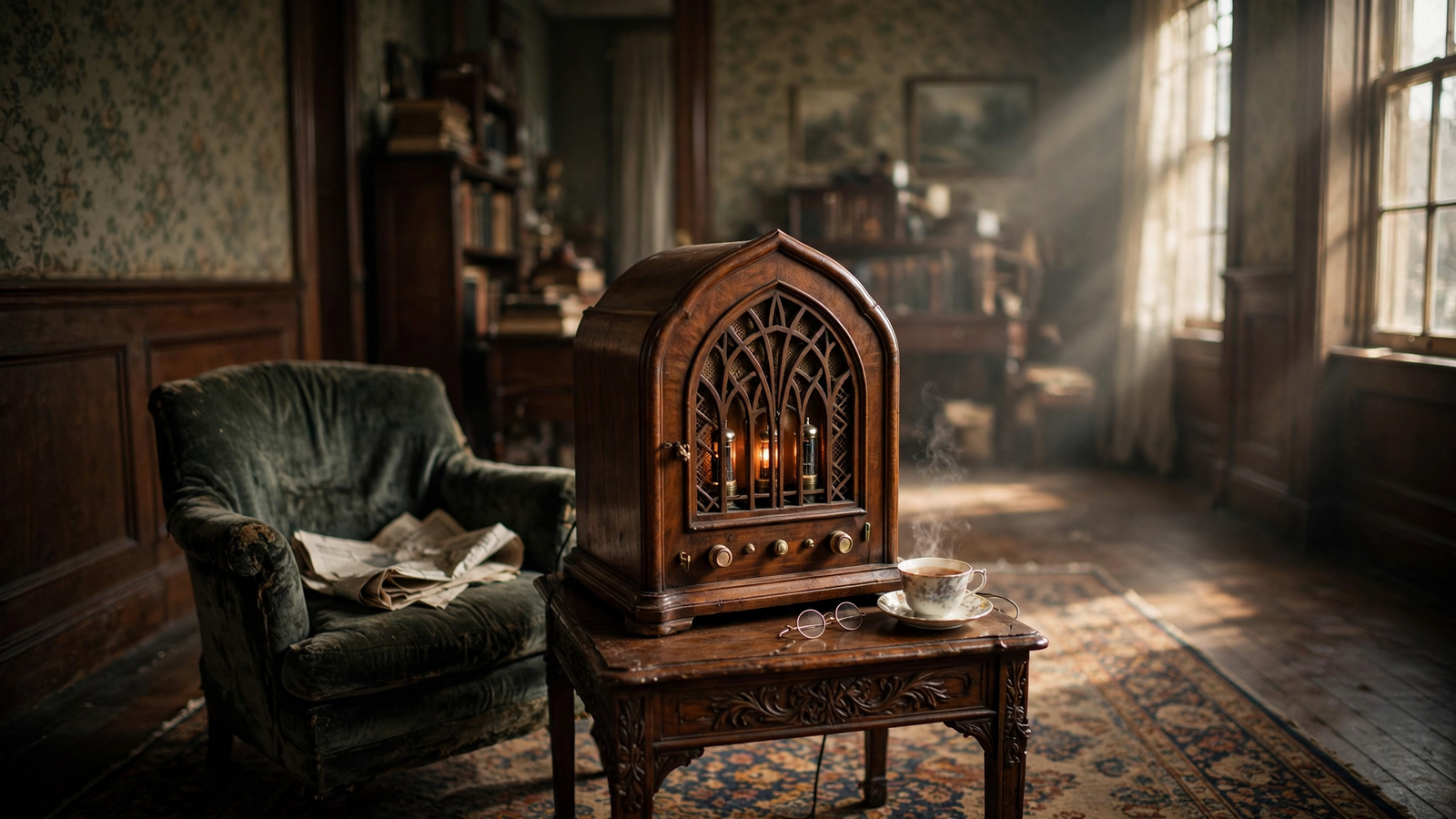
Radio’s early audiences often listened collectively. Families gathered around a receiver in the living room. Neighbors shared sets. Clubs, schools, and public spaces sometimes arranged listening sessions. The radio was not initially a private, portable stream of content. It was a household object that created a shared soundscape.
That social arrangement gave broadcasting unusual power. A newspaper delivered information to individual readers, but radio could make thousands of people hear the same voice, performance, or announcement at roughly the same time. It created a new kind of public experience—one that was simultaneous without requiring people to be in the same place.
The medium also changed the meaning of distance. A concert, speech, sporting event, or election report could travel beyond the room where it occurred. Listeners did not need to read about an event later; they could experience a version of it as it unfolded.
Radio needed rules, standards, and an industry
The growth of broadcasting quickly exposed problems. More stations meant more chances for signals to interfere with one another. Frequencies had to be organized, licenses clarified, and technical standards established. The government had to decide how the airwaves would be managed and who could use them.
The Radio Act of 1927 created the Federal Radio Commission, an early federal effort to regulate broadcasting and assign frequencies. The law reflected a growing understanding that radio was not simply a private invention. The airwaves were a public resource, and their use affected listeners across state lines. For related reading, see Gladys West: How a Quiet Mathematician Helped Give the World GPS.
Broadcasting also developed a new economic structure. Stations needed money for equipment, staff, studios, performers, and transmission. Advertising became a central source of support. Networks later allowed programs produced in one location to reach affiliates across wide regions, turning radio into a national business and a national culture.
KDKA was part of that transition, but it was also part of a much larger ecosystem. Stations across the country tested their own formats. Manufacturers sold receivers. Newspapers entered broadcasting. Musicians, actors, lecturers, advertisers, and journalists found new ways to work in sound.
The lasting lesson of KDKA
The story of KDKA is sometimes reduced to a single sentence: a Pittsburgh station broadcast election returns in 1920 and became the first commercial radio station. The fuller story is more interesting.
The broadcast succeeded because several developments met at the same moment. Wireless engineering had advanced enough to transmit voice and music. Manufacturers saw a market for receivers. An election offered compelling content. Engineers understood that listeners wanted entertainment as well as messages. And a growing public was ready to treat an invisible signal as a form of companionship.
That combination became the foundation for modern broadcasting. Radio did not merely add sound to the news. It changed the speed of public information, created new forms of celebrity, brought music into homes, and made shared national experiences possible without a theater, auditorium, or town square.
Television would later add pictures. Streaming would make programs available on demand. Podcasts would return audio to a more personal form. But each new medium inherited part of the question first tested by early broadcasters in places like Pittsburgh: will people make room in their lives for voices and stories arriving through technology?
On that November evening, KDKA offered one answer. Radio did not need to remain a laboratory curiosity. It could become a habit—and, eventually, one of the central ways Americans learned what was happening beyond the walls of home.
Use: Background on the development of radio broadcasting and its role as a mass medium.
Use: Historical context on early U.S. broadcasting, regulation, and the development of commercial radio.
Use: Technical and historical context for Westinghouse, Frank Conrad, and KDKA’s 1920 election broadcast.
Use: Context on early radio equipment, listening culture, and broadcasting’s place in American media history.