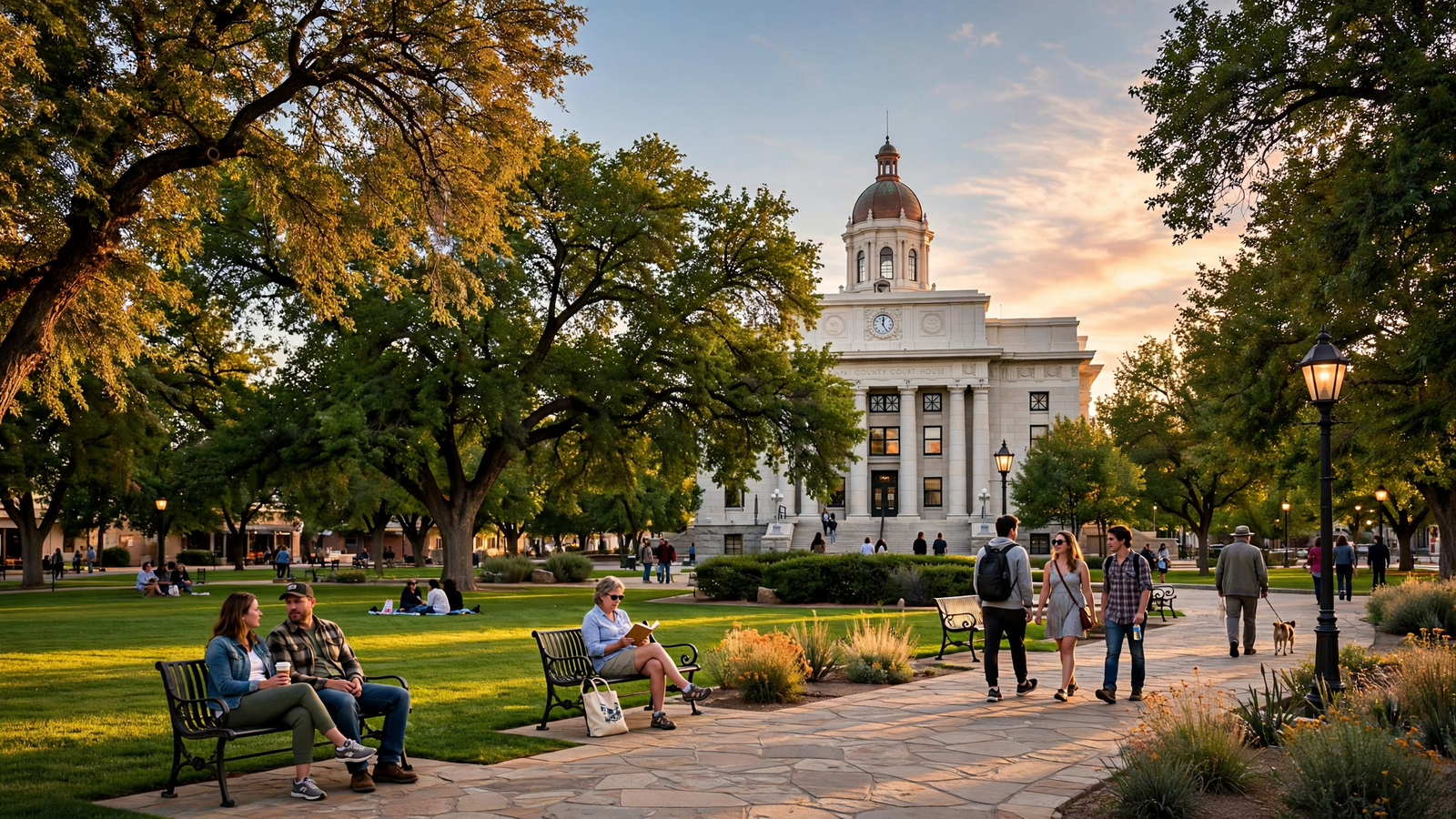
In Prescott, the city’s history does not sit behind glass or end at the edge of a museum exhibit. It gathers in the middle of downtown, beneath tall trees and around a broad public square where people meet for concerts, festivals, parades, seasonal celebrations, and the ordinary business of spending time outside.
That place is Courthouse Plaza. Surrounded by historic commercial buildings and connected to Prescott’s walkable downtown, the square is one of Yavapai County’s most recognizable public spaces. It is also one of the clearest examples of how a historic place can remain useful: not preserved as a frozen scene, but kept active through repeated community use.
A square at the center of an early Arizona town
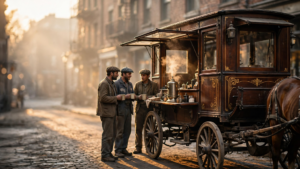
Prescott was established in 1864, during the territorial period, as the United States expanded administrative and military presence in central Arizona. The town became the first capital of the Arizona Territory and developed around a traditional civic layout in which public institutions, commerce, and transportation met near a central square.
The name “Courthouse Plaza” reflects that civic history. Yavapai County’s government was part of the town’s earliest institutional life, and the courthouse grounds became a defining feature of the developing community. As Prescott grew, the square helped organize the town around more than government offices. It became a place where residents could see one another, conduct business, attend public events, and mark important moments together.
Prescott’s downtown later changed in many ways. Buildings were replaced or remodeled, businesses came and went, and automobiles reshaped how people moved through the city. Yet the basic idea of a central public square endured. That continuity is part of the plaza’s significance: it shows how a town can change around a public place without losing the place itself.
More than a historic backdrop
Courthouse Plaza is easy to describe as a historic attraction, but that description can make it sound more passive than it really is. The square functions as downtown Prescott’s outdoor living room.
People use it as a meeting point before walking to nearby shops and restaurants. Visitors pause beneath the trees, take photographs, listen to musicians, or watch activity along the surrounding streets. Residents pass through on their way to appointments and errands. During organized events, the plaza becomes a stage, gathering ground, or viewing area. On quieter days, its value is less dramatic: it provides a comfortable reason to stop.
That range of uses is important. A public place becomes durable when it serves more than one audience or one season. Courthouse Plaza can accommodate a formal community celebration, a family visit, a lunchtime break, or a brief encounter with local history. Its success is not based on a single monument or attraction. It comes from the way the space supports many small activities at once.
The setting makes the history visible
The plaza is part of a larger historic downtown rather than an isolated park. Buildings around the square preserve the visual character of Prescott’s commercial center, where storefronts, upper stories, sidewalks, and shaded outdoor spaces create a close connection between public and private life.
That relationship gives the square much of its character. A visitor can stand in one place and see several layers of Prescott at once: the civic plan of a territorial town, historic commercial architecture, contemporary businesses, and the daily movement of a modern community. The result is more revealing than a reconstruction of the past would be. The plaza shows history continuing to operate.
The trees and landscaping also soften the hard surfaces of the surrounding streets. Shade changes how long people are willing to stay outdoors, especially during warmer months. Benches, walkways, open sightlines, and the surrounding storefronts make the space feel connected rather than enclosed. These details may seem modest, but they determine whether a square becomes a place people merely cross or a place they choose to occupy.
A stage for Prescott’s traditions
Prescott is known for traditions that bring people downtown throughout the year. Courthouse Plaza plays an important role in that calendar, including events associated with the city’s long-running Western heritage and seasonal celebrations.
The annual Prescott Frontier Days celebration, widely known through the World’s Oldest Rodeo, is one of the city’s most visible traditions. The rodeo itself takes place at a separate venue, but the broader celebration reaches into downtown through parades, public gatherings, and related activities. The plaza’s central location makes it a natural place for residents and visitors to experience that civic energy.
At other times of year, the square hosts music, holiday programming, art-related events, and community gatherings. The exact schedule changes, which is part of the point: the plaza is not dependent on one permanent exhibit. Its programming can adapt to the community’s current interests while the underlying space remains familiar.
Seasonal traditions are especially effective in historic public spaces because they connect memory with repetition. Someone may visit Prescott for the first time during a holiday event, return years later for a concert, and eventually come to regard the square as part of a personal tradition. Public places gain meaning in this gradual way, through accumulated experiences rather than a single official narrative.
Why the plaza still matters
Many communities have historic buildings, but fewer have a central space that remains both recognizable and actively used. Courthouse Plaza offers Prescott a kind of civic continuity that is difficult to create after the fact.
It gives the city a common address. Government history, local business, tourism, celebrations, and informal social life all meet there. That mixture matters because public space can become less welcoming when it is designed around only one purpose. A square reserved exclusively for ceremonies may feel empty most days. A space built only for commerce may leave little room for lingering. Courthouse Plaza works because it accommodates both planned events and unplanned use.
Its location also supports downtown businesses without turning the plaza into an advertisement. Visitors who come for the square can explore the surrounding streets, while people who arrive to shop or eat can discover the public space along the way. The connection is mutually reinforcing: a lively square makes downtown more inviting, and an active downtown gives the square more reasons to be used.
There is an environmental benefit to this kind of compact public life as well. A visitor can experience a substantial part of Prescott’s historic center on foot, moving between the plaza, storefronts, galleries, restaurants, and nearby civic landmarks without needing to drive from one destination to the next. The square becomes an anchor for a slower form of exploring.
How to experience Courthouse Plaza
The best way to visit is to allow time rather than treating the plaza as a quick photo stop. Begin with a walk around the square and look outward at the surrounding buildings. Their scale and arrangement help explain why the space feels like the center of town.
Then notice how people use it. On an event day, the plaza may feel energetic and collective. On an ordinary morning, its character may be quieter, with pedestrians, downtown workers, visitors, and residents sharing the same space without a formal program.
Because events and access conditions can change, travelers should check the City of Prescott’s parks and recreation information and local event listings before planning a visit. The plaza is in the middle of downtown, where parking, traffic restrictions, and event setups may vary. Visitors can also pair the square with a walk through the surrounding historic district and a visit to one of Prescott’s museums or cultural institutions.
A living piece of Yavapai County
Courthouse Plaza’s importance is not simply that it is old. Its deeper value is that it has remained available to ordinary public life.
The square carries the memory of territorial Prescott, but it is not trapped in that era. Children play nearby, musicians perform, local organizations gather, businesses open their doors, and visitors learn the shape of the city by walking through it. Each use adds another layer without requiring the place to explain itself as a museum.
That is what makes the plaza an enduring place in Yavapai County. It demonstrates that preservation can be active rather than merely protective. A historic square survives not only because its physical features are maintained, but because people continue to find reasons to return.
In the center of Prescott, the past remains visible. More importantly, it remains part of the present.