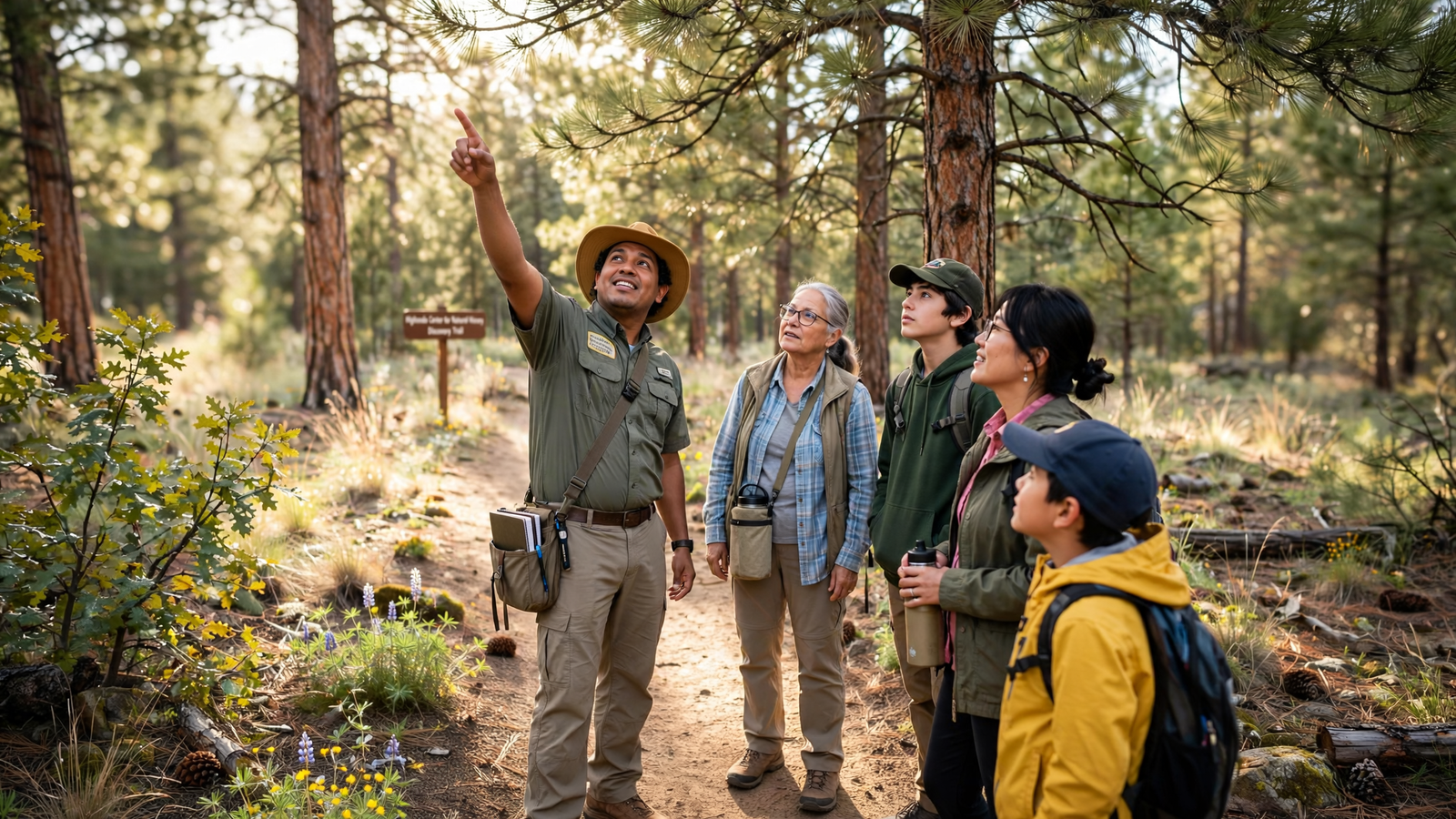
On the southern edge of Prescott, where the city begins to give way to ponderosa pine forest, learning does not have to happen indoors.
A trail can become a lesson in water. A fallen log can reveal an entire community of insects, fungi and small animals. The sound of birds moving through the canopy can turn a familiar walk into an exercise in attention. At the Highlands Center for Natural History, the forest itself is the main exhibit.
The nonprofit nature center sits within the Prescott National Forest and has built its work around a simple idea: people are more likely to care for a landscape when they have had the chance to know it. Through trails, gardens, school programs, public events and hands-on activities, the center helps make the ecology of central Arizona visible and approachable.
A forest setting that does some of the teaching
The Highlands Center is located along Arizona State Route 89A south of Prescott, in a high-elevation landscape shaped by ponderosa pine, oak, granite and seasonal water. It is close enough to town for a short outing, but its setting offers a different pace from the built city.
That location is important. The center does not have to recreate a southwestern ecosystem behind glass or explain it only through photographs. Visitors encounter living trees, changing weather, animal tracks and the ordinary signs of seasonal change outside the door.
Central Arizona’s uplands are not static scenery. They are working ecological systems. Ponderosa pine forests provide habitat and shade, while rocky slopes and small drainages influence how water moves through the landscape. The region’s plants and animals must adapt to drought, wildfire, winter cold and the pressures created by a growing population.
A place such as the Highlands Center gives those large environmental questions a human scale. Instead of beginning with an abstract discussion of habitat, a visitor might begin with one tree, one bird call or one patch of soil.
The James Family Discovery Gardens
One of the center’s most accessible features is the James Family Discovery Gardens, where native plants and carefully designed outdoor spaces create opportunities for observation and exploration. The gardens are not simply decorative landscaping. They demonstrate how a planted space can support pollinators, birds and other wildlife while helping people recognize species that belong to the region.
Gardens are particularly useful in an educational setting because they make ecological relationships easier to see. A flowering plant attracts insects. Insects become food for birds. Seeds, shelter and water influence which animals spend time nearby. These connections can be overlooked in a broad forest, but a garden allows them to be examined at close range.
The Discovery Gardens also offer an inviting entry point for children. A young visitor does not need to know the name of every plant to begin asking useful questions: Why is this flower shaped that way? What is moving under the leaves? Why do some plants grow together? Those questions are the beginning of natural history.
Trails made for noticing
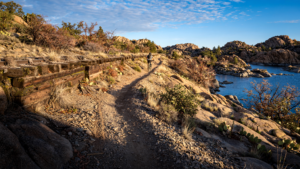
The Highlands Center’s trail system extends the experience beyond the gardens. Walking through the property, visitors can encounter the forest as a series of changing habitats rather than a single, uniform landscape.
The value of these trails is not measured only in distance. They encourage the kind of slow observation that is difficult to practice on a hurried drive through the mountains. A short trail can reveal differences in sunlight, soil, slope and moisture. It can show why one group of plants thrives near a drainage while another occupies a dry, exposed ridge.
For families, the trails make science active. For adults, they offer an opportunity to revisit knowledge that may have become disconnected from daily life. And for residents of Prescott, they provide a nearby way to experience the forest without needing to plan a major backcountry trip.
The center’s outdoor classrooms and gathering areas reinforce that purpose. The built features are present, but they are arranged to lead people back toward the surrounding landscape. The goal is not to separate education from nature; it is to make the relationship between the two more obvious.
Connecting children with a place
Much of the Highlands Center’s work focuses on children and young people. Its school and youth programs use field study, exploration and practical activities to introduce students to the ecology of the Prescott area.
That work matters because environmental education is most effective when it is connected to a real place. A lesson about watersheds becomes more meaningful when students can see how a slope directs rainwater. A conversation about adaptation becomes more concrete when they examine the features of a plant growing in a dry forest. A discussion of conservation can begin with the question of what happens to a habitat when its parts are removed.
Outdoor learning also makes room for different kinds of curiosity. Some students respond to birds, others to insects, geology, weather or engineering. A living landscape offers multiple ways into the same subject.
The result is not simply a collection of facts. It is familiarity. A child who has spent time noticing the forest may later recognize when a stream is unusually dry, when a bird species has returned or when a burned area begins to regenerate. Familiarity can become responsibility because it gives change a personal reference point.
A public place for local natural history
The phrase “natural history” can sound like a subject confined to museums and old specimens. At the Highlands Center, it has a more immediate meaning: the ongoing story of the land and the life that depends on it.
That story includes the plants of the high country, the animals that move through the forest, the geology beneath the trails and the people whose choices shape the landscape. It also includes fire. In ponderosa pine country, wildfire is both a natural ecological process and a serious threat to communities. Understanding the forest means understanding its fire history, its changing conditions and the choices involved in living near it.
The center does not replace the larger work of land management carried out by the U.S. Forest Service and other public agencies. Its role is different. It helps residents and visitors build the knowledge needed to participate thoughtfully in conversations about forests, water, wildlife and recreation.
That educational role is easy to underestimate. Public lands are often discussed in terms of acreage, trail mileage or visitor counts. But a landscape also needs people who can read it. They need to understand why a trail may close, why a streamside area needs protection, why a wildfire can change habitat for decades, or why a native plant garden benefits more than the person who planted it.
Why places like this matter in a growing region
Yavapai County contains some of Arizona’s most recognizable landscapes, but its appeal also creates pressure. Prescott and the surrounding communities attract new residents, visitors and outdoor recreation. More people are looking for ways to walk, camp, ride, watch wildlife and experience the forests.
That growing interest can be positive. It can strengthen support for public lands and create a wider constituency for conservation. But it also raises practical questions about crowding, habitat disturbance, wildfire preparedness and the long-term health of trails and waterways.
A nature center cannot solve all of those problems. It can, however, help people approach them with more context. It can show that recreation is part of a larger system, that a forest is more than a backdrop and that stewardship begins with attention.
The Highlands Center’s achievement is therefore modest in appearance but broad in effect. It has created a place where science is not hidden behind technical language, where children can encounter the natural world directly and where adults can reconnect with the ecology of the county they call home.
In an era when many environmental stories arrive as distant headlines, the center offers a different experience. It asks visitors to start nearby: with the tree overhead, the soil beneath a boot, the bird moving between branches and the seasonal changes that are already taking place around them.
That is the promise of the Highlands Center. It turns a portion of Prescott’s surrounding forest into a shared classroom—and reminds the community that understanding a place is one of the first ways to care for it.