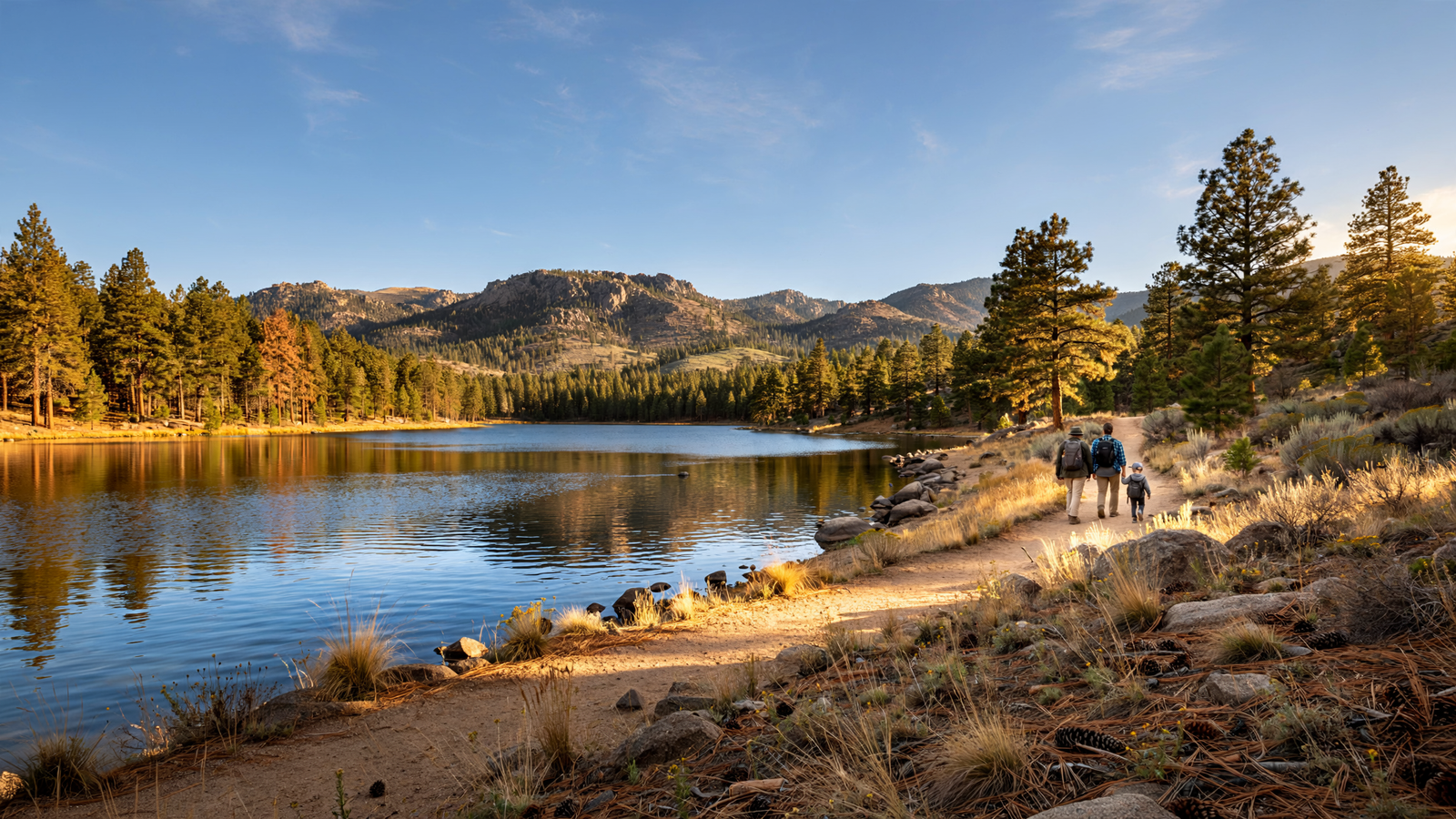
Some of Prescott’s most welcoming public places do not announce themselves with a grand entrance. They arrive more quietly: a road leaving town, a stand of ponderosa pines opening around blue water, a picnic table beneath the trees.
Goldwater Lake is one of those places. Located a few miles south of Prescott, the city-owned reservoir has become a familiar destination for fishing, hiking, paddling, picnicking and simply sitting near the water. It is not a wilderness removed from everyday life. It is a working piece of Prescott’s landscape that has grown into something broader—a shared outdoor room for residents and visitors.
That transformation is part of what makes Goldwater Lake worth noticing. The lake was created as a water-supply project, but its value today is not measured only in gallons. It gives the city a place where people can spend an hour or an afternoon without needing a major expedition. Children can watch the surface for movement. Anglers can cast from the shoreline. Hikers can follow the water through the forest. Families can bring lunch and leave the city behind without traveling far.
A reservoir with a public life
Goldwater Lake was constructed by the City of Prescott in the early 20th century and is named for Morris Goldwater, a former Prescott mayor and civic leader. The project reflected a practical need: a growing mountain community needed dependable water infrastructure.
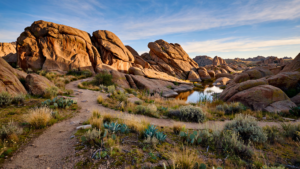
Over time, the reservoir gained another role. It became one of Prescott’s most accessible recreation areas, a place where the city’s infrastructure and its natural setting meet in plain view. The water is held back by a dam, but the shoreline feels less like an industrial utility site than a mountain park. Pines rise around the reservoir, granite appears in the surrounding terrain and the narrow roads leading toward it create a gradual transition from neighborhood streets to open country.
The city identifies Goldwater Lake as a roughly 15-acre recreation area. Its scale is part of its appeal. It is large enough to create the feeling of a destination, yet compact enough for visitors to understand the landscape quickly. A person can arrive without a detailed itinerary and still find several ways to spend time there.
One place, several kinds of visitors
At many outdoor destinations, recreation is organized around one defining activity. Goldwater Lake is more flexible. Fishing may be the main reason one visitor comes, while another arrives for a short walk, a picnic or the chance to photograph the water framed by trees.
The city permits non-motorized boating, including kayaks and canoes, under its recreation rules. That keeps the lake’s atmosphere relatively calm. There is no need for a large marina or a busy motorboat culture to make the water useful. A small craft, a fishing rod or a quiet shoreline can be enough.
Fishing gives the lake a particularly strong connection to the surrounding community. Arizona Game and Fish Department regularly manages fish populations in public waters across the state, and Goldwater Lake is included among the central Arizona waters used by anglers. The lake’s accessibility makes it a practical place for people learning to fish, as well as for experienced anglers looking for a nearby outing.
Fishing also changes the pace of the visit. Unlike activities built around covering distance, it rewards attention to small changes: the movement of water, a shadow near the bank, the sound of birds in the trees. That slower rhythm is one reason a reservoir can feel restorative even when it is close to town.
The shoreline as a walking landscape
Goldwater Lake is also part of Prescott’s broader network of trails and open spaces. Walking near the water offers a different experience from hiking through a dry upland landscape. The reservoir creates a visual center, while the surrounding forest provides shade, texture and changing views.
Visitors should not expect a flat, urban park. The terrain around Prescott is shaped by elevation, granite and uneven ground. Trail conditions can change with weather, and a short outing still calls for ordinary preparation: sturdy footwear, water, sun protection and awareness of seasonal conditions.
That modest level of preparation is part of the lake’s character. Goldwater is accessible, but it is not artificial. The setting remains tied to the high-desert and mountain environment around Prescott. Wildlife moves through the area, weather can shift quickly and the landscape carries the signs of drought, heat and seasonal change.
The result is a useful middle ground between a formal city park and a remote backcountry destination. People can reach it without a long journey, but they still encounter the natural systems that define central Arizona.
Why water changes the feeling of a place
Prescott is surrounded by dry country, which makes any permanent body of water unusually powerful as a public setting. Goldwater Lake does not resemble a large western reservoir, and it does not need to. Its importance comes from contrast.
The water gathers attention. It reflects the sky, opens a view through the trees and gives visitors a reason to pause. Around it, ordinary activities—eating lunch, talking, watching birds, taking a short walk—feel slightly different because the landscape has a center.
This is one reason reservoirs can become more than infrastructure. They create edges, and edges invite people to linger. A shoreline is a place where two environments meet: land and water, forest and open view, built systems and natural processes. Goldwater Lake makes that meeting visible without requiring visitors to know much about hydrology or local history.
Yet the history matters. The lake exists because earlier generations of Prescott invested in a public water project. Its recreational identity rests on that older civic decision. The same place can therefore be read in two ways: as an example of municipal engineering and as a landscape people have adopted for leisure.
A shared place requires shared care
The popularity of Goldwater Lake also creates responsibilities. A public landscape remains welcoming only when visitors treat it as shared property rather than a private backdrop.
That means following posted rules, keeping dogs under control where required, carrying out trash, avoiding damage to vegetation and respecting other visitors’ reasons for coming. Anglers need to follow current Arizona fishing regulations and licensing requirements. Boaters need to use appropriate safety equipment and understand that conditions on the water can change.
Care also means recognizing the limits of the setting. Goldwater Lake is not a swimming beach, and the city’s rules prohibit swimming. Its facilities and shoreline are designed for low-impact recreation rather than large-scale development. That restraint helps preserve the qualities that make the lake attractive in the first place: quiet, proximity and a sense of being surrounded by trees instead of concessions.
As with many Arizona outdoor places, water conservation is part of the larger context. A reservoir can be beautiful while still reminding visitors that water is limited. The lake’s existence does not separate Prescott from the realities of drought and changing weather. Instead, it gives those realities a visible form.
The value of an ordinary destination
Goldwater Lake does not need to compete with Arizona’s most famous landscapes. Its contribution is more local and, in some ways, more durable.
It is a place people can return to repeatedly. A first visit may be about seeing the lake. A later visit may be about a familiar fishing spot, an easy picnic, a walk after work or a few quiet minutes before heading home. Repeated use is how a public place becomes part of community life.
That role is easy to underestimate. Outdoor access is often discussed through spectacular destinations, long trails and major conservation victories. But a city also needs smaller places where nature is available without requiring a full day of planning. Goldwater Lake serves that everyday need.
Its story is ultimately one of adaptation. A structure built for water supply became a recreation landscape. A reservoir became a meeting point between Prescott and the forest. A nearby outing became a place for fishing, walking, family time and quiet observation.
For visitors, the invitation is simple: arrive prepared, follow the rules and give the lake time to reveal itself. The reward is not a dramatic landmark but a more useful kind of beauty—the kind that can become part of ordinary life.