Prescott has no shortage of places where Arizona’s past is visible. It stands in the courthouse, in the downtown buildings, along old roads and beneath the surrounding granite hills. But one of the clearest records of the city’s beginnings sits in a quieter place: Citizens Cemetery, just east of the historic center.
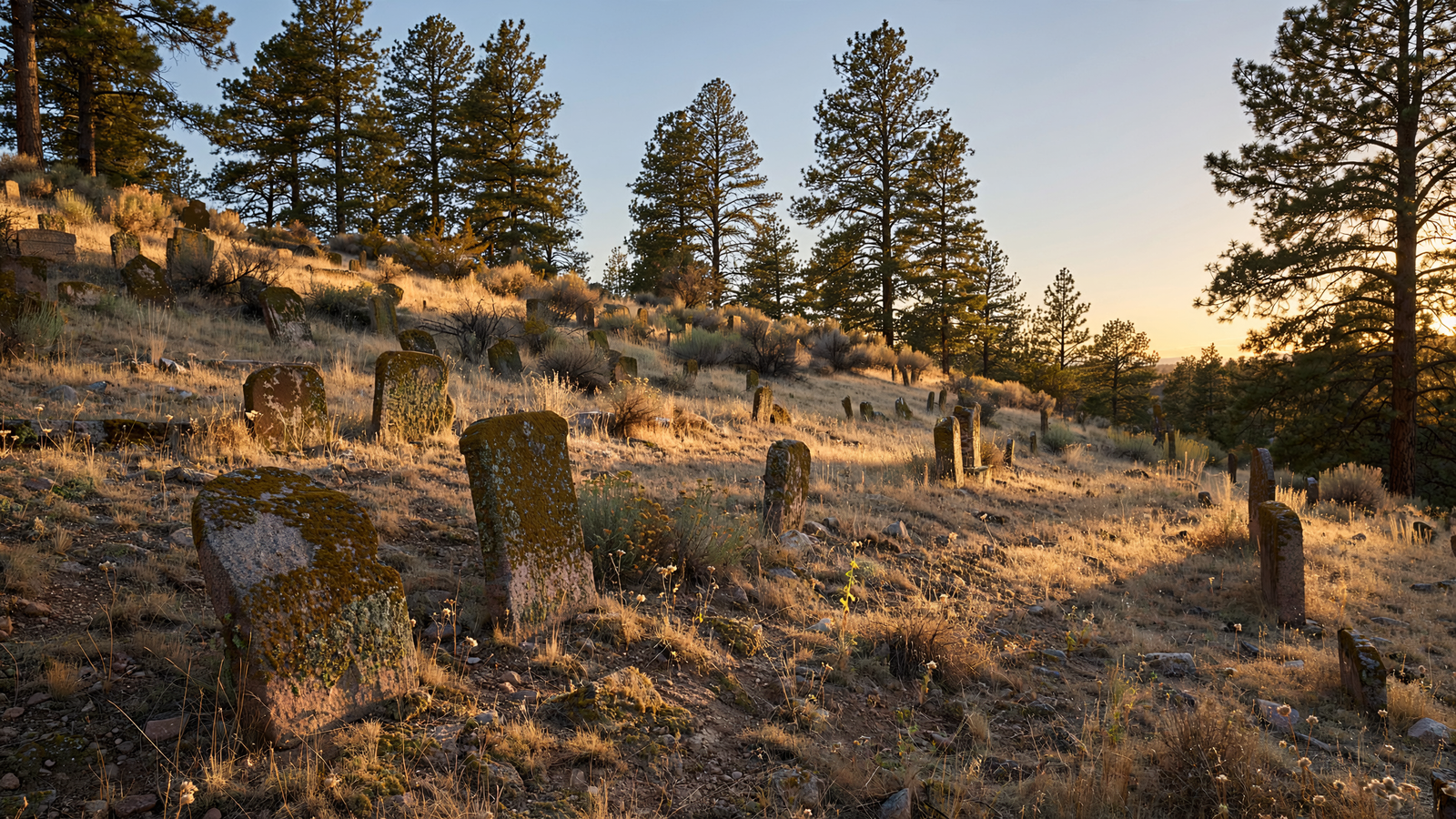
The cemetery is not a museum in the usual sense. There are no galleries, exhibit labels, or enclosed rooms. Instead, its history is arranged in rows, names, dates, family groupings, weathered markers, and the changing shape of the landscape. Walk its paths and Prescott’s early years become more personal. The territorial period is no longer only a sequence of military posts, mining claims, businesses, and public offices. It becomes a collection of individual lives.
A cemetery from Prescott’s territorial beginning
Citizens Cemetery dates to 1864, the year Prescott was established as the capital of the newly created Arizona Territory. That timing gives the place unusual importance. The community was still being formed when the cemetery began receiving its dead, and the earliest burials belong to the same period that produced Prescott’s first streets, buildings, institutions, and civic traditions.
Prescott would not remain the territorial capital without interruption. The seat of government moved to Tucson in the late 1860s and returned to Prescott in the 1870s before moving permanently to Phoenix in 1889. Through those changes, however, the cemetery remained part of the town’s daily geography.
That continuity is what makes Citizens Cemetery different from a historical site devoted to one event or one famous person. It preserves the ordinary scale of a community. The people represented there included residents whose names appeared in public records and local newspapers, but also people whose lives were known mainly to relatives, neighbors, employers, congregations, or fellow travelers.
History written in names and dates
A historic cemetery can be read in several ways. The first is chronological. Early markers reveal the dangers and limits of life in a frontier settlement: illness, accidents, violence, childbirth, harsh work, and long journeys all appear indirectly in the dates and ages carved into stone.
The second is social. Names repeat across adjoining plots, showing family connections that may not be obvious from a single marker. Fraternal organizations, military service, religious affiliation, and occupational identities sometimes appear in symbols or inscriptions. A cemetery can therefore reveal which institutions helped organize life beyond the official town government.
The third is geographic. Citizens Cemetery connects Prescott to the wider territory. People buried there came from different places and backgrounds, and their markers document the movement that shaped the American West. Prescott was never an isolated settlement; it was tied to military routes, mining districts, ranches, trading networks, and later transportation links. The cemetery is one place where those connections remain visible without requiring a map.
That makes a visit rewarding even when a visitor arrives without a specific family name to find. The broader story is legible in the density of the grounds: older stones and newer memorials share the same place, while the changing styles of lettering, stonework, and landscaping mark different eras of local life.
Why preservation here matters
Cemeteries are vulnerable historical resources. Buildings can be stabilized and documents can be stored in climate-controlled collections. A cemetery remains outdoors, exposed to sun, rain, freezing temperatures, plant growth, erosion, and the gradual wear caused by time. Its meaning also depends on protecting the relationship between markers, paths, trees, and surrounding open space.
Preservation is therefore more than repairing a broken stone. It includes recording burials, maintaining grounds, protecting markers from damage, and keeping the cemetery available to families, researchers, and the public. Burial records can answer practical questions for descendants, while the physical landscape preserves information that a database cannot: the location of a grave, the design of a monument, the arrangement of a family plot, or the way a community chose to remember someone.
The City of Prescott’s cemetery resources help make that history more accessible. Public information about the grounds and burial records gives visitors a starting point for research, whether they are tracing a family connection or simply trying to understand the people who helped shape the town.
A different kind of public place
Citizens Cemetery is also notable because it remains a functioning civic landscape rather than a preserved scene frozen entirely in the past. Newer burials and memorials exist alongside older ones. The place continues to serve a community that has changed considerably since the territorial era.
That combination can be easy to overlook. Visitors often approach historic sites expecting a clean division between “then” and “now.” A cemetery resists that division. The past is not separated from the present; it is layered beneath it. Families still visit. Grounds still require care. Names that once appeared in early Prescott records may sit near names belonging to residents of a much more recent Arizona.
This ongoing use gives the cemetery a quieter kind of significance. It does not merely tell visitors that Prescott has a history. It shows that history is made of generations occupying the same civic landscape, even when their lives were separated by decades.
How to visit with care
A visit is best approached slowly. Rather than treating the cemetery as a checklist of notable graves, visitors can begin with the layout. Notice the oldest-looking sections, the changes in marker materials, and the ways families are grouped. Read inscriptions without disturbing the grounds, and remember that the place is both a public historical resource and an active site of mourning.
Researchers may want to begin with the City of Prescott’s cemetery information before arriving. A name, approximate date, or family connection can turn a general walk into a more meaningful investigation. Local library and archival resources can add newspaper notices, photographs, maps, and other records that help place an individual life in context.
Photography should be respectful, especially when visitors are attending a service or maintaining a family plot. The strongest experience here is not necessarily the dramatic one. It may be a small discovery: a familiar surname, an unexpectedly young age, a marker showing an old occupation, or a cluster of graves that reveals a family’s presence across several generations.
Prescott’s memory at human scale
Many places preserve the story of Prescott through grand subjects: territorial government, mining, military history, architecture, or the city’s famous public traditions. Citizens Cemetery offers something different. It brings those large subjects down to the scale of a life.
The cemetery does not explain every person buried there, and many stories remain incomplete. That is part of its value. The stones invite questions rather than pretending that a town’s past can be reduced to a handful of celebrated names. Who arrived first? Who stayed? Which families built businesses or farms? Who died far from home? Which children grew up in a place that was still becoming a city?
Those questions make Citizens Cemetery more than a quiet corner of Prescott. They make it an open historical record—one that links the territorial town to the modern community and reminds visitors that a place is built not only by its landmarks, but by the people whose lives give those landmarks meaning.