There are places in Arizona where the past feels distant, sealed away in a museum case or hidden beneath layers of rock. Petrified Forest National Park offers a different experience. Here, deep time lies openly across the ground.
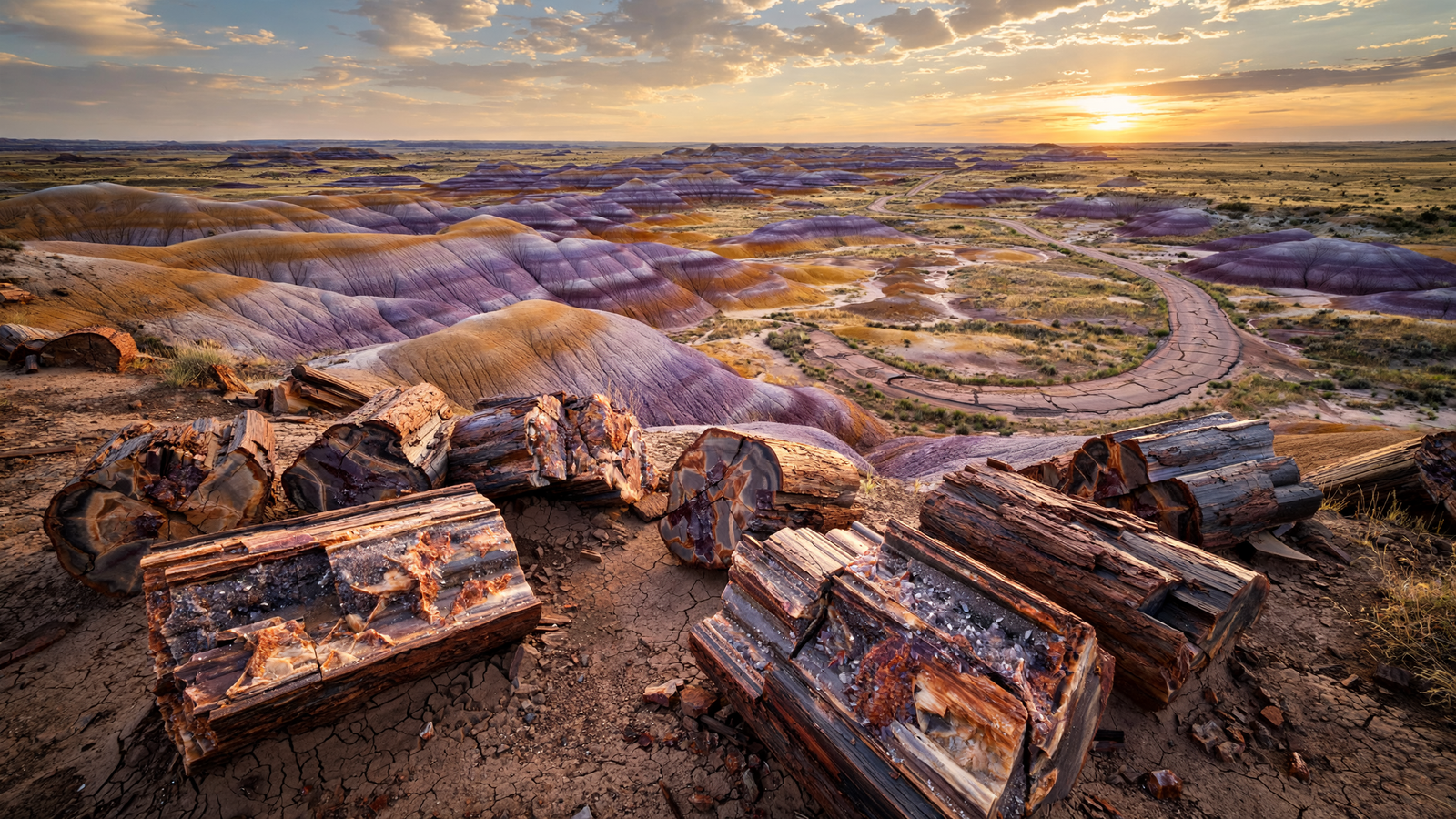
Fragments of trees that lived more than 200 million years ago glitter beside trails. The hills shift from red and lavender to gray, cream, and rust. Petroglyphs mark stone surfaces. The remains of an ancestral Puebloan village sit near the modern road. Farther north, the Painted Desert opens into a broad horizon that can make the present feel briefly weightless.
The park is often introduced through its petrified wood, and that is still its great visual signature. But the larger story is about connection: between forests and deserts, geology and human history, preservation and travel. Petrified Forest is not simply a collection of fossils. It is a landscape where several chapters of Arizona remain visible at once.
A forest transformed by water and time
The trees preserved here grew during the Late Triassic Period, roughly 225 million years ago, when the region was part of a much different environment. The climate was warmer and wetter than today, and rivers carried fallen logs across a broad floodplain.
Buried beneath sediment, the wood was gradually exposed to groundwater carrying dissolved silica. Over immense spans of time, minerals entered the wood’s cellular structure and replaced much of its original material. The result kept the shape and fine grain of the tree while turning it into stone.
That process explains why petrified wood can look uncannily organic. Rings, bark textures, knots, and broken branches remain recognizable. Yet the colors belong to geology as much as biology. Iron, manganese, and other minerals can create reds, yellows, purples, and deep blacks inside the quartz-rich material.
At the park’s Giant Logs area, large sections of petrified trees rest near the Rainbow Forest Museum. The Blue Mesa trail descends into rounded hills whose bands of blue and gray bentonite create a landscape that looks almost painted. In the Crystal Forest, a short walk passes smaller pieces of brilliantly colored petrified wood embedded in the surrounding terrain.
The scale can be surprising. Visitors may arrive expecting a stand of upright stone trees and instead find a wide desert scattered with fallen trunks and fragments. That openness is part of the experience. The park does not recreate an ancient forest; it lets visitors move through the geological remains of one.
The Painted Desert makes the story larger
Petrified Forest National Park extends across more than 220,000 acres in northeastern Arizona. Its northern section is dominated by the Painted Desert, a vast formation of layered badlands shaped by erosion.
The colors are not painted onto the land in any human sense. They come from sedimentary layers and the minerals within them, revealed as wind and water wear away softer rock. Light changes the scene throughout the day. At one hour, the hills may appear muted and dusty; later, low sunlight can bring out bands of red, orange, violet, and gold.
Painted Desert overlooks offer some of the park’s most accessible encounters with this scale. The land seems empty from a distance, but it is better understood as an active geological surface. Rain can cut new channels. Slopes retreat. Exposed layers provide clues to the environments that existed long before Arizona’s present deserts.
That combination of color and emptiness also changes how the park is perceived. The petrified logs invite close attention: a hand-sized fragment, a crystal-filled break, the pattern of a tree ring. The Painted Desert asks visitors to step back and consider whole hillsides and horizons. Together, they turn the park into both a place of detail and a place of distance.
People have been part of this landscape for centuries
The park’s story did not begin with modern roads or national-park boundaries. Indigenous people have lived in and traveled through the region for centuries, using the landscape’s water sources, plants, stone, and natural routes.
Puerco Pueblo, near the center of the park, preserves the remains of a multiroom settlement occupied during the late 1200s and 1300s. Its walls were built from locally available sandstone and mud mortar. The structure is no longer a complete village, but its surviving outlines make the settlement’s organization legible from the trail.
Nearby petroglyphs record another layer of human presence. Images pecked into dark rock surfaces include geometric forms, animals, and human-like figures. Their precise meanings are not always known, and responsible interpretation requires resisting the temptation to turn every mark into a simple explanation. What can be said with confidence is that these images are part of a long cultural landscape, not decorative additions to a scenic view.
The park also contains evidence of much older human activity, including stone tools and traces of habitation. These remains broaden the meaning of preservation. Protecting the park is not only about keeping fossil wood intact. It is also about caring for places that hold Indigenous history and continuing cultural significance.
Where Route 66 crossed the ancient ground
One of the park’s most unexpected stories belongs to the 20th century. Historic Route 66 once crossed the landscape, carrying travelers westward through a country increasingly linked by automobiles.
The road’s physical trace remains visible in parts of the park, and an old automobile marks the location of a former alignment. The exhibit is modest compared with the park’s geological features, but its meaning is large. Route 66 connected communities, roadside businesses, families, and travelers moving through a rapidly changing United States. In Petrified Forest, that modern story sits beside Triassic fossils and ancestral village sites.
The juxtaposition is one reason the park feels more layered than its name suggests. A person can look across the Painted Desert, examine a petrified log, stand near an ancestral settlement, and follow the line of a highway built for the automobile age—all within the same protected landscape.
Preservation means leaving the pieces where they are
Petrified wood has long attracted collectors because it is beautiful, durable, and easy to carry in small pieces. But every fragment removed from the park is more than a souvenir. It is part of a scientific and geographic record: a piece of a deposit, a marker of how material was transported, and a clue to the ancient environment.
The National Park Service asks visitors not to collect petrified wood, fossils, rocks, plants, or archaeological materials. That rule can feel strict in a place where the ground appears covered with loose stone. Its purpose is cumulative. A single small piece may seem insignificant, but millions of visitors making the same choice would steadily dismantle the landscape.
Preservation also protects the experience of discovery. When the material remains in place, future visitors can encounter it as part of the land rather than as an isolated object. Researchers can study its setting. Children can see that science does not always happen behind glass; sometimes it begins with noticing what lies underfoot.
A national park built for changing attention
Petrified Forest rewards more than one kind of visit. Some people come for a short stop at a viewpoint. Others follow a trail into the Blue Mesa or walk among the giant logs. A longer journey through the park can move from the Painted Desert in the north to the fossil-rich formations in the south, revealing how dramatically the terrain changes along the way.
That variety is part of the park’s generosity. It offers spectacle, but it also offers quiet evidence. A colored stone may prompt a question about minerals. A line of masonry may lead to a conversation about ancestral communities. A nearly vanished road may bring the history of American mobility into view.
Arizona is often described through its most famous extremes: towering canyon walls, tall saguaros, red-rock formations, and immense open spaces. Petrified Forest belongs in that company, but its character is different. Its wonder is distributed across the ground. The park asks visitors to slow down enough to see that a fragment can contain a forest, a hillside can contain an ancient climate, and a road can carry several eras through the same place.
That is what makes Petrified Forest a particularly memorable Arizona landscape. It does not separate natural history from human history or the ancient world from the modern one. It holds them together in the open, under the changing light of the Painted Desert.