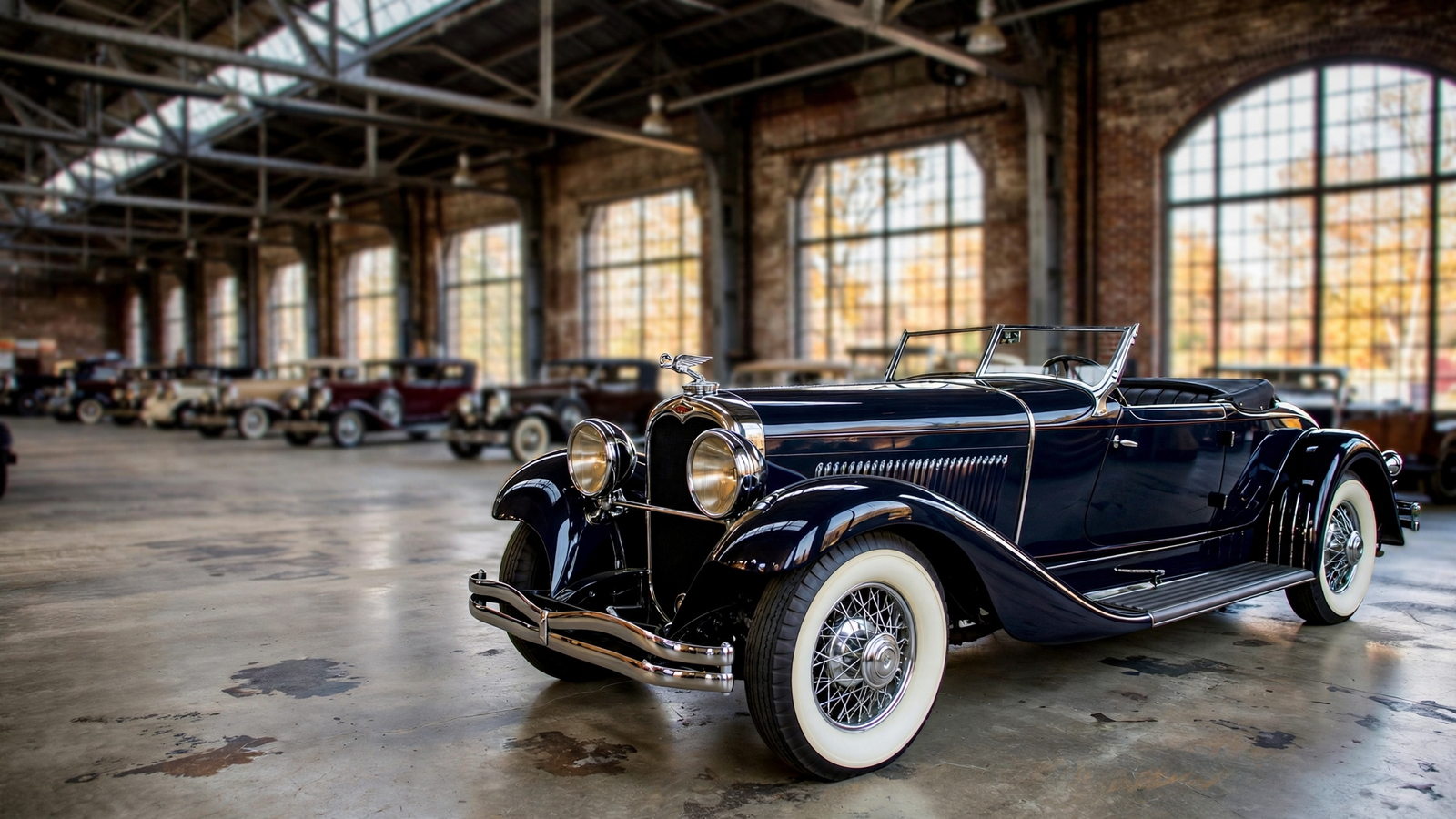
In Auburn, Indiana, the automobile is more than a way to get somewhere. It is part of the town’s physical memory.
That memory survives in a former automobile company office building where polished coachwork, enormous engines, hand-finished interiors, and unusual mechanical ideas tell the story of a short but influential chapter in American manufacturing. The Auburn Cord Duesenberg Automobile Museum is not simply a collection of old cars. It is a place where visitors can see how American designers and engineers once imagined the future—and how quickly that future could disappear.
The museum occupies the former administration building of the Auburn Automobile Company, a landmark of the city’s industrial past. Inside, the cars are arranged not as isolated curiosities but as evidence of a changing country: a nation moving from local carriage makers to mass production, from simple transportation to expressive design, and from open touring cars to machines built around speed, comfort, and status.
A car town in northeastern Indiana
Auburn’s automotive history began with the Eckhart family, whose carriage business eventually entered automobile manufacturing around the beginning of the 20th century. The company took the name Auburn, after the town, and built a reputation for producing attractive cars at prices that allowed the brand to reach beyond the wealthiest buyers.
The company’s rise reflected a broader American shift. In the early automobile era, manufacturers were scattered across the country, and small cities could become important production centers if they had skilled workers, rail connections, machine shops, and enough local ambition. Auburn had those ingredients. It also had a civic identity increasingly tied to the cars leaving its factories.
By the 1920s, however, the automobile business was becoming more competitive. Large manufacturers were gaining advantages in purchasing, production, advertising, and distribution. Smaller companies needed something distinctive. Auburn found part of its answer in Errett Lobban Cord, an energetic businessman who brought together a group of companies and designers under a single corporate vision.
When engineering became a form of style
The Auburn, Cord, and Duesenberg names are often remembered together, but each represented a different idea of what an automobile could be.
Auburn built cars that combined visual appeal with comparatively attainable pricing. Duesenberg occupied the opposite end of the market. Its Model J, introduced in 1928, was created as an elite automobile, with exceptional performance, lavish materials, and coachbuilt bodies tailored to individual customers. A Duesenberg was not merely selected from a catalog; its appearance could be shaped around the owner.
Cord, meanwhile, became a laboratory for technical experimentation. The Cord L-29 used front-wheel drive at a time when rear-wheel drive was overwhelmingly common in American passenger cars. The later Cord 810, introduced for the 1936 model year, pushed the idea further with a low, streamlined body, concealed headlights, and a distinctive hood design. Its front-wheel-drive layout helped create a long, uninterrupted profile that still looks unconventional decades later.
These cars were expensive and produced in relatively small numbers. They did not replace the ordinary family sedan. Their importance lies elsewhere: they showed that an American automobile could be conceived as a complete work of design, in which engineering, proportion, materials, and visual drama worked together.
A building that belongs to the story
The museum’s setting gives the collection an unusual strength. Rather than presenting the cars in a generic modern hall, it places them inside a building created for the company that made many of them.
The administration building was part of Auburn’s manufacturing complex and dates from the period when the company was trying to present itself as a modern, integrated automotive organization. Its architecture, offices, and circulation spaces retain the atmosphere of an industrial headquarters. The building itself becomes a kind of oversized artifact—one that explains how automobile companies once connected design studios, engineering departments, sales offices, executives, and factory floors.
That connection matters. A Duesenberg can seem almost impossibly glamorous when viewed alone. In Auburn, it is easier to place the car within the network that made it possible: machinists, body builders, upholsterers, draftsmen, salespeople, suppliers, and the communities that depended on the factory’s payroll.
The museum therefore preserves more than finished products. It preserves a way of making things, and a way of organizing civic life around manufacturing.
Why the collection feels bigger than its size
The museum’s collection includes Auburn, Cord, and Duesenberg automobiles as well as vehicles and artifacts connected to the wider history of transportation and automotive design. Its galleries also help explain the people behind the machines, from industrial leaders to designers and engineers.
That context keeps the experience from becoming a parade of expensive objects. Visitors can compare different solutions to familiar problems: how to make a body more aerodynamic, how to improve power delivery, how to make an interior feel luxurious, or how to distinguish one company’s identity from another’s.
Even the details invite closer attention. A dashboard can reveal changing ideas about information and control. A hood ornament can show how a manufacturer turned a mechanical object into a recognizable symbol. A coachbuilt body can make clear how much individuality once existed in a market that is now dominated by standardized production.
The museum also makes room for failure and limitation. The Cord 810 was innovative, but its advanced design was accompanied by production and reliability challenges. The companies associated with Auburn ultimately could not withstand the economic pressures of the late 1930s. Their disappearance is part of the lesson. In the automobile industry, imagination alone is not enough; a company must also master cost, distribution, service, timing, and scale.
The end of an era
The collapse of the Auburn Automobile Company and its related enterprises came during a difficult period for American industry. The Great Depression had reduced demand for luxury goods, while larger manufacturers continued to strengthen their position. Auburn production ended in the 1930s, and the Cord brand did not become the lasting mass-market success its designers had hoped for.
Yet the end of production did not erase the significance of the work. The cars remained influential because they made bold choices visible. They demonstrated that an automobile could be low and sculptural, front-wheel drive, highly personalized, or engineered with the performance of a racing machine. Their ideas continued to attract designers, collectors, historians, and ordinary visitors who simply recognize an unforgettable shape when they see one.
The museum’s existence is itself a second chapter in that story. It opened in 1974, when many historic automobiles were still being treated primarily as collectibles rather than as cultural artifacts. Preserving the old administration building and filling it with cars gave Auburn a way to interpret its industrial past instead of allowing that past to survive only in photographs and memories.
A living lesson in American ambition
Automobile museums can sometimes become rooms full of nostalgia. The Auburn Cord Duesenberg Automobile Museum offers something more useful: a way to think about ambition.
The companies represented there were not cautious. They attempted to compete through design, performance, craftsmanship, and technical distinction at a moment when the industry was rapidly consolidating. Some of those experiments worked. Some did not. Together, they reveal the creative tension inside American manufacturing—a desire to make products practical enough to sell and remarkable enough to be remembered.
That tension still shapes the automobile. Every new vehicle has to negotiate between efficiency and emotion, cost and quality, standardization and individuality. The cars in Auburn make those choices unusually visible because their designers were willing to put the argument on the outside of the bodywork.
For travelers, the museum offers a concentrated way to encounter that history. For Auburn, it provides something deeper: a preserved civic landmark that keeps the town’s industrial identity connected to the present. And for anyone interested in American design, it demonstrates that innovation is not always found in the largest factory or the most successful company.
Sometimes it survives in a smaller city, inside an old headquarters, in the form of a car whose ideas arrived before the market was ready for them.