Some automobiles announce themselves with spectacle. They arrive wearing dramatic shapes, powerful engines, or names designed to sound larger than life. Others become important by doing something more difficult: fitting themselves into ordinary life.
The Honda Civic belongs to the second group. It was never merely a small car, although that was its starting point. Over more than five decades, the Civic became a commuter car, a first car, a family car, a student car, a taxi, a road-trip companion, and, in some versions, a serious performance machine. Its achievement was not that it transformed the automobile overnight. It was that it kept adapting while remaining understandable and attainable.
That makes the Civic an important part of American automotive history, even though its story began in Japan. The car helped change what American drivers expected from a compact vehicle—and helped establish a model for how a global automobile could become part of the everyday American landscape.
A small car arrives at a large moment
Honda introduced the Civic in 1972, when the automobile industry was entering a period of uncertainty. The postwar American preference for large cars had not disappeared, but fuel prices, environmental concerns, and new emissions rules were beginning to challenge the assumption that bigger was always better.
The first Civic was compact by the standards of the time, but its usefulness was carefully considered. It was offered in practical body styles, including a two-door sedan and a three-door hatchback. The hatchback in particular gave the car an unusual amount of flexibility for its size. It could carry people through the week and accommodate bulky everyday cargo without pretending to be a truck or a luxury vehicle.
That balance mattered. A small car could save fuel, but it still had to work as transportation. The Civic’s early appeal came from making efficiency feel less like a sacrifice and more like a sensible choice.
The engine that answered a difficult question
Honda’s most important early contribution to the Civic story was not simply making a small engine. It was developing a way for a compact car to meet increasingly demanding emissions standards while remaining practical for ordinary buyers.
In 1975, Honda introduced its Compound Vortex Controlled Combustion, or CVCC, engine technology. The system used a divided combustion chamber and a carefully controlled air-fuel mixture to reduce emissions. Honda said the Civic equipped with CVCC could meet the stricter requirements of the U.S. Clean Air Act without relying on a catalytic converter at the time.
The achievement was significant because it challenged a widespread industry assumption: that cleaner exhaust would necessarily require a large and expensive technological leap. Honda’s approach was not the final answer to automotive emissions, and catalytic converters soon became standard across the industry. But the Civic demonstrated that a relatively small company could respond creatively to a major environmental and engineering problem.
It also helped build trust in the compact car. Efficiency no longer had to mean crude, underpowered, or temporary. A small automobile could be thoughtfully engineered and capable of meeting the demands of a changing world.
From imported curiosity to American-made car
At first, American Civics arrived from Japan. That changed as Honda invested in manufacturing in the United States. The company established Honda of America Manufacturing in Ohio in the late 1970s, and Civic production began at the East Liberty plant in 1986.
This was more than a change in shipping arrangements. It placed the Civic inside the American industrial story. The car was no longer simply a Japanese product being sold on American roads; it was also being assembled by American workers, alongside a growing network of suppliers and communities connected to the plants.
Honda’s Ohio operations became part of a broader transformation in American auto manufacturing. Japanese automakers did not merely export vehicles to the United States. They built factories, trained workers, developed supplier networks, and adapted their production systems to local conditions. The result was a more complicated automotive map—one in which national identity mattered less than the shared work of designing, building, selling, and maintaining a car.
The Civic was especially well suited to that transition. Its size and mechanical simplicity made it a natural fit for drivers who wanted manageable operating costs. Its growing range of body styles made it easier to imagine as a long-term vehicle rather than a stopgap until a buyer could afford something larger.
The car that taught a generation to choose differently
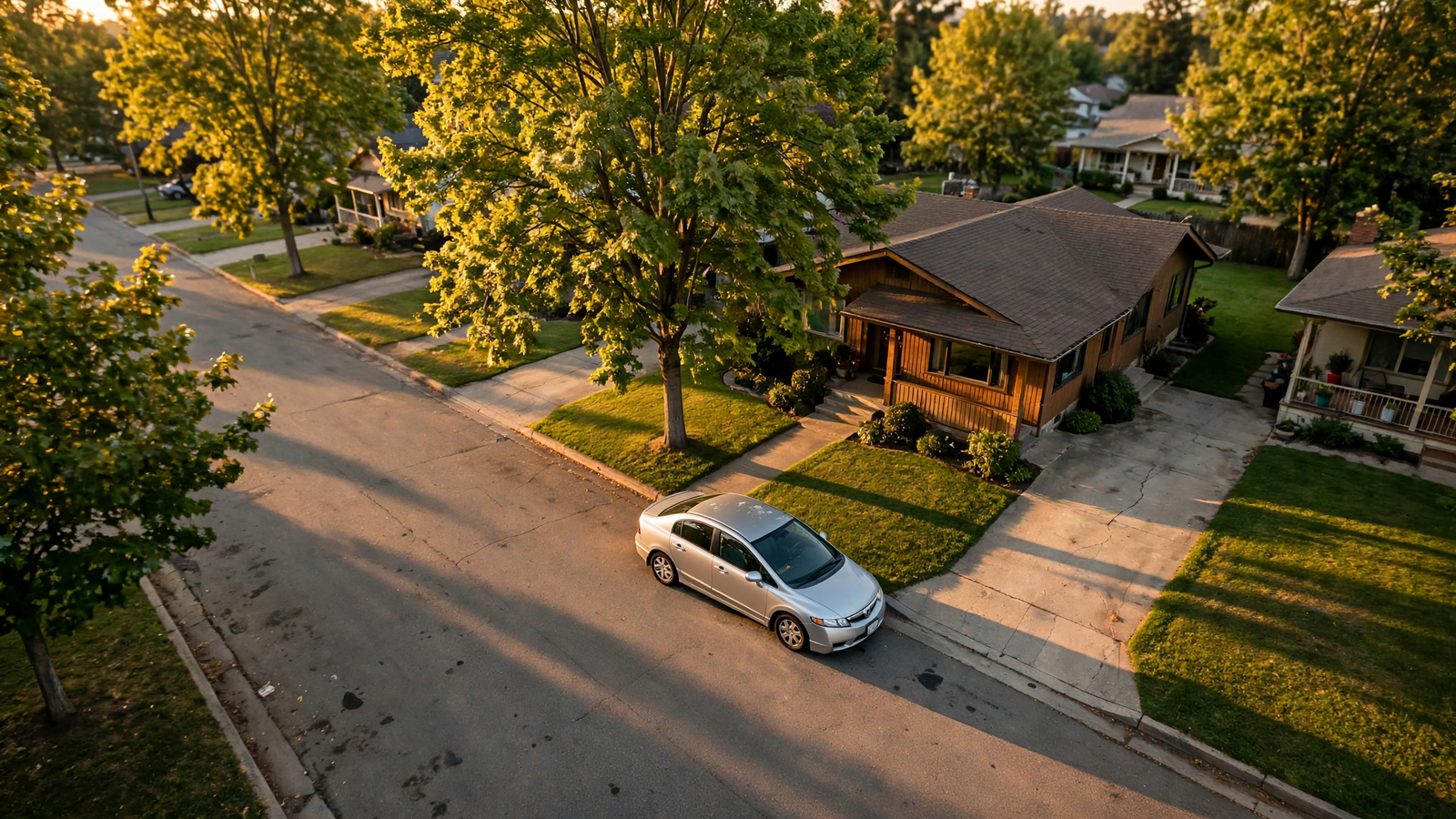
By the 1980s and 1990s, the Civic had become part of the American road’s everyday vocabulary. It was visible in suburban driveways, college parking lots, city streets, and long commutes. Owners valued its fuel economy, but the car’s reputation was built just as much on durability and ease of ownership.
That reputation created a kind of social usefulness. A reliable compact car can expand a person’s choices. It can make a longer commute possible, help a student reach school or work, allow a young family to manage transportation costs, or give a household a second vehicle without taking over the budget.
The Civic also became a platform for personal expression. Some owners modified their cars for appearance or performance. Honda’s own performance-oriented variants, including the Civic Si and later the Type R, showed that a compact car could be engaging without abandoning its practical roots. The same basic name could describe a sensible commuter and, in another version, a sharply focused enthusiast’s car.
That breadth helped the Civic avoid being trapped in a single identity. It was economical without being joyless, practical without being anonymous, and adaptable without losing its basic purpose.
A global car with local meanings
Honda’s Civic story eventually became much larger than the United States. The model has been sold in markets around the world and produced in multiple countries over successive generations. Honda has described cumulative Civic sales as exceeding 27 million vehicles across more than 170 countries and regions.
Those numbers describe scale, but they do not fully explain the car’s reach. A global model has to be flexible enough to serve different roads, regulations, incomes, and habits. The Civic has appeared as a hatchback, sedan, coupe, wagon, hybrid, and performance car, with specifications changing from one market to another.
Yet the model’s central idea has remained recognizable: provide useful transportation in a relatively efficient and manageable package. That idea travels well because it answers a common human need. Whether a driver is navigating a crowded city, a rural highway, or an American interstate, a car that is economical, dependable, and easy to live with has a practical advantage.
Adapting without losing the plot
The modern Civic is larger and more technologically complex than its 1970s predecessor. It offers driver-assistance systems, advanced safety engineering, turbocharged engines in some versions, and hybrid powertrains in markets where those options are available. The basic car has grown because drivers’ expectations have grown.
That expansion carries a risk. Every new feature can add weight, cost, and complexity. The challenge for Honda has been to keep the Civic accessible while moving it into a world of stricter safety standards, lower emissions targets, digital interfaces, and changing consumer preferences.
The model’s continued presence suggests that the company has generally understood the importance of continuity. A Civic does not need to look exactly as it did in 1972 to remain faithful to its original purpose. It needs to remain useful, efficient, and approachable—and to make technological change feel compatible with everyday life.
Why the Civic still matters
The automobile is often discussed through its extremes: the fastest, most expensive, most luxurious, or most powerful vehicles. The Civic represents another measure of success. It shows what can happen when a car is designed not for a narrow audience, but for millions of people with ordinary needs.
Its history includes environmental engineering, international manufacturing, changing American tastes, and the democratization of personal mobility. It also illustrates how influence can accumulate quietly. A Civic rarely changes a person’s life through drama. It does so by starting reliably, using reasonable amounts of fuel, carrying what needs carrying, and continuing to work year after year.
That is not a lesser kind of automotive achievement. It is one of the hardest to sustain.
More than fifty years after its introduction, the Civic remains a reminder that the future of transportation is not shaped only by spectacular prototypes. It is also shaped by the ordinary cars that millions of people can actually use. In that sense, the Civic became more than a successful Honda. It became a global everyday car—and an enduring part of America’s road story.