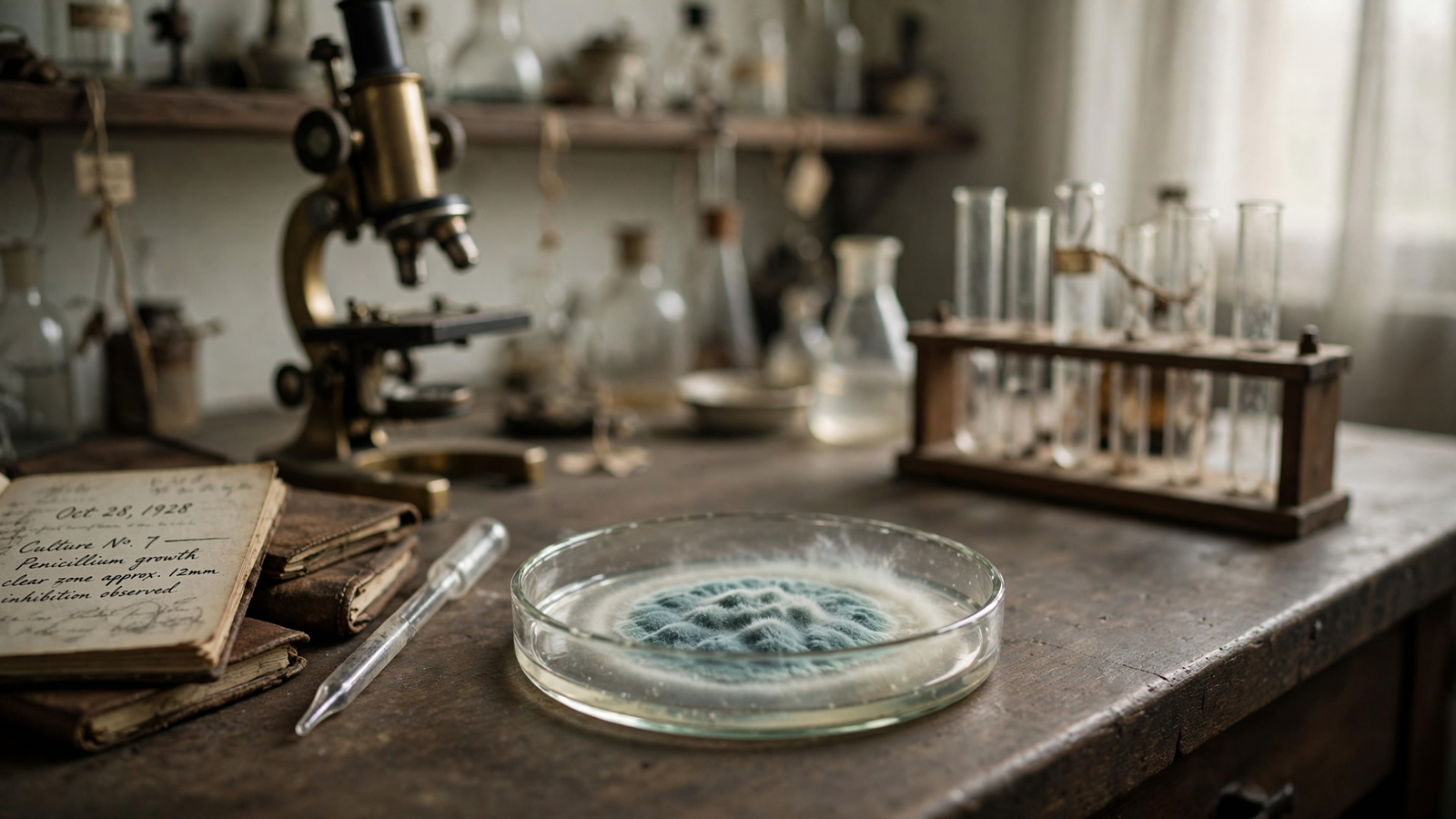
In early September 1928, Alexander Fleming returned to his laboratory at St Mary’s Hospital in London after a holiday. Among the dishes of bacteria he had been studying was one that had been left near an open window. A patch of mold had appeared on the dish, and the bacteria surrounding it were no longer growing.
It was an easily overlooked laboratory accident. Instead, Fleming examined it closely. The mold seemed to release a substance that killed or inhibited nearby bacteria. He called that substance “penicillin,” after the Penicillium mold that produced it.
The observation did not immediately create a usable drug. Fleming’s work was the beginning of a much longer story—one involving microbiology, chemistry, clinical medicine, industrial fermentation, and international cooperation. But it marked a turning point in the search for ways to treat bacterial infection.
A discovery hiding in plain sight
Fleming had been studying staphylococci, bacteria that can cause infections in wounds and tissues. When he inspected the contaminated culture in 1928, he noticed a clear zone around the mold. The bacteria had been destroyed or prevented from multiplying in that area.
Fleming’s insight was not simply that mold had contaminated a culture. Mold contamination was a familiar nuisance in laboratories. His important conclusion was that the mold was producing an antibacterial substance that might be useful against disease-causing organisms.
He and his colleagues tested the substance against several kinds of bacteria. In a paper published in 1929, Fleming described penicillin as a powerful antibacterial agent while also noting its apparent lack of toxicity to some animal cells. The finding was scientifically important, but the substance was difficult to isolate, unstable, and available only in tiny quantities.
That limitation helps explain why penicillin did not become an instant medical revolution. Fleming had found a promising phenomenon, but turning it into a dependable treatment required solving problems his laboratory could not yet overcome.
Why the first discovery was not enough
Penicillin broke down relatively quickly and was hard to purify. Fleming continued investigating it, but the work did not immediately attract the sustained attention needed to develop a medicine. For more than a decade, penicillin remained a remarkable laboratory finding rather than a standard treatment.
The next decisive stage began at the University of Oxford. A research team led by the pathologist Howard Florey and the biochemist Ernst Chain began revisiting Fleming’s published work in the late 1930s. Their group included the biophysicist Norman Heatley, whose technical work was essential to extracting, concentrating, and testing penicillin.
The Oxford researchers developed methods for producing enough of the substance to conduct animal experiments. In 1940, they reported that penicillin could protect infected mice from bacteria that would otherwise kill them. The experiment offered evidence that penicillin was not merely an interesting chemical in a culture dish: it could work inside a living animal.
The team then moved toward human treatment. In 1941, a British police constable named Albert Alexander received penicillin for a severe infection. He initially improved, but the available supply ran out before treatment could be completed. The case demonstrated both the drug’s promise and the practical problem facing the researchers: they needed far more penicillin than a small university laboratory could produce.
From Oxford benches to industrial scale
World War II made the search urgent. Wounds, surgery, pneumonia, and other bacterial infections threatened the lives of soldiers and civilians. Existing treatments were limited, and an effective antibacterial drug could reduce deaths from infections that had once been extremely difficult to control.
British scientists shared their findings with researchers in the United States. In 1941, Florey and Heatley traveled to North America to seek help with large-scale production. Government laboratories, universities, and pharmaceutical companies began working on the manufacturing challenge.
One important center was the Northern Regional Research Laboratory in Peoria, Illinois. There, researchers improved fermentation techniques and searched for molds that produced more penicillin. A mold found on a cantaloupe purchased in a Peoria market proved especially productive. Through selection and cultivation, scientists used high-yield strains to increase output dramatically.
Manufacturers also shifted from surface cultures to deep-tank fermentation. Instead of growing mold in shallow containers, they could grow it in large tanks under controlled conditions. This change made it possible to produce penicillin in quantities suitable for widespread medical use.
The result was not a single dramatic invention but a chain of improvements. Fleming identified the antibacterial effect. The Oxford group established methods for concentrating and testing it. American and British researchers improved the organism and the production process. Industry turned those advances into a medicine that could be made at scale.
A medicine that changed the meaning of infection
Penicillin became increasingly available to Allied military hospitals during the war. It was used to treat infections in wounded service members and to address diseases such as pneumonia and bacterial sepsis. After the war, production expanded for civilian medicine.
Its significance went beyond any one infection. Before antibiotics, a small wound could become life-threatening, and operations that are routine today carried a much greater risk of infection. Physicians had few reliable tools for treating bacterial disease once it had taken hold.
Penicillin did not make infection harmless, and it did not work against viruses. It also created a problem that would become more serious over time: bacteria can evolve resistance when antibiotics are misused or overused. Fleming himself warned in his Nobel lecture that improper exposure could allow resistant organisms to emerge.
That warning remains part of penicillin’s history. The discovery changed medicine because it made bacterial infection more treatable, but it did not eliminate the need for careful diagnosis, appropriate prescribing, research, and public-health safeguards.
The Nobel recognition
In 1945, Fleming, Florey, and Chain received the Nobel Prize in Physiology or Medicine “for the discovery of penicillin and its curative effect in various infectious diseases.” The shared award reflected the unusual structure of the achievement. Penicillin was not the product of one moment alone, even though Fleming’s 1928 observation provided its starting point.
That distinction matters. Popular accounts often present penicillin as a lucky accident, and luck was certainly involved in the contaminated culture that caught Fleming’s attention. But the medicine that followed depended on trained observation, repeated experiments, difficult purification, animal studies, clinical testing, biological strain selection, and industrial engineering.
The story is therefore less about an accident than about what scientists did after noticing one. A discarded-looking culture became meaningful because someone asked why the bacteria had stopped growing. Years later, other researchers recognized that the answer could be developed into a treatment. Still more people found ways to produce it reliably.
A discovery that still shapes the present
Penicillin opened the antibiotic era and helped establish a new expectation for medicine: that some dangerous bacterial infections could be treated with targeted drugs rather than endured, surgically drained, or left to the body’s defenses alone.
Its legacy also carries a lesson about scientific progress. Breakthroughs often move through several stages before they reach the public. An observation must be confirmed. A substance must be understood. A treatment must be tested for safety and effectiveness. Production must be made dependable. Finally, doctors and patients must learn how to use it responsibly.
In 1928, Fleming saw a small clear ring around a mold in a London laboratory. The ring was only the visible beginning. The larger achievement came from the sustained effort to understand it—and to turn a fragile laboratory clue into one of the most consequential medicines in modern history.