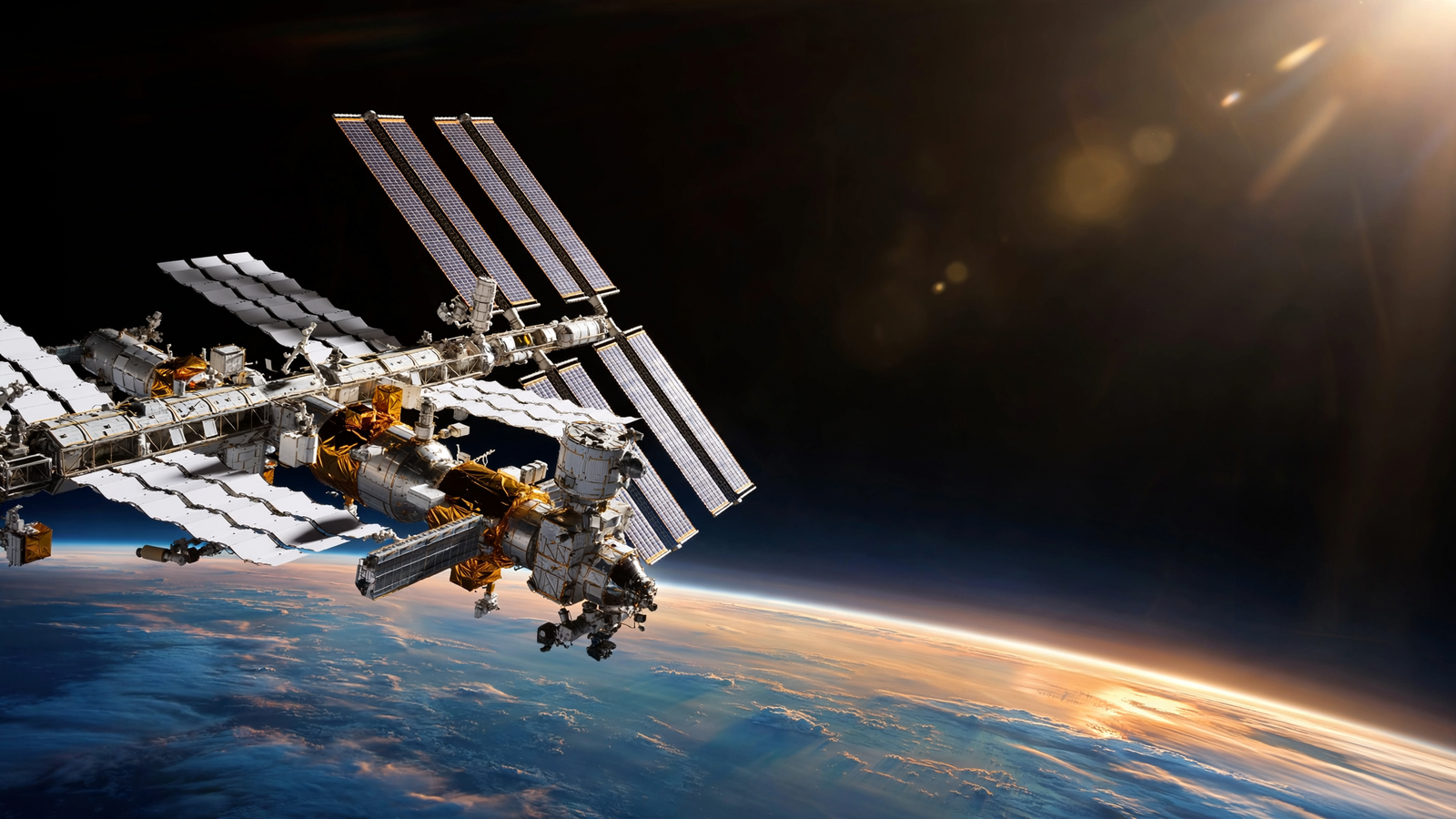
Every 90 minutes or so, the International Space Station passes from daylight into darkness and back again. From its orbit roughly 250 miles above Earth, it crosses national borders without seeing them. Its crew may be conducting an experiment designed in Europe, using equipment built in Japan, while communicating through a network managed by the United States and Russia.
The station is one of the most ambitious cooperative projects ever attempted. It is also a working laboratory, an engineering test bed, an Earth-observation platform, and a home in space. Its importance is not only that people live there. The deeper achievement is that many nations developed the hardware, procedures, and trust required to keep a shared place functioning in one of the most demanding environments humans have entered.
A laboratory assembled in orbit
The first piece of the station, the Russian-built Zarya module, reached orbit in November 1998. A second module, Unity, followed soon afterward aboard the space shuttle Endeavour. From those early components, the station grew through dozens of shuttle missions and robotic launches.
Construction could not be completed on Earth and launched as a single structure. The station was too large and too complex. Instead, astronauts and robotic systems connected its elements in orbit, gradually adding laboratories, living quarters, solar arrays, cooling systems, docking ports, and truss sections.
That method turned the ISS into more than a destination. It became a long-running demonstration of orbital construction. Crews learned how to install equipment outside a spacecraft, route power and data across a growing structure, and repair systems that could not simply be brought back to a workshop.
NASA, Roscosmos, the European Space Agency, Japan’s JAXA, and the Canadian Space Agency are the principal partners. Their roles are different but interlocking. The United States contributed major laboratory and power systems; Russia provided important propulsion, habitation, and station-control capabilities; Europe and Japan added laboratories and research hardware; Canada supplied the robotic systems used to move equipment and support assembly.
The station became a home before it became complete
The first long-duration crew, known as Expedition 1, arrived in October 2000. Since then, people have lived aboard the station continuously, creating an unbroken human presence in orbit that has lasted for more than two decades.
Living there requires ordinary routines in an extraordinary setting. Crew members sleep in small private compartments, exercise to limit the loss of bone and muscle caused by microgravity, maintain equipment, conduct experiments, and manage supplies delivered by cargo spacecraft. Water is carefully reclaimed, air is monitored, and almost every object has to be secured so it does not drift away.
The station’s interior is not a spacious science-fiction habitat. It is a crowded network of connected modules filled with cables, handrails, computers, storage bags, exercise machines, research racks, and emergency equipment. The design reflects a practical reality: every kilogram launched into orbit costs money, and every system must earn its place.
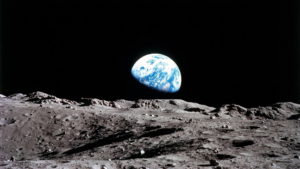
Yet the station also offers something its builders could not reproduce on the ground: a continuous view of Earth. Astronauts see weather systems develop, coastlines curve away, cities glow at night, and atmospheric colors change near sunrise. Their photographs have become an informal record of a planet that is visually united even when its politics are not.
Why perform experiments in microgravity?
On Earth, gravity is present in nearly every experiment. It drives convection in fluids, causes sediment to settle, shapes flames, and influences how living organisms grow. In orbit, microgravity reduces or changes those effects, allowing researchers to isolate processes that are difficult to study on the ground.
Some investigations examine how the human body changes during long spaceflight. Astronauts experience shifts in bone density, muscle strength, vision, balance, sleep, and the distribution of fluids in the body. Understanding those changes helps researchers design safer missions beyond low Earth orbit and can also provide insights into health problems on Earth.
Other studies focus on biology. Plants are grown to learn how food might be produced during future missions and how roots and leaves respond when “up” and “down” are no longer obvious. Scientists study microbes, cells, tissues, and model organisms to see how spaceflight affects growth and repair.
Physics experiments use the station’s unusual environment to explore combustion, fluids, materials, and manufacturing. A flame behaves differently when buoyancy is reduced. Crystals can form in ways that are difficult to reproduce in a terrestrial laboratory. Materials can be exposed to vacuum, radiation, extreme temperature changes, and atomic oxygen to test how they age in space.
The research is not automatically useful simply because it happens in orbit. Experiments have to answer a specific question, and results still require careful analysis. But the station gives scientists a place where certain variables can be changed or reduced, creating opportunities that ground laboratories cannot provide.
A machine for learning how to go farther
The ISS is also a test site for technologies needed beyond low Earth orbit. Life-support systems must remove carbon dioxide, maintain breathable air, and recover water. Power systems must operate through repeated transitions between sunlight and darkness. Computers, pumps, seals, sensors, and communications equipment must work for years while exposed to radiation and vibration.
That experience matters because future missions to the Moon and Mars will be farther from Earth and harder to resupply. A crew traveling to the Moon may have limited opportunities for replacement parts. A Mars mission would face communication delays and a journey measured in months. The station cannot solve every problem of deep-space travel, but it allows engineers and astronauts to identify failures, improve procedures, and practice long-duration operations close enough for support.
Robotics are part of that preparation. Canada’s robotic technology has been used to move equipment along the station’s exterior and support construction. Robotic arms and free-flying systems reduce the need for astronauts to perform every task by hand, while also helping researchers study how machines can work alongside people in space.
Earth remains the station’s largest subject
Although the ISS is built for spaceflight, much of what it observes is happening below. Instruments and crew photographs contribute to studies of storms, wildfires, dust, pollution, agriculture, coastlines, glaciers, and changing land use.
The station’s orbit passes over a wide range of latitudes, giving researchers repeated views of regions that are difficult to monitor from a single ground location. Some instruments collect data automatically; astronauts also photograph events that may be missed by scheduled satellite observations. These observations can support scientific research, disaster response, and environmental monitoring.
The perspective is useful partly because it combines detail with context. A crew member looking through a window may see a smoke plume spreading across a landscape, a river changing color near its mouth, or the scale of a storm system. Such images do not replace scientific instruments, but they can help researchers interpret what automated sensors detect.
Cooperation under pressure
The station’s most unusual feature may be its organizational design. It is not owned or operated by one country alone. Mission control centers in different nations coordinate crew schedules, spacecraft traffic, maintenance, experiments, and emergencies. Astronauts and cosmonauts train together, learn one another’s procedures, and share responsibility for a single vehicle.
That cooperation has never made international relations simple. The partners have different governments, budgets, languages, technical traditions, and political priorities. The station has also faced delays, equipment failures, changing launch systems, and the difficult reality of maintaining aging hardware in orbit.
Its continued operation nevertheless shows what sustained collaboration can accomplish. Cooperation here is not an abstract promise. It appears in compatible docking systems, shared emergency plans, common training, jointly operated laboratories, and crews that depend on one another every day.
The lasting lesson of the ISS
The International Space Station is often described as a symbol, but it is more useful to see it as a working example. Symbols can be admired from a distance. The station has to function. Air must circulate, power must flow, research must be completed, and people must return safely.
Its legacy will include scientific findings, engineering methods, spectacular images, and the experience of living in space for long periods. It will also include a record of how a complicated international project can be assembled piece by piece, with no single partner able to complete it alone.
When the station moves across the night sky, it looks like a small point of light. Behind that point is a structure larger than a football field, a network of laboratories and habitats, and a history built by thousands of people on Earth. The enduring achievement is not simply that humanity placed a home in orbit. It is that the home was made shared.