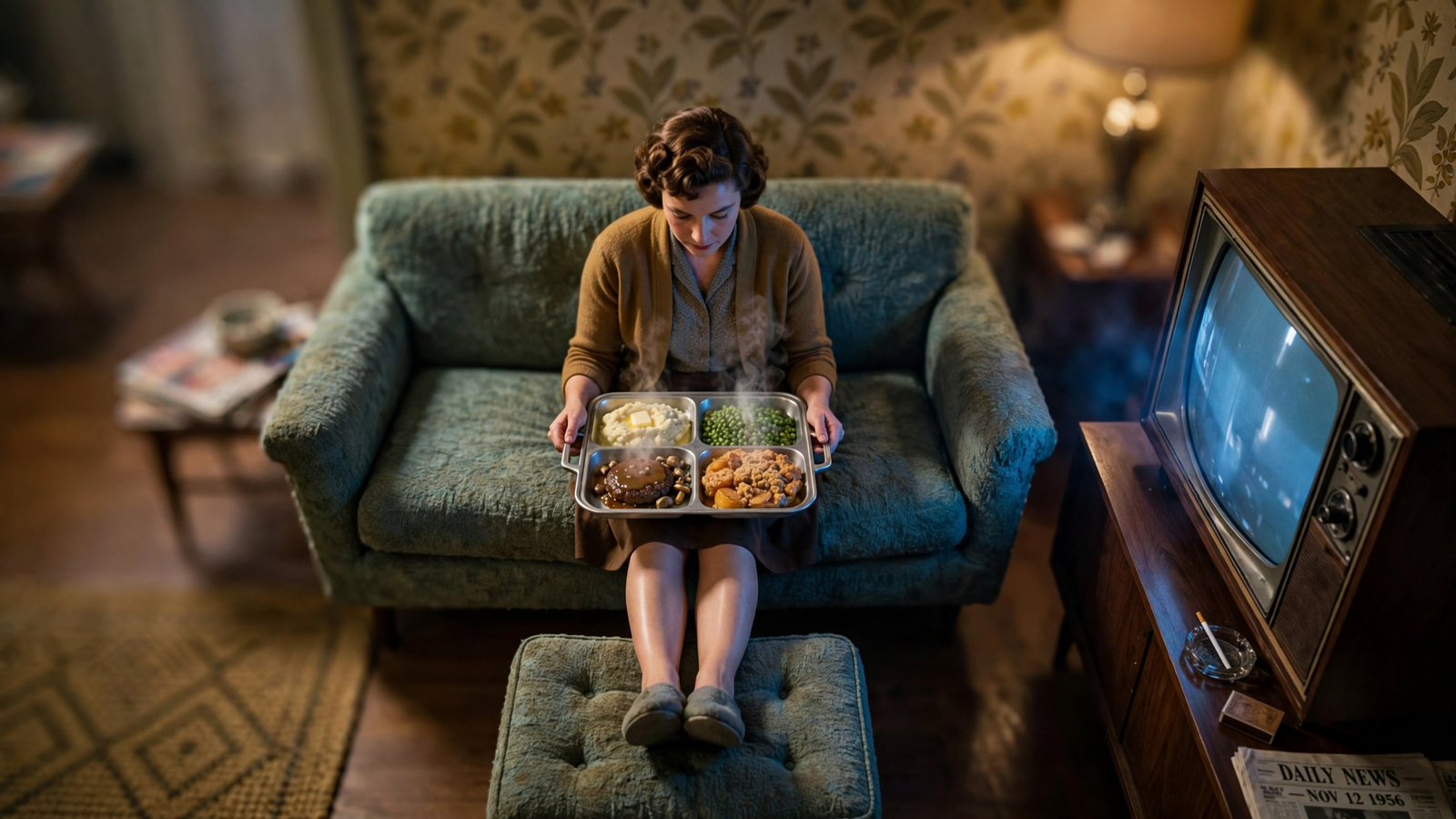
For millions of Americans, dinner once arrived on a metal tray divided into neat compartments: meat in one section, vegetables in another, and a small square of dessert tucked beside them. The meal was hot, packaged, portioned, and ready in minutes. It was also meant to be eaten somewhere new—not around the family table, but in front of the television.
The TV dinner did more than introduce frozen food to a wider audience. It captured a particular moment in American life, when household appliances, television, supermarkets, aviation technology, and postwar optimism were reshaping the meaning of convenience. A meal that began as a practical solution to a warehouse problem became a symbol of modern domestic life.
A Thanksgiving problem becomes a business opportunity
The story usually begins in 1953, when C.A. Swanson & Sons faced a large surplus of frozen Thanksgiving food. The company had overestimated demand for turkeys, leaving it with hundreds of thousands of pounds of unsold product. According to the company’s later account, salesman Gerry Thomas proposed packaging the turkey with familiar side dishes in a compartmented aluminum tray.
The idea was not created from nothing. Airlines had already demonstrated that food could be cooked, chilled or frozen, portioned, and reheated for passengers. Swanson’s innovation was to adapt that logic for the home freezer and the supermarket aisle.
The first meals combined turkey with dressing, gravy, sweet potatoes, and peas. A dessert section completed the arrangement. The tray could go directly into the oven, eliminating the need for separate pots and pans. Its design made the meal look organized and complete, even though every component had been industrially prepared.
Swanson did not originally call the product a “TV dinner.” The name became part of the marketing as television ownership expanded and evening entertainment moved into American living rooms. The association was obvious: this was food designed for a household gathered around a screen.
Why the tray mattered
Frozen dinners had existed before Swanson’s launch, but they had not yet become a mass-market habit. The compartmented tray solved several problems at once.
- It controlled portions. Each food occupied its own space, making the meal predictable and easy to serve.
- It simplified preparation. The consumer needed little more than an oven, a timer, and a willingness to wait.
- It reduced cleanup. The tray functioned as both cooking vessel and plate.
- It fit the freezer. The meal could be stored for later rather than prepared immediately.
- It made variety portable. Meat, vegetables, starch, and dessert could travel together in one package.
That combination reflected the postwar American kitchen. Freezers were becoming more common, supermarkets were expanding their frozen-food sections, and food companies were learning how to preserve texture and flavor at industrial scale. Convenience was no longer simply a luxury for travelers or wealthy households. It was becoming a consumer expectation.
The television connection
The TV dinner’s name helped turn an appliance into a dining partner. Television had moved rapidly from novelty to household presence during the 1950s. Families watched news, variety programs, westerns, comedies, and sporting events according to evening schedules that increasingly organized domestic time.
A conventional family meal required people to remain at the table. A frozen dinner allowed them to carry the meal into the living room. The tray’s shape was practical for balancing on a lap or a small table, while its packaging suggested that the viewer did not need to miss the program while eating.
This did not mean every American abandoned the dining table. Nor was the TV dinner the only force changing family meals. Car culture, longer commutes, changing work patterns, school schedules, and the growth of prepared foods all contributed to a more flexible approach to eating. Still, the frozen tray became one of the clearest objects associated with that transition.
It also helped normalize the idea that dinner could be assembled by a company, stored in a freezer, and consumed according to a household’s schedule. The meal no longer depended entirely on the timing of a cook or the coordination of a family.
From turkey to an entire frozen-food aisle
Once the format proved successful, frozen dinners expanded beyond the original Thanksgiving plate. Beef, fried chicken, meatloaf, macaroni and cheese, fish, and other familiar dishes appeared in tray form. Regional preferences and changing ideas about nutrition influenced the combinations, but the basic formula remained recognizable: a complete meal, divided into sections, requiring minimal preparation.
The aluminum tray was central to the early experience. It could withstand oven heat and keep separate foods from blending together. Later packaging developments introduced materials suitable for microwave heating, which changed preparation times and made frozen dinners even more convenient.
The microwave accelerated the category’s transformation. Earlier meals often required a conventional oven and considerable waiting. Microwaveable dinners made the promise of speed much more literal. By the late twentieth century, the frozen entrée had become a standard part of supermarket life, available in forms ranging from inexpensive comfort food to diet meals and cuisine-inspired dishes.
The convenience food Americans learned to judge
TV dinners also became a way for Americans to debate what a meal should be. Admirers valued their low cost, long shelf life, portion control, and ease. Critics associated them with excessive packaging, high sodium, bland texture, and the decline of shared meals.
Those arguments have continued as frozen food has evolved. Today’s frozen meals may include vegetarian, vegan, organic, low-carbohydrate, gluten-free, or globally inspired options. Some are designed for nutrition and speed; others are deliberately nostalgic. The category has absorbed changing ideas about health and identity without abandoning its central promise: dinner can be ready when you are.
The original TV dinner also reveals how marketing can give a technology an emotional setting. A frozen meal might have been sold simply as a preserved food product. Linking it to television made it part of an evening ritual. The product did not merely feed a person; it helped define where that person sat, what the person watched, and how the household experienced time together.
A homemade version for the modern table
A home cook can recreate the logic of a classic tray dinner without reproducing its industrial character. The goal is not historical exactness but balance: one main dish, two contrasting sides, and a small sweet finish.
Simple roast-chicken tray dinner
- Roasted chicken or sliced leftover turkey
- Mashed potatoes or a small portion of stuffing
- Green peas, green beans, or roasted carrots
- Gravy or pan sauce
- A small serving of apple crisp, brownie, or baked fruit
Arrange the food in separate sections of an oven-safe dish. Reheat the savory portions until they are hot throughout, then add the dessert after warming if its texture calls for it. The most important principle is the original one: keep the components distinct while allowing them to share a single serving dish.
That arrangement may seem ordinary now, but it once represented a remarkable shift. The meal was no longer tied to a kitchen full of active preparation. It could wait in the freezer, travel from the oven to the living room, and fit neatly into an evening shaped by television.
The TV dinner remains a small object with a large cultural footprint. It preserved the look of a traditional plate while changing the labor behind it. It made convenience visible in aluminum and cardboard. And it gave postwar America one of its most recognizable food rituals: dinner served in compartments, eaten on schedule—or whenever the next commercial break arrived.