Long before a circus arrived, its pictures usually got there first. A painted elephant, a flying trapeze artist, or a daring rider might appear on a shop wall weeks ahead of the tent. For generations of Americans, the circus poster was not merely an advertisement. It was a portable theater curtain, offering a glimpse of a world that seemed to exist just beyond the edge of town.
The posters became possible through lithography, a printing process that allowed artists and printers to reproduce elaborate images in strong, luminous colors. Unlike a small newspaper notice, a lithographed sheet could dominate a public space. Its purpose was immediate: stop people in their tracks, make the event seem enormous, and persuade them that missing the show would mean missing something extraordinary.
A Traveling Show Needed a Traveling Image
American circuses operated on movement. Companies traveled by wagon and later by railroad, appearing for only a short time before moving on. Their advertising had to work quickly and at a distance. Large posters answered that need with visual shorthand: towering performers, exotic animals, packed crowds, glittering costumes, and impossible feats.
The image was often more important than the wording. A passerby might not read every line describing the program, but a dramatic composition could communicate scale and excitement in an instant. The circus poster sold not only a performance but the feeling of entering a larger, more colorful world.
The Lithographer as Showman
Printing firms such as Cincinnati’s Strobridge Lithographing Company became closely associated with the golden age of circus advertising. Their work demonstrated how commercial printing could approach the visual ambition of fine art while remaining practical enough for mass distribution.
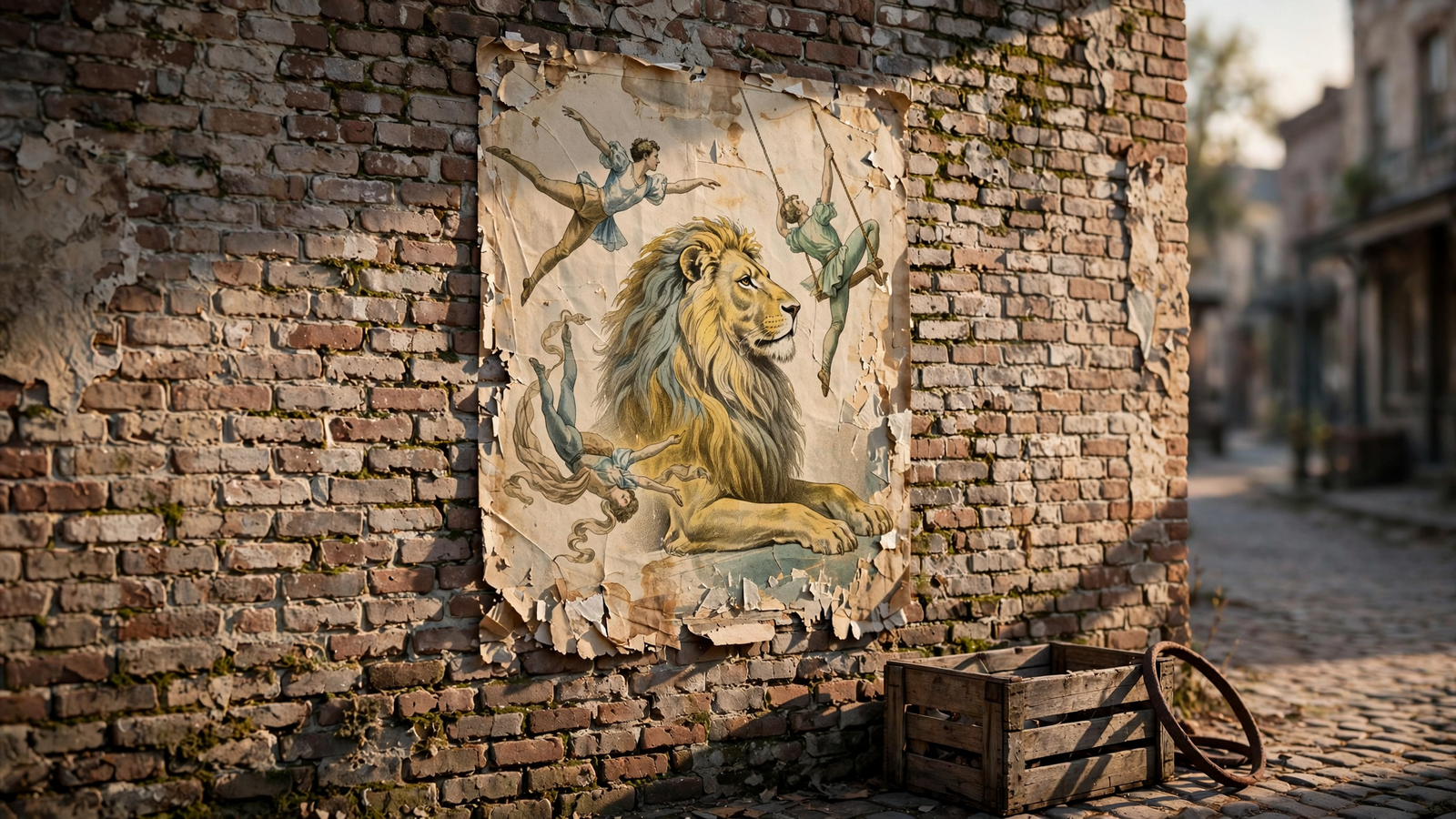
Artists and printers exaggerated what the audience wanted to believe. Animals appeared unusually powerful. Acrobats seemed suspended in a space without gravity. Processions stretched beyond the frame. The exaggeration was part of the contract: the poster promised wonder, and the circus was expected to deliver a living version of the image.
Color was central to that promise. Rich reds, yellows, blues, and greens helped the sheets remain visible outdoors and gave them a theatrical intensity. The result was a distinctly American form of public art—made for commerce, designed for speed, and encountered by people who might never visit a museum.
From Town Wall to National Memory
Circus posters also helped create a shared visual vocabulary for American entertainment. Barnum & Bailey, the Ringling Bros. shows, and other touring companies developed recognizable styles that could be understood across regional and cultural boundaries. The posters suggested that the circus belonged everywhere: to a rural crossroads, a growing industrial city, or a temporary lot at the edge of town.
Their influence lasted after the performances ended. Many sheets were saved by collectors, museums, and circus organizations, preserving evidence of how Americans imagined spectacle before film, television, and digital advertising transformed promotion. Today, the posters are valued not only for their craftsmanship but also for the social history they contain: ideas about celebrity, travel, animals, technology, danger, and the limits of believable entertainment.
Seen together, they tell a story about a country learning to advertise itself through images. The circus poster made distance feel close and fantasy feel scheduled. It turned a blank wall into an invitation—and helped establish the vivid, outsized visual language that would shape American popular culture long after the tents had moved on.