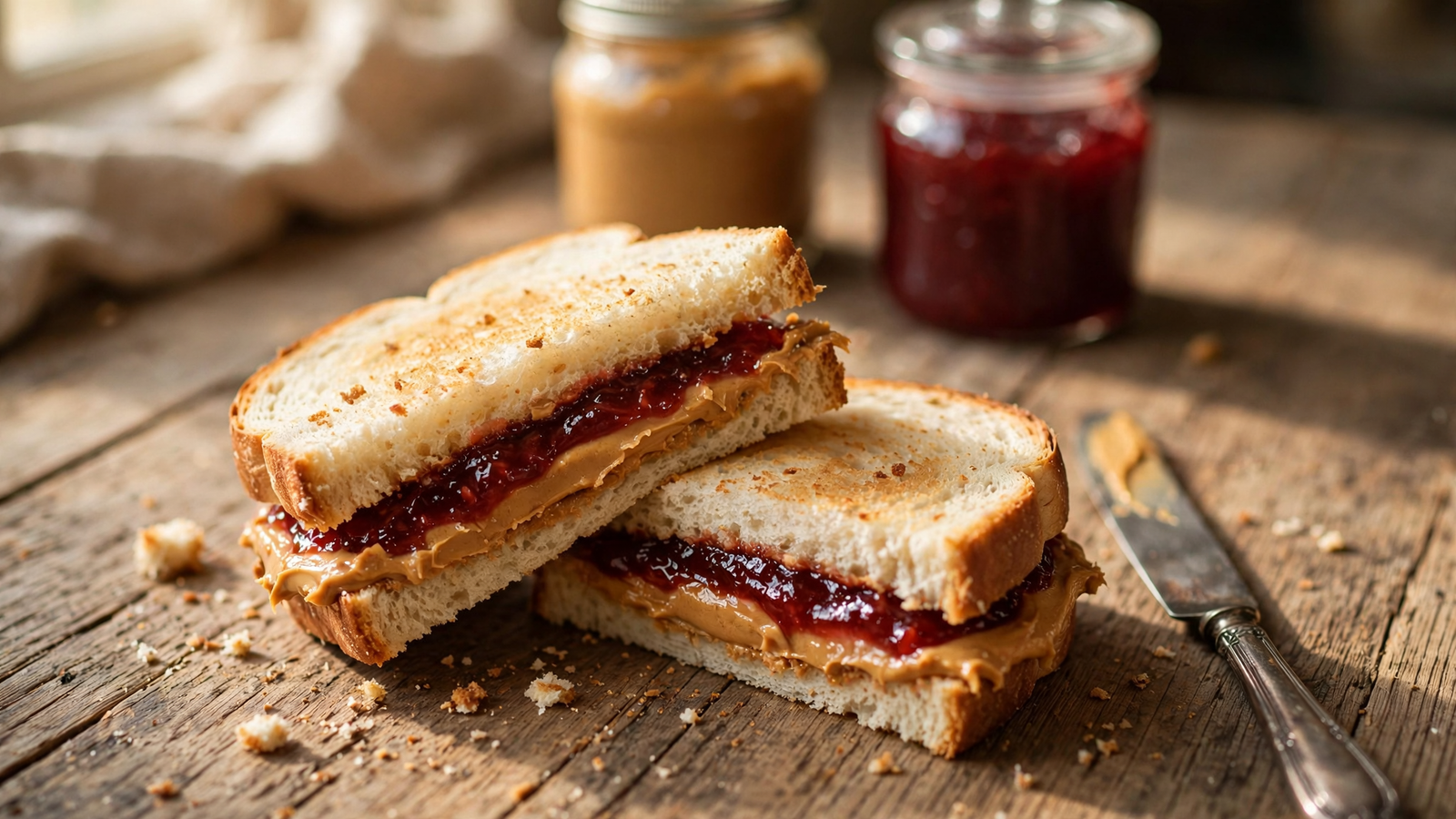
Few American meals are as modest, recognizable, and adaptable as the peanut butter and jelly sandwich. It needs no stove, no special equipment, and no particular culinary confidence. A child can assemble one. An adult can make it absent-mindedly. Its ingredients can be inexpensive, shelf-stable, homemade, branded, smooth, chunky, seeded, or entirely improvised.
That simplicity is part of the sandwich’s achievement. Peanut butter and jelly did not begin as a single invention, and no one person can reasonably be credited with creating the finished American classic. The sandwich emerged gradually, as several older food traditions met the technologies and habits of modern mass food production.
Its history is also a small story about American abundance. Peanuts became easier to process, fruit preserves became widely available, sliced bread entered ordinary kitchens, and packaged foods made a dependable lunch possible almost anywhere. The result was not haute cuisine. It was something more durable: a meal designed for busy households, schoolchildren, workers, soldiers, travelers, and anyone who needed food to wait patiently until it was time to eat.
Before the sandwich, there were two separate foods
Peanuts had long been important crops in parts of Africa, Asia, and the Americas before becoming a major commercial food in the United States. In the American South, peanuts were grown, eaten, and eventually incorporated into regional cooking. They were boiled, roasted, ground, and used in both sweet and savory preparations.
Peanut butter, however, required more than the existence of peanuts. It depended on machinery capable of grinding the nuts into a smooth, spreadable paste and on a market willing to treat that paste as a packaged food. In the late nineteenth century, inventors and food manufacturers developed methods for producing peanut products at commercial scale. Marcellus Gilmore Edson received a Canadian patent in 1884 for a peanut paste, while American entrepreneurs and manufacturers continued refining grinding and processing methods in the following decades.
Peanut butter gained public exposure at the 1893 World’s Columbian Exposition in Chicago, where visitors encountered peanut-based products among the new foods and technologies displayed there. The product was initially more expensive and unfamiliar than the jar on a modern grocery shelf. It appeared in health-food settings, served in upscale restaurants, and was sometimes treated as a novelty rather than an everyday staple.
Jelly had a much older lineage. Fruit preserves, jams, jellies, and marmalades were practical ways to extend the life of seasonal produce. Sugar, cooking, and sealed containers transformed fragile fruit into something that could be stored and spread later. American households made preserves at home, but commercial canning gradually made them easier to buy year-round.
These foods were already useful individually. Their partnership became more likely when the modern American pantry began to fill with manufactured staples that were cheap, portable, and ready to eat.
The early printed sandwich
One of the earliest known printed references to a peanut butter and jelly combination appeared in the Boston Cooking-School Magazine in 1901. Food writer Julia Davis Chandler recommended combining peanut butter with jelly in a sandwich. The appearance of the pairing in a cooking publication matters because it shows that the idea existed in print before the sandwich became a universal childhood memory.
It did not become instantly popular everywhere. Early peanut butter was often sold as a fresh product, and its texture and flavor could vary. Commercial peanut butter had to become more consistent, more affordable, and more familiar. Food companies advertised it as nutritious and convenient, while grocers made it easier for shoppers to encounter in ordinary markets.
The sandwich also needed a suitable carrier. Bread had of course been part of American life for centuries, but factory baking and commercial slicing changed its role. Sliced bread reduced the work of preparing lunch and made a spread-based sandwich especially easy to assemble. By the 1930s, packaged sliced bread was increasingly common in American households, helping turn sandwiches into a routine rather than an occasional preparation.
Peanut butter and jelly were therefore not simply matched because their flavors worked. They were matched because their physical properties worked. Peanut butter was rich, dense, and savory-sweet. Jelly supplied moisture, sugar, and fruit acidity. Bread held both together. Each component corrected a weakness in the others.
Why the combination endured
The sandwich’s appeal is partly sensory. Peanut butter brings roasted depth and fat; jelly brings brightness and sweetness. The soft bread provides a neutral middle ground. Different proportions create noticeably different experiences: a thin layer of jelly makes the sandwich more restrained, while a generous spoonful turns it into a sticky dessert-like lunch.
Its practical advantages are even more important. A properly made peanut butter and jelly sandwich can be prepared quickly, carried without utensils, and eaten cold. Peanut butter does not require refrigeration before opening, and sealed jelly can remain in a pantry. That made the pairing particularly useful in homes where lunch had to be packed in advance.
The sandwich also belongs to a broader American tradition of combining ingredients that are already available. It reflects the logic of the pantry: use the bread on the counter, the spread in the cupboard, and the preserve made during the previous season. Its familiar form can be recreated with homemade jam, bakery bread, or supermarket basics, which helps explain why it has never been tied to one region or one social class.
From lunchbox to military ration
Peanut butter and jelly became strongly associated with children’s lunches during the twentieth century, but schools were only one part of the story. The sandwich’s portability and calorie density also made it useful for institutional feeding, camping, travel, and military life.
During the Second World War, peanut butter and jelly were among the foods used in American military and civilian food systems because they were inexpensive, familiar, and relatively easy to store. Peanut products supplied protein and energy, while fruit preserves added sweetness and variety. The wartime movement of people and food helped reinforce the pairing as a practical American meal.
That history should not be simplified into the claim that the military invented the sandwich. The combination was already known in print decades earlier. Wartime food systems helped normalize and distribute convenient packaged foods, but the sandwich’s popularity came from several overlapping forces: industrial production, advertising, sliced bread, household time pressure, and the ordinary pleasure of the flavor.
A recipe with almost no fixed recipe
Unlike dishes defined by an official formula, the peanut butter and jelly sandwich survives through variation. White bread is traditional for many Americans, but whole wheat, sourdough, rye, tortillas, crackers, and waffles can perform the same basic job. Grape jelly may be the best-known partner, yet strawberry jam, raspberry preserves, apricot spread, apple butter, honey, and sliced bananas all belong to the sandwich’s extended family.
The choice of peanut butter changes the experience, too. Smooth peanut butter creates an even, creamy filling. Chunky peanut butter adds contrast and makes the sandwich feel more substantial. Natural peanut butter can separate in the jar and may require stirring, while stabilized commercial versions are designed to remain uniform.
There are small techniques that reveal how much food knowledge can hide inside a simple lunch. Spreading peanut butter on both slices of bread creates a barrier that can slow jelly from soaking through. Letting toast cool before adding the filling preserves the distinction between crisp bread and soft spread. A pinch of salt, a little cinnamon, or a few thin banana slices can shift the sandwich without making it unrecognizable.
These choices are not culinary rules. They are evidence of the sandwich’s flexibility. It can be assembled according to household habit, dietary need, budget, or mood.
The limits of a universal classic
The peanut butter and jelly sandwich is often described as universally beloved, but no food is literally universal. Peanut allergies can make peanut butter dangerous, and some schools and workplaces restrict it to protect people at risk. Families also adapt the basic idea with sunflower-seed butter, soy nut butter, tahini, or other spreads.
Those substitutions do not erase the sandwich’s identity. They show how the underlying idea travels: a protein-rich spread, a sweet or tart fruit component, and bread or another soft foundation. The form is more important than any single brand or ingredient.
That adaptability helps explain why the sandwich remains culturally powerful. It can be a child’s first self-prepared meal, a worker’s inexpensive lunch, a road-trip provision, or a nostalgic taste of home. It crosses generations without requiring everyone to make it the same way.
The American achievement of making do
The peanut butter and jelly sandwich is not a monument to culinary complexity. Its importance lies elsewhere. It shows how an everyday food can emerge when agriculture, machinery, packaging, retail, and household routines align.
Peanuts became a processed spread. Fruit became a shelf-stable preserve. Bread became pre-sliced and widely distributed. Families gained a meal that could be made in minutes and carried for hours. None of those changes alone created the classic. Together, they made it ordinary.
That may be the sandwich’s most American quality: it turns convenience into tradition. A jar, a loaf, and a spoonful of fruit can become a lunch remembered decades later. The recipe is simple enough to disappear into daily life, yet sturdy enough to survive changing tastes, new diets, and countless variations.
In the end, peanut butter and jelly endure not because they are extravagant, but because they solve several problems at once. They are filling, portable, inexpensive, familiar, and easy to personalize. A food with that many practical virtues does not need a grand origin story. It only needs to keep showing up—one lunchbox, kitchen counter, and hurried afternoon at a time.