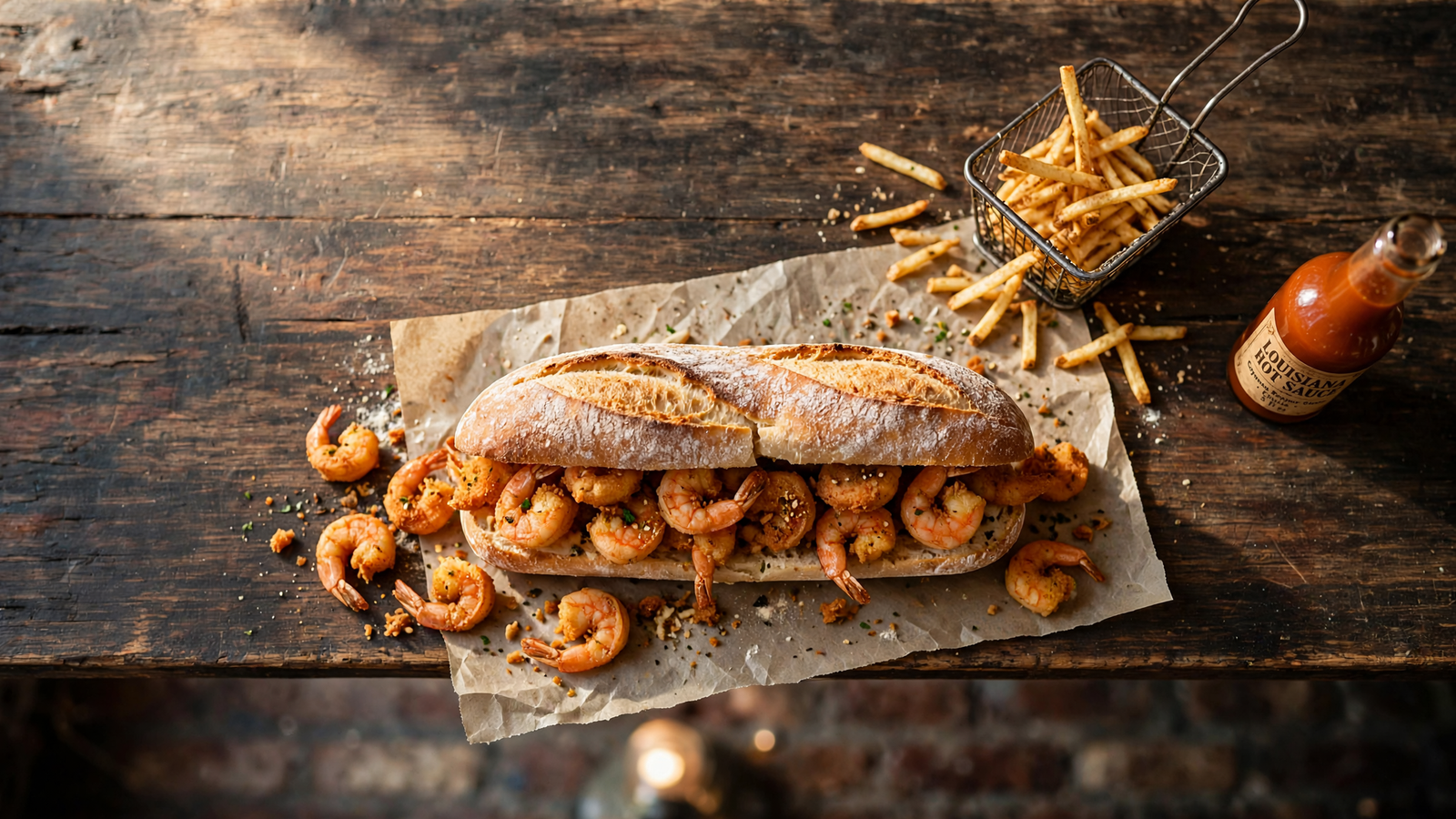
In New Orleans, a sandwich can be a meal, a memory, a political history, and a neighborhood argument all at once.
The po’ boy carries all of those meanings between two pieces of bread. It may arrive filled with fried shrimp, oysters, roast beef, hot sausage, or whatever a particular shop has made its own. It may be dressed with lettuce, tomato, pickles, and mayonnaise—or served nearly bare, depending on the filling and the person ordering it. There is no single po’ boy, but there is a recognizable idea: generous food, built for ordinary people, served without unnecessary ceremony.
That idea is usually traced to a difficult moment in New Orleans history. In 1929, streetcar operators went on strike after a dispute with the New Orleans Public Service company. Bennie and Clovis Martin, brothers who had once worked as streetcar conductors, supported the strikers by giving them free sandwiches at their restaurant and coffee stand on St. Claude Avenue.
The Martins reportedly referred to the unemployed or striking workers as “poor boys.” In the local accent, the phrase became “po’ boy.” The story has been repeated for generations, and Louisiana food historians generally identify the Martins’ support for the streetcar workers as the sandwich’s most widely accepted origin. But the history is not perfectly tidy. Sandwiches made with local French bread and inexpensive fillings existed before the Martins’ restaurant, and the exact moment when “poor boy” became the name of a particular sandwich remains difficult to document.
A sandwich shaped by a city’s working life
The po’ boy makes sense in New Orleans because the city has always been a place where food traditions meet: French baking, West African cooking knowledge, Caribbean flavors, Gulf seafood, Italian grocery culture, and the practical habits of dockworkers, porters, cooks, and streetcar operators.
Its most important ingredient is often the bread. A classic New Orleans po’ boy depends on a long loaf with a crisp, delicate crust and a light interior. The bread must be sturdy enough to hold gravy, fried seafood, or a pile of sliced meat, but not so dense that it overwhelms the filling. Local bakers developed their own version of the French-style loaf, and that bread became central to the sandwich’s identity.
That matters because a po’ boy is not simply a filling placed inside any available roll. The bread changes the experience. A roast beef po’ boy may require enough interior softness to absorb gravy. A fried shrimp po’ boy needs a crust that can withstand moisture while keeping some crunch. The loaf is the frame that lets very different foods belong to the same family.
The sandwich’s working-class roots also help explain its flexibility. A restaurant could use what it had: leftover roast beef, bits of sausage, fried seafood, ham, cheese, or vegetables. The po’ boy did not begin as a carefully standardized dish. It was a format that welcomed abundance and improvisation.
From “poor boys” to “dressed”
One of the most useful words in a New Orleans sandwich shop is “dressed.” In po’ boy language, ordering a sandwich dressed generally means adding shredded lettuce, tomato, pickles, and mayonnaise. The combination brings coolness and acidity to fried seafood, while giving a roast beef sandwich a different balance of textures.
But “dressed” is not a universal command. Shops have their own customs, and diners often have strong preferences. Some people want extra pickles. Others want no mayonnaise, no tomato, or nothing that might compete with the filling. The vocabulary may be shared, but the final sandwich remains personal.
The most famous varieties are closely tied to Louisiana’s landscape. Fried shrimp and oysters connect the sandwich to the Gulf and the region’s seafood economy. Roast beef po’ boys turn a long loaf into something closer to a full Sunday-style meal, especially when the meat is served with gravy and the bread becomes soft at the edges. Sausage, ham, and hot fillings reflect the city’s broader culinary history.
There is also a useful distinction between a po’ boy’s ingredients and its mythology. The sandwich is often presented as a pure expression of New Orleans, but New Orleans food has never been culturally isolated. Its traditions were built by people from different backgrounds, including Black cooks and food workers whose contributions were often under-credited in older versions of culinary history. The po’ boy belongs to a city shaped by exchange, not by one inventor working alone.
The name tells a labor story
The 1929 streetcar strike gives the sandwich more than a colorful origin anecdote. It places the food within the history of organized labor and urban life.
Streetcars were essential to how people moved through New Orleans. When operators stopped working, the dispute affected the city’s daily rhythm, not merely the company’s balance sheet. The Martins’ decision to feed striking workers connected a restaurant to a wider community of people facing lost wages and uncertainty. Their sandwiches became associated with solidarity before they became a tourist symbol.
That does not mean every later po’ boy carried an explicit political message. Over time, the sandwich moved from strike relief to lunch counters, neighborhood restaurants, seafood shacks, festivals, and family kitchens. Yet the original story helps explain why the po’ boy feels different from a generic deli sandwich. Its cultural reputation includes the idea that a satisfying meal should be available to people who work hard, travel far, or do not have much to spend.
Food histories often become simplified as they are retold. The Martins’ story is memorable, so it can overshadow earlier local sandwich traditions and the many cooks who shaped what people actually ate. The fairest way to understand the origin is not to treat the Martins as the sole creators of an entirely new food, but to see them as important figures in the naming, popularization, and public memory of a sandwich already emerging from New Orleans’ food culture.
Why the po’ boy traveled so well
A dish becomes durable when it can change without losing its recognizable form. The po’ boy has that quality.
At its center is a simple arrangement: a long loaf, a substantial filling, and enough seasoning or dressing to make the whole thing coherent. That structure can accommodate seafood, meat, sausage, vegetables, and regional tastes. It works at a neighborhood counter and at a family gathering. It can be inexpensive, celebratory, messy, or all three at once.
The sandwich also rewards local interpretation. A Gulf Coast restaurant may emphasize shrimp or oysters. A shop farther inland may feature roast beef or sausage. Outside Louisiana, cooks may use whatever seafood or meat is available while borrowing the language and format of the original. These versions are not identical to a New Orleans po’ boy, but they show why the form endured: it is specific enough to have an identity and open enough to invite adaptation.
That adaptability has helped the po’ boy remain visible as American eating habits changed. It survived the rise of fast food, the spread of national sandwich chains, and the transformation of many urban neighborhoods. Its best versions still depend on local bread, local knowledge, and the judgment of the person behind the counter.
Building the idea at home
A home cook does not need to reproduce a restaurant’s exact recipe to understand the sandwich. Start with a fresh, airy French-style loaf rather than a dense sub roll. Choose one main filling and make it generous. Fried shrimp, roast beef, sliced sausage, or crisp vegetables can all work, provided the textures are balanced.
For a fried seafood version, a light coating and a hot cooking oil help preserve the contrast between crisp exterior and tender interior. For roast beef, the bread should be able to absorb some gravy without collapsing immediately. Lettuce, tomato, pickles, and mayonnaise can be added according to taste, but the sandwich should remain easy to hold and eat.
The goal is not perfection or theatrical excess. A good po’ boy should feel assembled for a hungry person, not designed for a photograph. It should be generous without becoming impossible, seasoned without hiding the main ingredient, and sturdy enough to survive the journey from counter to table.
A living piece of Americana
The po’ boy is now one of the most recognizable foods associated with New Orleans, but its appeal is larger than regional branding. It tells a distinctly American story about how ordinary foods acquire meaning.
A loaf and a filling became a record of labor, migration, local baking, Gulf commerce, and neighborhood taste. A phrase used for struggling workers became the name of a dish ordered by visitors from around the world. The sandwich changed as the city changed, yet it kept its basic promise: something substantial, informal, and shared.
That may be why the po’ boy has remained more than a culinary souvenir. It is a small edible map of New Orleans—French in its bread, Gulf-connected in its seafood, shaped by Black and immigrant foodways, and rooted in the working life of a port city. Every version carries some of that history, even when the order is simply a roast beef sandwich with extra pickles.