On the morning of June 6, 1944, the Allied invasion of Normandy depended on an unlikely piece of equipment: a shallow-draft wooden boat designed in New Orleans for the swamps and marshes of Louisiana.
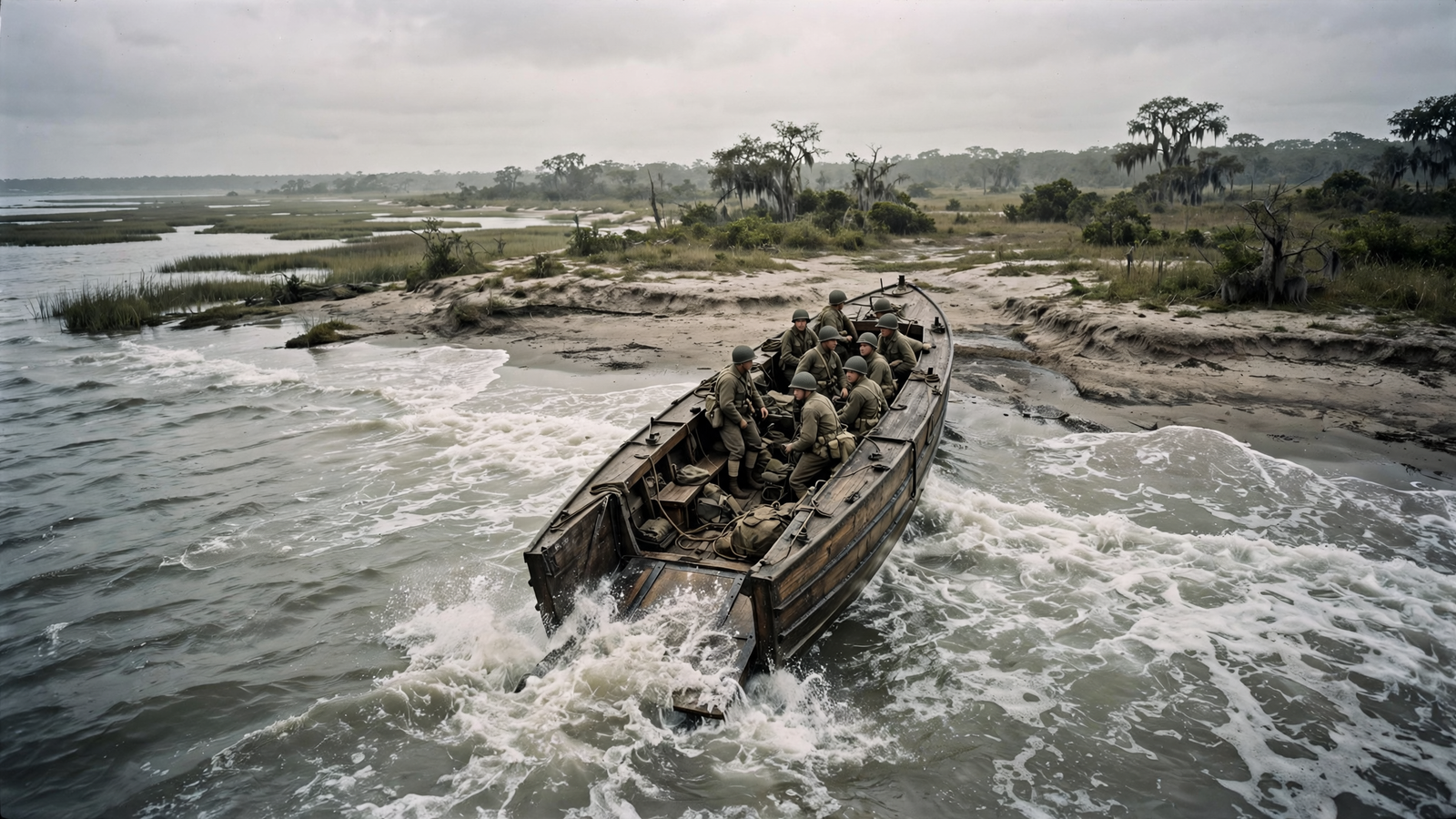
It was called the Landing Craft, Vehicle, Personnel, or LCVP. Many soldiers knew it simply as the Higgins boat. With a flat bottom, a front ramp, and enough room for troops, equipment, or a small vehicle, it could carry men directly onto a beach and then pull away through the surf. The design was not glamorous. It was practical, adaptable, and built in enormous numbers.
That combination changed the possibilities of amphibious warfare. The Higgins boat helped Allied forces land in North Africa, Sicily, Italy, Normandy, and across the Pacific. It also turned Andrew Jackson Higgins, a self-taught boat builder from Nebraska who made his industrial home in Louisiana, into one of the most consequential manufacturers of the Second World War.
A boat designed for difficult water
Before the war, Higgins was best known for building boats that could move through the shallow, vegetation-choked waters of the Mississippi Delta and the Louisiana bayous. Conventional boats often became trapped in mud or damaged by submerged obstacles. Higgins experimented with hull shapes, propellers, and construction methods that allowed his boats to operate in water too shallow for many standard craft.
His most important early design was the Eureka boat, also known as the Higgins boat. It had a rounded front and a propeller protected by a tunnel-like hull arrangement. The boat could slide over mud and sand, reverse away from a shoreline, and operate close to land. These qualities attracted the attention of the United States military during the interwar years, when planners were increasingly concerned with how troops might attack defended coastlines.
The central challenge was simple to describe and difficult to solve: how could an army move large numbers of soldiers and vehicles from ships at sea onto an enemy-held beach?
A craft that could carry troops but not approach the shore was not enough. A boat that could reach the beach but had no efficient way to unload was not enough either. The military needed a vessel that combined shallow-water performance, cargo capacity, speed, and a rapid method of getting men ashore.
From experiment to standard equipment
During the 1930s, the United States military tested several types of landing craft. Higgins’s designs gradually proved their value because they could run directly onto a beach and use a bow ramp to unload. The ramp reduced the time soldiers spent climbing over the sides of a boat or wading through deep water under fire.
That feature became the foundation of the LCVP. The standardized craft was roughly 36 feet long and could carry a platoon-sized group of soldiers, a small vehicle, or a comparable load of supplies. Its wooden construction kept it relatively light, while its shallow draft allowed it to approach beaches that were inaccessible to larger ships.
The boat was not invulnerable. Its sides offered little protection from artillery, machine guns, mines, rough seas, or underwater obstacles. Its ramp could jam. Its engines and steering gear could fail. Landing craft crews had to navigate crowded waters, shifting tides, smoke, surf, and confusion. The Higgins boat did not make an amphibious assault safe. It made one possible at a scale that earlier landing craft could not easily support.
Higgins Industries expanded rapidly as the war approached. Factories in and around New Orleans employed thousands of workers, including women and African American laborers who entered industrial jobs as wartime production transformed the city. The company also operated facilities beyond Louisiana, helping produce landing craft in multiple locations.
By the middle of the war, Higgins Industries had built thousands of boats. The LCVP was only one member of a much larger family of landing craft, but its basic arrangement became instantly recognizable: a low hull, a front ramp, and the capacity to move people and equipment from ship to shore in repeated waves.
The boat behind the invasion
The best-known use of the Higgins boat came at Normandy. Operation Overlord required the Allies to land a huge force across several beaches while maintaining a steady flow of ammunition, fuel, vehicles, engineers, medics, and reinforcements.
The LCVP was part of the logistical system that made that operation possible. It carried assault troops from larger transports toward the beaches, delivered vehicles and supplies, and returned to sea for another load when conditions allowed. Other landing craft carried tanks, artillery, fuel, or heavier equipment, but the Higgins boat provided the basic connection between offshore shipping and the beach.
On D-Day, the boats confronted strong currents, obstacles placed in the water, damaged ramps, mines, and enemy fire. Some landed far from their assigned positions. Others swamped or struck obstacles. Crews and soldiers faced an exposed journey in which the boat’s greatest advantage—its ramp—also made the craft vulnerable when open.
Even with those dangers, the system worked. Men and equipment reached the Normandy shore in successive waves, allowing the invasion to grow from a series of precarious beach landings into a sustained military operation. Once the Allies secured the beaches, the same landing-craft network helped maintain the supply line that carried the invasion inland.
The boat’s importance was not limited to Europe. In the Pacific, where Allied forces repeatedly assaulted islands separated by wide stretches of ocean, landing craft were essential. Higgins boats carried Marines and soldiers toward beaches, coral reefs, river mouths, and improvised landing areas. Their shallow draft was particularly useful in environments where reefs and sandbars made direct approaches by larger vessels difficult.
Industrial scale mattered as much as design
The story of the Higgins boat is sometimes told as a story of invention alone. In reality, its wartime significance came from the meeting of design and production.
An excellent landing craft would have mattered little if only a few existed. Amphibious warfare demanded hundreds or thousands of boats, trained crews, repair facilities, transport ships, fuel, spare parts, and a command structure capable of coordinating them. Higgins Industries helped demonstrate that landing craft could be built in large quantities, while the Navy and Army developed the doctrine and organizations needed to use them.
Mass production also required standardization. Boats had to be similar enough that crews could be trained efficiently and damaged craft could be repaired with familiar parts. Workers had to learn specialized tasks quickly. Shipyards had to maintain output despite shortages of materials and the constant pressure of wartime deadlines.
That industrial effort reflected a broader American wartime pattern. The United States did not win amphibious operations through one machine or one factory. It combined engineering, manufacturing, logistics, training, intelligence, naval power, air support, and the endurance of the people who operated the equipment.
A complicated legacy
Andrew Higgins died in 1952, only a few years after the war. His name remained closely associated with the landing craft that carried Allied forces into hostile shores. The boats themselves also became part of the visual language of the Second World War: lines of identical craft moving through rough water, ramps dropping, and soldiers stepping into the surf.
Yet the Higgins boat deserves to be remembered as more than a symbol of D-Day. It represented a change in how military planners imagined the coastline. Beaches were no longer merely barriers that ships had to avoid. With specialized craft, careful planning, and overwhelming logistical support, they could become points of entry.
The design also showed how civilian experience could influence military technology. Higgins did not begin by trying to create a famous invasion boat. He was solving local transportation problems in shallow southern waters. The qualities that made his boats useful in the bayous—maneuverability, shallow draft, and the ability to reach difficult shorelines—later answered a global military need.
There is a lesson in that path from regional boatyard to world war. Important technologies do not always emerge from the places that appear most strategically important. Sometimes they begin with a practical problem, a stubborn builder, and a design that works a little better in conditions others have overlooked.
The Higgins boat did not win the war by itself. No boat could. But it gave Allied armies a reliable way to cross the final distance between ship and shore. In doing so, a humble craft from New Orleans became one of the defining tools of modern amphibious warfare.