On April 28, 1947, a raft made from balsa logs left the Peruvian port of Callao and headed west into the Pacific. Its six-person crew had no modern engine to fall back on. Their vessel, named Kon-Tiki, would travel thousands of miles before reaching the Tuamotu Islands more than three months later.
The expedition’s leader, Norwegian explorer Thor Heyerdahl, hoped the crossing would test a bold idea: that people from South America might have reached Polynesia on rafts like this one. The voyage became a celebrated feat of exploration. But its most lasting lesson was more precise than Heyerdahl’s original theory. Kon-Tiki demonstrated that a balsa raft could make the journey; it did not establish who settled the Pacific islands.
A question that became an expedition
Heyerdahl had spent time in the Marquesas Islands before the Second World War. There, he became interested in the origins of Polynesian peoples and in traditions that he interpreted as pointing toward the east. He argued that ancient South Americans might have crossed the ocean and helped settle Polynesia.
That proposal ran against the prevailing account of Polynesian settlement, which traced the ancestors of Polynesian peoples westward across the Pacific from Asia. Heyerdahl’s critics also questioned whether a raft could travel reliably across such a vast stretch of open water. He decided that a practical trial could answer at least part of the dispute.
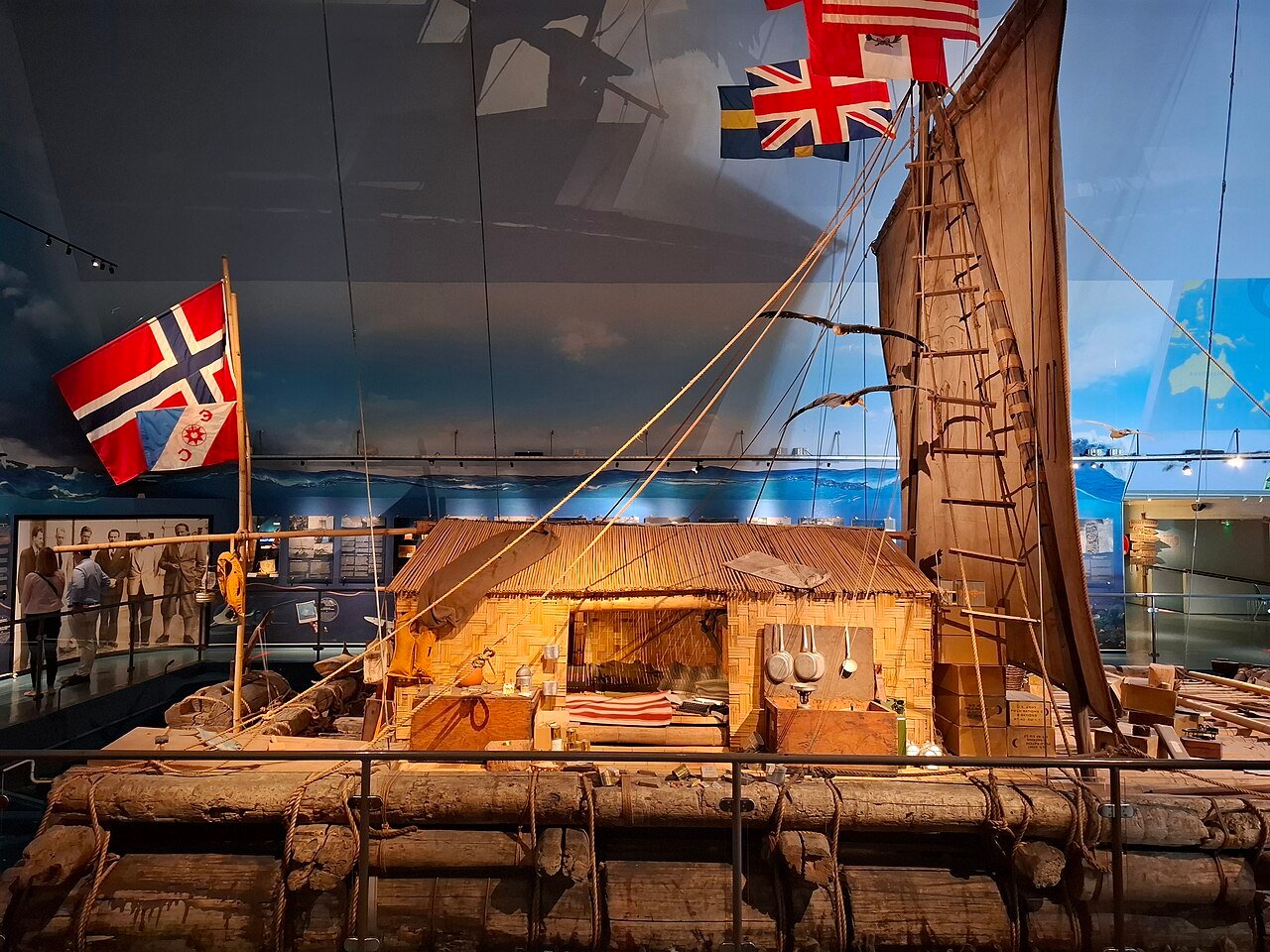
For the raft, he chose balsa logs and construction methods he believed resembled those available to pre-Columbian South Americans. The vessel carried a sail, a small cabin and essential supplies. It also carried a radio and other equipment for communicating and recording the journey. This was a demanding ocean voyage, not an attempt to reproduce every aspect of ancient life.
Three months at sea
Kon-Tiki moved west with the currents and trade winds. The crew had to manage the sail, keep the raft on course and live in close quarters while the ocean set the daily conditions. Their progress was not a straight line across a map: winds and currents shaped where the raft went and how quickly.
After 101 days at sea, Kon-Tiki reached the Tuamotu archipelago. On August 7, 1947, the raft struck a reef at Raroia and the crew made it to land. The expedition had covered roughly 4,300 miles. The Kon-Tiki Museum in Oslo preserves the raft and records of the voyage, while Heyerdahl’s book and a documentary helped bring the expedition to a wide audience.
The crossing answered a real question about possibility. A raft built with materials and techniques available in South America could be carried west across the Pacific by prevailing conditions. That mattered to debates about ancient travel. It was not, however, the same as proving that South Americans made the first settlement of Polynesia—or that they were the source of Polynesian culture.
What a voyage can—and cannot—prove
A successful crossing shows that a route can be traveled under some conditions. By itself, it cannot tell us that a particular people took that route in the distant past. Evidence of settlement has to come from many sources, including archaeology, language, history and genetics.
Research since Heyerdahl’s expedition has reinforced the account of Polynesian settlement as a remarkable eastward expansion by seafarers whose ancestors came from the west. Polynesian navigators were not simply passengers carried by the wind: their knowledge of stars, ocean swells, birds and other signs supported purposeful voyaging across immense distances. A raft’s ability to drift west does not explain that achievement away.
At the same time, the history is not a simple story of sealed-off worlds. A 2020 study in Nature, analyzing genetic data, reported evidence of contact between Indigenous people of the Americas and Polynesian populations before Europeans arrived. The researchers placed that contact around 1200, while emphasizing that the findings do not vindicate Heyerdahl’s broad claim that South Americans originated Polynesian settlement. Contact, migration and the founding of island populations are distinct questions.
That distinction makes Kon-Tiki more interesting, not less. The expedition is a vivid example of how exploration can turn an argument into a test—but also of why one dramatic experiment cannot settle a complex history. Heyerdahl’s raft provided evidence about what a vessel could do. It could not substitute for the many kinds of evidence needed to explain the peopling of an ocean.
The legacy of the raft
Kon-Tiki captured public attention because its question was easy to picture: could a raft cross the Pacific? The answer was yes. The deeper question—who first settled Polynesia, and how—required a broader body of evidence and greater attention to Polynesian knowledge and agency.
Heyerdahl’s voyage remains a milestone in the public history of exploration: a carefully planned, hazardous journey that tested one part of a larger hypothesis. Its enduring value lies not in treating the crossing as proof of everything its leader believed, but in seeing clearly what the expedition did establish—and where the evidence must continue to lead.