Before the internet, before television became the country’s shared living room, a public event often began with a sheet of paper pasted to a wall.
It might announce a museum exhibition, a puppet performance, a lecture, a concert, a public-health campaign, or a class at a neighborhood art center. Its life could be brief. A passerby would see it on the way to work, absorb its colors and commanding type, and continue down the street. Then another notice would cover it.
During the Great Depression, thousands of these temporary messages were made by artists employed through the New Deal. The posters were practical objects, but they were also experiments in modern graphic design. With flat colors, emphatic lettering, simplified figures, and a confidence that a government notice could be visually exciting, they helped bring art into the ordinary routines of American life.
Today, the surviving works are among the clearest reminders that the New Deal was not only a program of dams, roads, and public buildings. It was also an ambitious effort to support cultural life—and to treat artists as workers whose skills could serve the public.
A jobs program with a visual language
The Work Projects Administration, originally called the Works Progress Administration, was created in 1935 under President Franklin D. Roosevelt. Its purpose was to provide employment during the economic crisis, and its projects reached into construction, education, theater, music, writing, historical research, and the visual arts.
The Federal Art Project was the visual-art branch of that larger effort. It supported murals, easel paintings, community art centers, art education, exhibitions, and the Index of American Design, which documented American decorative arts and craft traditions. It also supported poster production.
That arrangement mattered. Artists were not simply asked to volunteer their creativity for a public cause. They were hired and paid through a federal employment program. Their work was considered useful labor: a way to inform citizens, promote public programs, and make cultural opportunities visible.
The Library of Congress preserves a substantial body of this material in its Work Projects Administration Poster Collection. The collection contains roughly 900 posters dating primarily from the late 1930s and early 1940s. They were produced for a wide range of organizations and activities, including museums, libraries, schools, theaters, government agencies, and community programs.
Why the posters looked so modern
The posters were designed to work at a distance. They needed to catch the eye of someone walking past, often in a busy street or public building. That encouraged strong silhouettes, limited color schemes, large areas of open space, and lettering that could be read quickly.
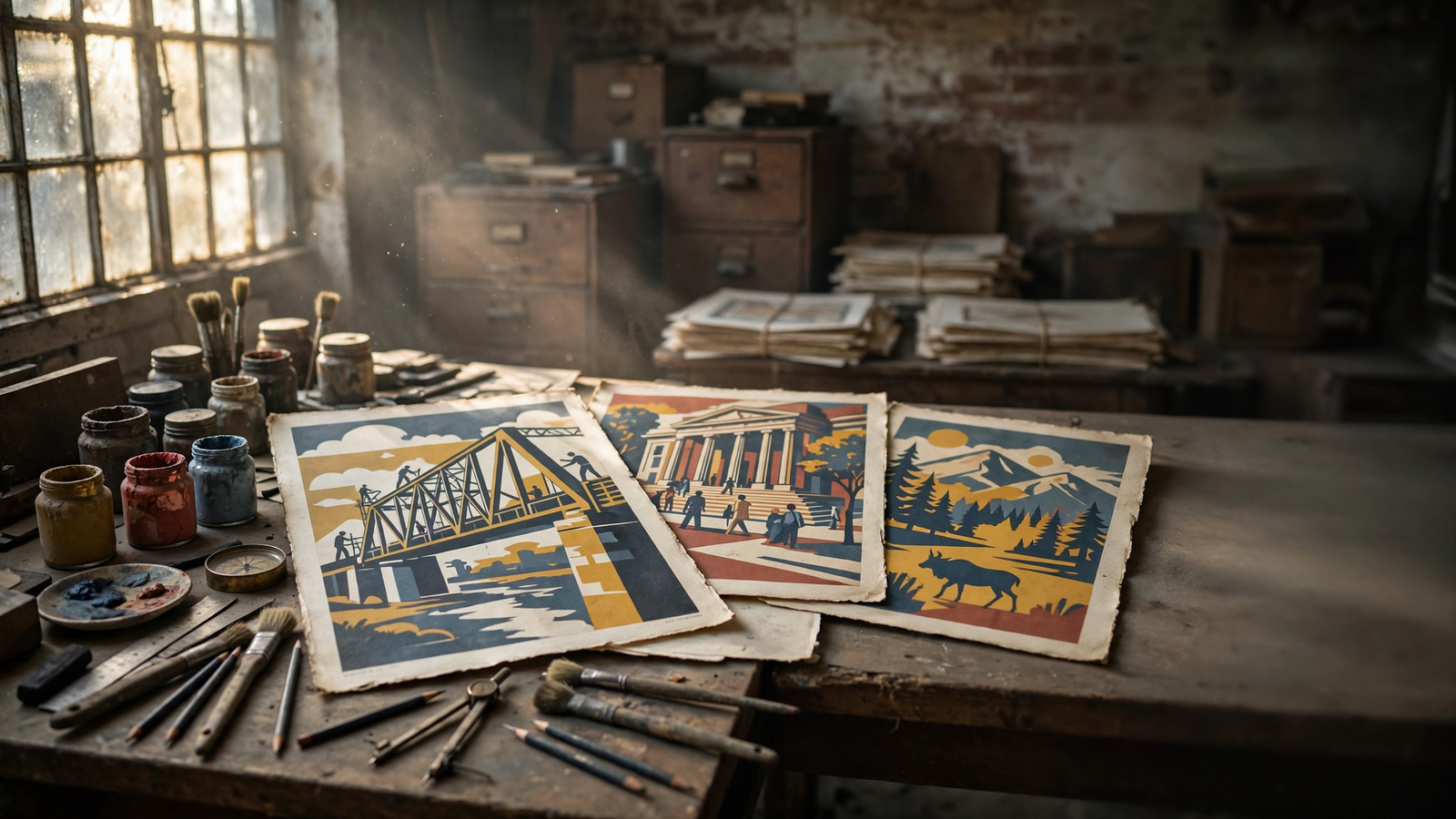
Many were produced through silkscreen, a printing method that allowed artists to create vivid, relatively inexpensive editions. Instead of relying on the fine gradations of a painted illustration, silkscreen favored clear shapes and decisive blocks of color. A face might be reduced to a few planes. A dancer could become a sweeping curve. A musical instrument, book, or stage curtain could carry the entire idea.
The process also gave artists unusual control over the relationship between image and text. Words did not have to sit beneath an illustration as an afterthought. They could become part of the image itself—stacked, angled, enlarged, or integrated into a figure’s movement.
That visual economy connected the WPA posters to the broader international development of modern graphic design. Yet the posters were not simply imitations of European modernism. They had local jobs to do. They had to tell Americans where to go, what to see, and why an event might matter.
A notice for almost every kind of public life
One of the most revealing qualities of the collection is its range. The posters do not tell a single story about the Depression. They show a country still trying to create, learn, perform, and gather.
Some promoted exhibitions of paintings or sculpture. Others invited people to concerts, dance performances, lectures, and theatrical productions. Posters encouraged attendance at libraries and museums, advertised classes, and drew attention to educational programs. In an era when many families had little money for entertainment, publicly supported cultural events could provide an accessible way to spend an evening.
That accessibility was part of the New Deal’s cultural ambition. Art was not meant to remain confined to private galleries or elite institutions. A neighborhood could have a community art center. A public building could display a mural. A local audience could attend a performance created through a federal arts project. The poster was often the first point of contact between a resident and that larger network.
There was a democratic idea embedded in the format: the invitation belonged in the street. A person did not need to subscribe to a journal, know a curator, or belong to a cultural club to encounter it. The announcement arrived in public space, alongside advertisements for stores and notices about civic business.
Artists as observers of their own country
The Federal Art Project operated across a nation of distinct regions and communities. Its artists brought different training and interests to the work, and the posters reflect that variety. Some are spare and geometric; others are theatrical, humorous, or crowded with hand-lettered energy.
They also reveal what public institutions believed people should be encouraged to do: read, visit museums, attend performances, learn a skill, protect their health, and take part in community life. Even when a poster was made for a single event, it could carry a broader message about the value of shared cultural spaces.
This is one reason the posters are useful historical documents. They preserve more than an image style. They show the infrastructure of everyday culture: the small theaters, libraries, galleries, schools, lecture programs, and art centers that might otherwise leave little visual trace.
Because posters were designed to be used rather than treasured, survival was never guaranteed. They were pasted outdoors, folded, discarded, painted over, or saved by chance. The examples that remain in museums and archives therefore offer a partial record—a bright but incomplete map of the cultural life the New Deal tried to build.
The temporary object becomes a permanent record
The irony of the WPA poster is that its original purpose was temporary. It was supposed to do a job quickly and then make way for the next announcement. Its success depended on being noticed, not preserved.
Archival care changed that. Collections at the Library of Congress and other institutions allow researchers and the public to study the posters as evidence of design, government employment, local programming, and American attitudes in the years before and during the Second World War.
Digitization has expanded that audience again. A poster once limited to a wall in a particular city can now be examined by anyone with an internet connection. Details that might disappear in a low-resolution reproduction—the texture of the printing, the balance of lettering, the way an artist used a single color to create movement—can be studied alongside thousands of related images.
The digital archive also restores something of the posters’ original public character. They were made to circulate beyond the studio. Their intended audience was not only a specialist, but anyone who might pass by.
A public culture made visible
The WPA poster is easy to underestimate because it is small, familiar, and direct. It does not look like a monumental government project. It does not require a bridge, a theater, or a museum building to make its case. It only needs a wall and a few seconds of attention.
Yet that modest scale is exactly what makes the posters so revealing. They show government support reaching into the visual texture of daily life. They show artists working under practical constraints and finding room for invention. And they show cultural participation being advertised not as a luxury, but as part of a functioning public world.
The best of these posters still perform their old task. They stop the eye. They make a lecture, exhibition, performance, or public program feel immediate. More than eight decades after many of them were printed, they continue to suggest that design can do more than sell a product. It can invite people into a shared life.