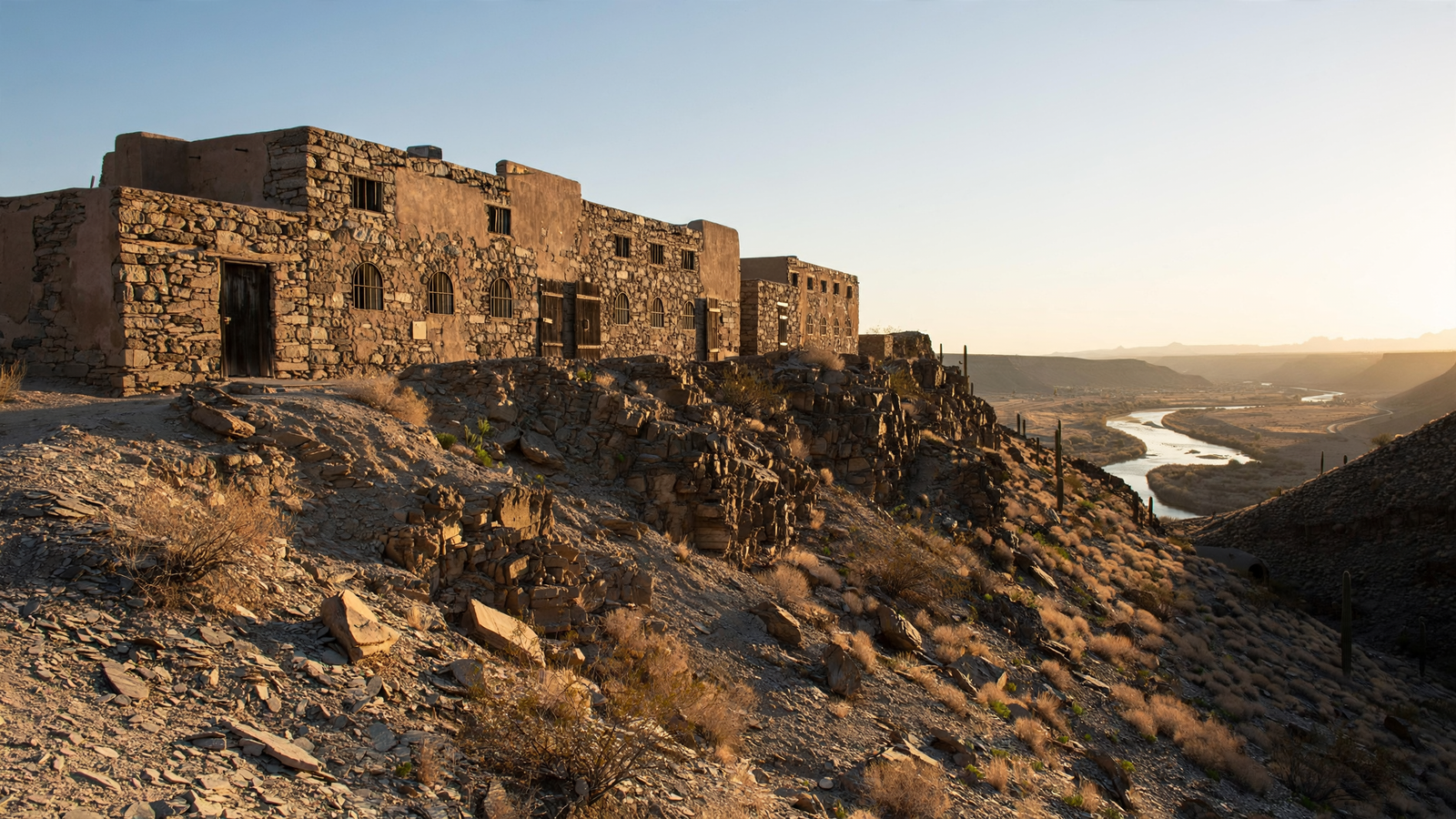
On the eastern edge of Yuma, a low, weathered complex sits above the Colorado River and the modern city below. Its walls, cells, guard tower and graveyard belong to a place that was designed to separate people from society, not welcome visitors. Yet the Yuma Territorial Prison is now one of Arizona’s most recognizable historic sites, a preserved landscape where the territory’s early government, justice system and frontier ambitions can be examined together.
The prison is not a story about a vanished Old West imagined through legend alone. It is a physical record of Arizona’s territorial period: a time when officials were trying to create institutions across a huge, sparsely settled region, while communities along the Colorado River were already shaped by Indigenous history, cross-border movement, commerce and transportation. The remaining buildings make that history unusually tangible. Visitors can stand where incarcerated people lived, where guards worked and where the territory’s government attempted to impose order.
A prison built at the edge of a new territory
Arizona Territory was established in 1863, but its institutions developed slowly. Roads were difficult, distances were enormous and communities were separated by deserts, mountains and rivers. For territorial officials, a permanent prison was part of the basic machinery of government. Courts could sentence people, but the territory also needed a place to hold those sentences.
Yuma was a logical, if severe, location. The settlement occupied an important crossing of the Colorado River and had long been connected to travel between the interior Southwest and California. The river offered transportation and a natural geographic landmark, while the desert surrounding the town made escape difficult. In 1875, territorial officials authorized construction of a prison at Yuma. The first incarcerated people arrived the following year, before the entire institution had reached its later form.
The prison’s setting did much of the work. It was built on a rocky rise overlooking the river, where heat, aridity and distance added to the restrictions created by walls and locks. The site did not need to resemble the massive stone penitentiaries of the East. Its designers relied on the landscape itself, adding adobe structures, stonework, iron bars and a perimeter that could be expanded as the prison population changed.
Construction and maintenance were closely connected to prison labor. Incarcerated people helped build and repair parts of the complex, an arrangement common in nineteenth-century prisons. That fact is important to the site’s interpretation: the prison was not simply a finished monument imposed on the landscape. It was also a working institution whose buildings were shaped by the people confined there and by the territorial government that controlled them.
What the surviving buildings reveal
The prison operated from 1876 until 1909. During those decades, more than 3,000 people passed through its records, according to Arizona State Parks. The population included men and women convicted under territorial law, and the institution contained a mixture of cell blocks, work areas, administrative spaces and service buildings.
Some of the most memorable features are small. The cells were crowded, and the “dark cell,” a space used for punishment, has become one of the site’s most recognizable reminders of the prison’s harsh discipline. The guard tower, known as the Sally Port Tower, helped control movement through the complex. A cemetery on the grounds reflects another part of institutional life: not everyone who entered the prison left it alive.
Those details resist the temptation to turn the prison into a simple adventure story. The site can be visually dramatic, but confinement was not theatrical for the people who experienced it. Heat, illness, hard labor, limited medical care and strict punishment were part of prison life in the nineteenth century. A responsible visit requires holding that reality alongside the architecture.
The prison’s records also offer a view of how territorial justice worked before Arizona became a state in 1912. The institution was not separate from the territory’s larger legal system. It depended on courts, sheriffs, transportation networks and political decisions made far beyond Yuma. Its history therefore reaches past the walls: it is also a history of how government authority expanded across Arizona.
Yuma was more than a prison town
The prison’s location can make it seem as though Yuma emerged around the institution. The opposite is closer to the truth. The Colorado River crossing had been important long before the prison opened. The Quechan people, whose homeland includes the lower Colorado River region, have deep ties to the landscape. Indigenous knowledge, movement and commerce shaped the region before territorial officials arrived.
Later, the river crossing became a strategic point for Spanish, Mexican and American travelers. Ferries, military activity, steamboat traffic and overland routes all contributed to Yuma’s development. The territorial prison was one institution within that larger network, not the reason the place existed.
That context changes the way the prison can be read. Its walls represent one form of power: the power to classify, confine and punish. Outside those walls, the river represents older and broader patterns of movement. Together, they show how a place can contain several histories at once. Yuma was a crossing, a homeland, a military and commercial center, and a territorial seat of authority. The prison became one visible expression of the government that was taking shape there.
From abandoned institution to public landmark
When the prison closed in 1909, the complex no longer served its original purpose. Like many historic institutions, it might have disappeared through neglect, reuse or demolition. Instead, the site gradually became part of Yuma’s public memory. Its buildings and ruins were preserved, and the former prison eventually became a state historic park.
Arizona State Parks now manages the property as Yuma Territorial Prison State Historic Park. The visitor experience combines preserved structures, museum displays, interpretive signs and views over the surrounding landscape. The emphasis is not only on the people who were confined there, but also on construction, daily routines, territorial government and the site’s relationship to Yuma.
Preservation has made it possible to see distinctions that a completely reconstructed attraction might blur. Some features survive as standing buildings; others remain as foundations, walls or archaeological traces. The difference between original material and later interpretation is part of the lesson. Historic places are not time machines. They are evidence, carefully maintained, that still requires questions.
The park’s continued usefulness also depends on what it does not hide. A prison museum can easily become a collection of colorful escape stories, famous inmates and exaggerated frontier myths. Yuma’s surviving site offers those points of interest, but its deeper value lies elsewhere. It asks visitors to consider punishment, labor, public authority and the people whose lives were shaped by an institution they could not freely leave.
Why the prison still belongs in Arizona’s story
Arizona has many historic places associated with spectacular scenery, Indigenous architecture, mining, ranching and transportation. Yuma Territorial Prison contributes something different. It shows the infrastructure of law: the buildings that made territorial government concrete, sometimes literally, and the costs of creating order in a rapidly changing region.
Its preservation is valuable precisely because the story is complicated. The prison is not a monument to one heroic figure or a single triumphant event. It is a place where difficult questions remain visible. Who made the rules? Who was confined? How were buildings constructed? What did the territory consider justice? Which histories were recorded, and which were left outside the official system?
Those questions make the site more than a preserved curiosity. They connect a nineteenth-century prison to continuing conversations about historical memory and public interpretation. A restored cell can show the limits of space. A worn wall can show the labor required to build an institution. A view of the river can remind visitors that the prison occupied a landscape with a much longer history than its own.
Today, Yuma Territorial Prison remains a place of arrival rather than disappearance. People come to see an old prison, but they leave with a broader view of how Arizona became a territory and, eventually, a state. The walls still describe confinement. The park around them creates room for context, inquiry and remembrance. That transformation—from working prison to public historic landscape—is what allows the site to matter beyond its original purpose.
Use: Primary source for the prison’s operating dates, site history, surviving features, visitor interpretation and current state-park status.
Use: Supplementary source for the site’s historical background, preservation history and visitor information.
Use: Authoritative preservation context for understanding historic-site documentation and the significance of nationally recognized properties.
Arizona State Parks — Yuma Territorial Prison State Historic Park — https://azstateparks.com/yuma-territorial/ — Primary source for the prison’s operating dates, site history, surviving features, visitor interpretation and current state-park status.
Yuma Territorial Prison — https://www.yumaprison.org/ — Supplementary source for the site’s historical background, preservation history and visitor information.
National Park Service — National Register of Historic Places — https://www.nps.gov/subjects/nationalregister/index.htm — Authoritative preservation context for understanding historic-site documentation and the significance of nationally recognized properties.