In an age of constant commentary, it is easy to mistake visibility for being heard. The loudest voices travel farthest. The most polished stories are often the ones that receive the most attention. For related reading, see The Pollinator Garden: How an Ordinary Yard Became a Small Refuge.
StoryCorps began with a quieter idea: that an ordinary conversation, carefully recorded, could be a work of art and a lasting piece of history. For related reading, see Jerome State Historic Park: How a Copper Town’s Mansion Became a Mountain Archive.
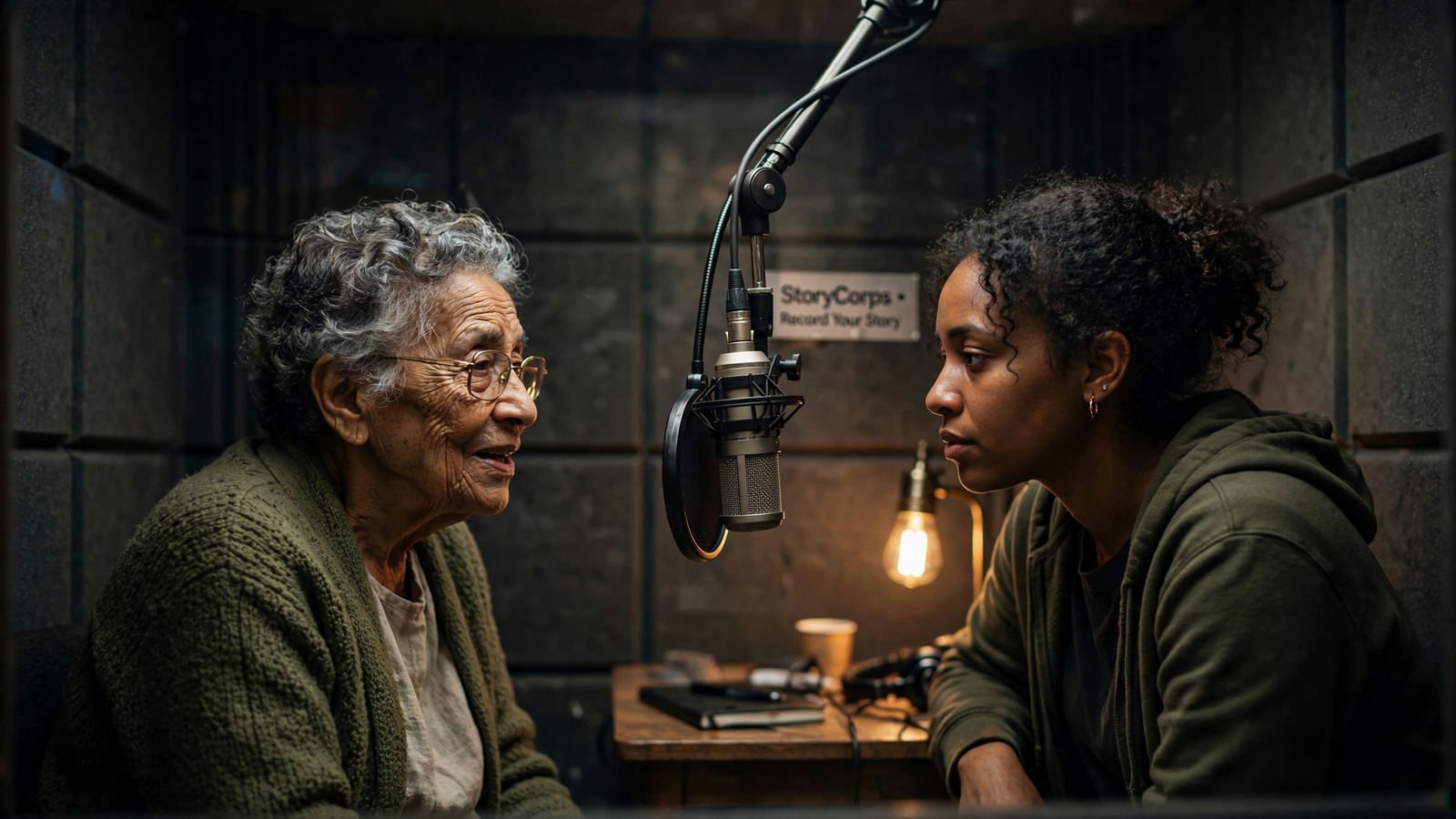
Since its first recording booth opened in New York City in 2003, the project has invited people to interview someone important to them—a parent, partner, friend, teacher, neighbor, or colleague. The conversations usually last about 40 minutes. They are personal rather than performative, shaped by memory, affection, curiosity, and the simple act of making time for another person.
That modest format has produced something large. StoryCorps recordings are preserved in the American Folklife Center at the Library of Congress, creating a national archive built from lived experience. Its collection includes hundreds of thousands of interviews involving more than half a million participants.
The achievement is not only the size of the archive. It is the choice of whose lives deserve to be saved.
A booth for the stories people usually keep at home
StoryCorps was founded by radio producer Dave Isay, who had already spent years documenting the lives of people whose experiences were rarely represented in mainstream media. The project’s first booth opened in Grand Central Terminal in October 2003, during a period when commuters could step away from the rush of the station and speak with someone they cared about.
The setting mattered. Grand Central was a place of departures, reunions, work, and daily movement. Inside the booth, however, the pace changed. A person could ask a question they had never asked before. Someone could explain a decision that had shaped an entire family. A listener could discover that a familiar relative had once been a stranger with ambitions, fears, and surprises of their own.
StoryCorps did not ask participants to perform expertise. It asked them to pay attention.
That distinction helped give the project its emotional force. The interviews are not simply profiles of remarkable people. Often, they are records of relationships: a daughter asking her mother about childhood, two friends recalling a long-ago turning point, or a worker describing the practical knowledge that made a job possible.
The result is a form of documentary art that depends on intimacy rather than spectacle. The interviewer is not a distant journalist searching for a headline. The interviewer is usually someone already inside the story.
From a local experiment to a national practice
The original booth was temporary, but the idea proved portable. StoryCorps developed mobile recording units that traveled to communities across the United States. It also created recording stations in libraries, museums, community centers, and other public places, allowing people to participate without traveling to New York.
That expansion changed the project’s geography. A national story no longer needed to be assembled only from major cities or famous institutions. Voices from small towns, military bases, reservations, rural communities, immigrant neighborhoods, and working-class families could enter the same broad archive.
Participants could also record conversations independently using StoryCorps’ tools and guidance. The organization’s interview question prompts encourage people to ask about childhood, love, work, family history, regret, gratitude, and hopes for the future. These questions are simple, but they create a structure for memories that might otherwise remain unspoken.
In 2005, the Library of Congress began preserving StoryCorps recordings in its American Folklife Center. That partnership gave the project an important public dimension. The conversations were not only broadcasts or private keepsakes; they became part of a research collection that future historians, students, artists, and family members could encounter.
Preservation also changed the meaning of an individual interview. A conversation recorded for one family could eventually help someone understand a workplace, a neighborhood, a migration pattern, a generation’s experience of war, or the everyday effects of social change.
The art of listening
StoryCorps is often described as an oral-history project, but its work also belongs to the world of writing and the arts. Each interview is shaped by narrative choices: where a story begins, what details a speaker remembers, which questions open a new subject, and how silence is allowed to remain part of the record.
The finished pieces are edited for radio, podcasts, animation, digital exhibits, and educational programs. Adaptation does not erase the ordinary quality of the conversations. Instead, it gives listeners a way into experiences they may not share themselves.
Some stories are funny. Others carry grief, illness, conflict, or loss. But the project’s central gesture remains affirmative: someone has decided that another person’s life is worth asking about, and someone else has agreed to answer.
That act of attention can be meaningful even when no recording is made. StoryCorps has published interview guides and educational materials that encourage people to conduct their own conversations. The project’s influence therefore extends beyond its archive. It has helped make listening a participatory practice rather than a specialized task reserved for reporters or historians.
A public archive made of private knowledge
Traditional national archives often emphasize official documents: laws, speeches, institutional records, photographs, and correspondence. Those materials are essential, but they do not always show how history felt in kitchens, workshops, classrooms, barracks, stores, farms, and living rooms.
Oral histories add another layer. They preserve accents, pauses, laughter, uncertainty, and the particular language people use when describing their own lives. They can reveal forms of knowledge that rarely appear in formal records—how a family adapted to a new country, how a craft was learned, how neighbors supported one another, or how a community remembered a place that had changed.
Because StoryCorps interviews are usually conducted by people with an existing relationship, they can also capture tenderness that a conventional interview might miss. The questions are not merely requests for information. They are invitations to recognize one another.
The archive’s value will grow with time. A recording that feels familiar to a family today may become an irreplaceable document for descendants decades from now. A voice that seems local or private can become part of a much larger account of American life.
Remembering that everyone has a story
StoryCorps does not solve the problem of whose voices are overlooked. No archive can represent a country evenly, and participation depends on access, time, technology, trust, and willingness to share personal experiences. But the project has created a durable invitation: history can begin with a question asked across a table.
Its most important achievement may be cultural rather than technological. StoryCorps has challenged the assumption that a life must be famous to be worth documenting. It has treated attention as a form of respect and conversation as a creative act.
The idea is remarkably democratic. A person does not need a publishing contract, a public platform, or an extraordinary résumé to leave a meaningful record. They need another person who is willing to listen closely.
That is why the project’s story is good news. In a culture crowded with messages, StoryCorps has made room for voices that might otherwise disappear into the everyday. It has turned the family interview into a public resource and the act of listening into a kind of civic art.
The archive continues to grow one conversation at a time. Each new recording says, in effect, that a life does not have to be celebrated by the whole country to matter. It only needs to be remembered truthfully by someone who cared enough to ask.
Use: Background on StoryCorps, its founding, mission, recording model, and national programs.
Use: Verification of the collection’s preservation by the American Folklife Center and its scale and archival significance.
Use: Independent background on Dave Isay’s work and the development of StoryCorps.
Use: Context on StoryCorps’ broadcast and audio storytelling work.
StoryCorps — About — https://storycorps.org/about/ — Background on StoryCorps, its founding, mission, recording model, and national programs.
Library of Congress — StoryCorps Collection — https://www.loc.gov/collections/story-corps-collection/about-this-collection/ — Verification of the collection’s preservation by the American Folklife Center and its scale and archival significance.
MacArthur Foundation — Dave Isay — https://www.macfound.org/fellows/class-of-2007/dave-isay — Independent background on Dave Isay’s work and the development of StoryCorps.
NPR — StoryCorps — https://www.npr.org/series/4516989/storycorps — Context on StoryCorps’ broadcast and audio storytelling work.