For most of history, asteroids belonged to the category of dangers people could imagine but not influence. We could observe them, calculate their paths and hope that none was headed our way. NASA’s Double Asteroid Redirection Test changed that relationship. For related reading, see NASA’s DART Mission Proved an Asteroid Can Be Nudged Off Course.
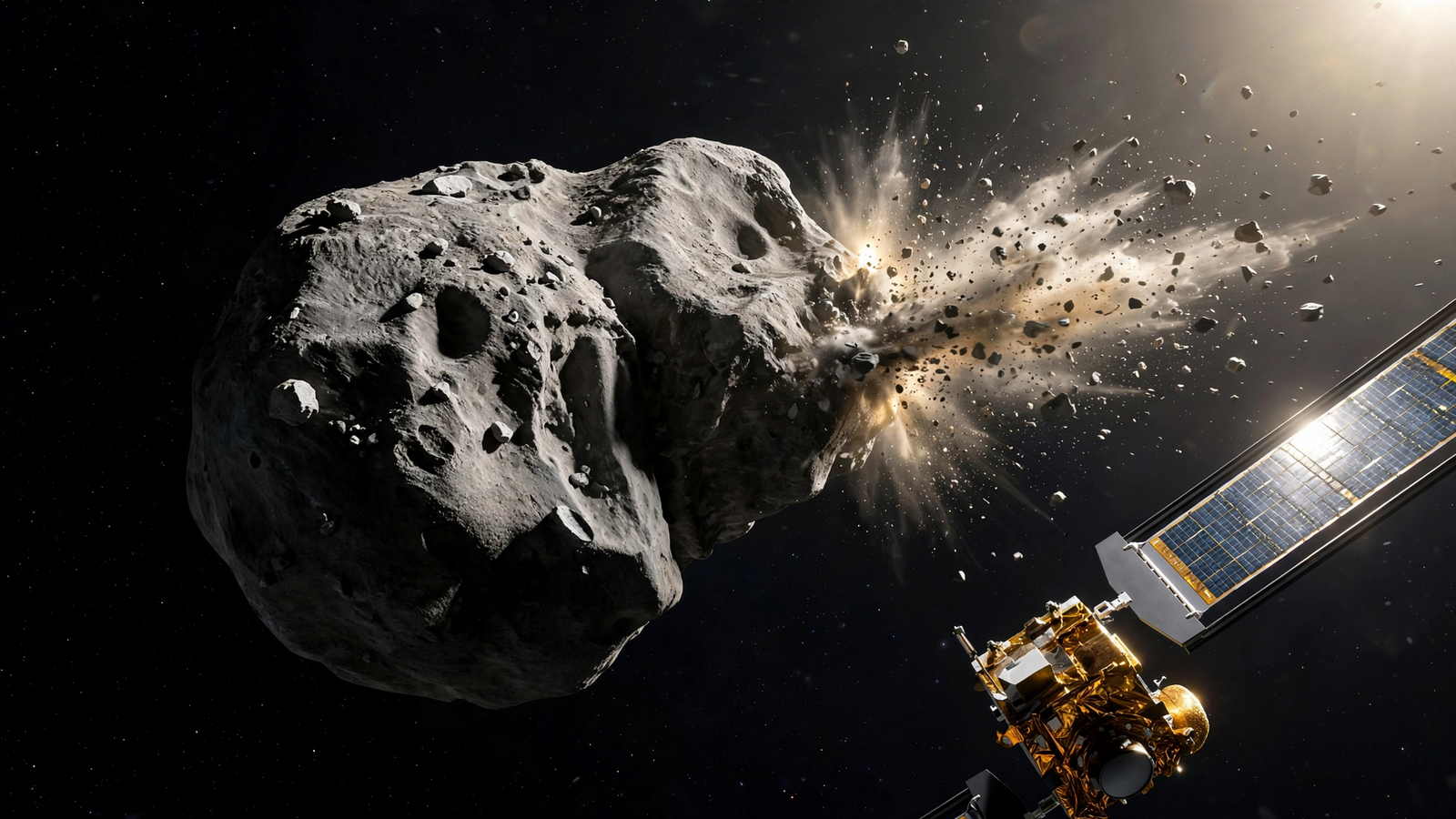
On September 26, 2022, a spacecraft about the size of a vending machine deliberately crashed into Dimorphos, a small moon orbiting the larger asteroid Didymos. The collision did not destroy the asteroid system. It did something more useful: it changed Dimorphos’s orbit, demonstrating that a spacecraft could push a celestial object onto a different path. For related reading, see NASA’s SPHEREx Is Building a New Map of the Entire Sky.
DART was not a mission to save Earth from a known threat. No member of the Didymos system posed a danger to our planet. Instead, the mission was designed as a controlled experiment—a chance to test one possible response before that response might ever be needed. For related reading, see The Asteroid Sample That Is Rewriting the Story of Earth’s Beginnings.
A target chosen for measurement
The Didymos system offered NASA an unusually clear natural laboratory. Didymos is the larger body, roughly 780 meters across, while Dimorphos is about 160 meters wide. Dimorphos travels around Didymos like a moon, completing an orbit in less than 12 hours.
That arrangement made the impact easier to measure. Telescopes on Earth did not need to track Dimorphos flying through the solar system. They only needed to watch for a change in the timing of its orbit around Didymos. If the impact worked, Dimorphos would begin arriving at particular points in its orbit earlier than it had before.
The mission’s simplicity was part of its strength. DART did not need to land, drill, collect a sample or return to Earth. It needed to find a small moving target, strike it at high speed and leave behind enough measurable change to test the method.
A spacecraft built to hit a moving world
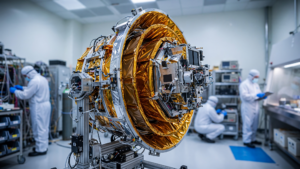
DART launched from California on November 24, 2021. Its main instrument was the Didymos Reconnaissance and Asteroid Camera for Optical navigation, known as DRACO. The camera helped the spacecraft distinguish the two bodies and guide itself toward Dimorphos during the final approach.
That final approach was a demanding piece of autonomous navigation. Earth was too far away for mission controllers to steer the spacecraft manually in real time. Radio signals take minutes to cross the distance between Earth and a spacecraft near an asteroid, so DART had to use its own images to decide which object was the target.
As the spacecraft closed in, Dimorphos grew from a point of light into a world with a visible surface. DART’s last complete image arrived only moments before impact. The target appeared rocky and irregular, with a surface covered in boulders rather than smooth dust.
DART struck Dimorphos at roughly 22,000 kilometers per hour. The spacecraft was destroyed, but its momentum was transferred to the asteroid moon. Material blasted from the surface also helped provide an extra push. This recoil effect—sometimes compared to the spray from a fire extinguisher—was important because the escaping debris carried momentum away from Dimorphos.
The first successful test
Before impact, Dimorphos took about 11 hours and 55 minutes to orbit Didymos. Afterward, observatories around the world measured a shorter orbit. NASA reported an initial change of about 32 minutes, far exceeding the mission’s minimum success requirement of 73 seconds.
The result did not mean that every asteroid could be redirected by the same amount. The effect depends on many variables: the asteroid’s size, density, internal structure, rotation, impact angle and the amount of debris thrown into space. A loosely held rubble pile may respond differently from a solid metal-rich body. A warning time of years or decades would also be far more useful than a last-minute attempt.
But the central question had been answered. A spacecraft could deliberately alter the orbit of a small asteroid moon. Planetary defense had moved from a collection of computer models and laboratory experiments into demonstrated space hardware.
The impact became a global observation
DART was designed as a NASA mission, but the experiment quickly became an international observing campaign. Ground-based telescopes measured the changing orbit. The Hubble Space Telescope and the James Webb Space Telescope watched the expanding cloud of debris. The Italian Space Agency’s small LICIACube spacecraft, which separated from DART before impact, flew past the system and returned images of the collision and its aftermath.
Those observations showed that the impact was more visually dramatic than a simple puncture. A broad plume of dust and rock streamed away from Dimorphos, and later images revealed long rays and complex structures extending from the system. Scientists could study the debris to learn how much material was ejected and how the asteroid responded.
In planetary science, the debris was not merely a spectacular byproduct. It was evidence. The shape and speed of the ejecta offered clues about Dimorphos’s surface and internal structure, while the size of the orbital change helped researchers estimate how efficiently the impact transferred momentum.
Why a small push matters
An asteroid does not need to be knocked dramatically off course to miss Earth. If a deflection happens far enough in advance, a small change in velocity can accumulate into a large difference in position over many years.
That is the logic behind a kinetic impactor. A spacecraft would intercept a threatening object and deliver a high-speed blow, changing its route by a small amount. The goal would not be to blow the asteroid apart. In many situations, fragmentation could create multiple dangerous objects. The preferred outcome would be a controlled miss.
DART also clarified the limits of the method. The mission targeted an asteroid moon whose orbital change could be measured precisely. A real emergency could involve a much larger object, an uncertain composition or too little warning. Deflection is therefore one tool within a broader planetary-defense system that includes surveys, orbit calculations, space-based observations and possible missions to characterize a threat.
The next mission will inspect the result
DART’s success was not intended to be the final word. The European Space Agency’s Hera mission launched in October 2024 and is scheduled to reach the Didymos system in late 2026. Hera will study the impact site and measure Dimorphos in much greater detail, including the crater created by DART and the moon’s mass.
Those measurements matter because the first mission could determine that the orbit changed, but it could not directly inspect the final crater. Hera will help scientists reconstruct the collision more completely and improve models for how kinetic impacts work on small asteroids.
Together, DART and Hera form a more useful experiment than either mission could conduct alone: one spacecraft performs the impact, while another returns for a forensic examination. The approach resembles a controlled engineering test carried out on a planetary scale.
A new kind of relationship with the sky
DART did not make Earth invulnerable. Astronomers continue to discover near-Earth objects, refine their orbits and assess risks. Many asteroids remain difficult to observe, particularly when they approach from the direction of the Sun. Planetary defense still depends on finding a threat early enough to understand it.
What changed was the practical meaning of preparation. Humanity now has a flight-tested example of changing an asteroid’s motion. The achievement was modest in physical scale—a small spacecraft striking a small moon—but enormous in implication.
The mission transformed a frightening question into an experimental one. Instead of asking only what would happen if an asteroid were on a collision course, scientists can also ask how much warning would be needed, how much force would be required and how an asteroid’s structure would affect the outcome.
That is the quiet significance of DART. It was not a rescue mission, because no rescue was needed. It was a rehearsal conducted in a real asteroid system, giving future planetary defense efforts something more valuable than reassurance: evidence.
Use: Mission purpose, spacecraft, impact and planetary-defense context.
Use: Measured orbital change and mission success result.
Use: Mission design, autonomous navigation and technical background.
Use: Follow-up mission, launch and planned investigation of the DART impact.
Use: Peer-reviewed analysis of the impact and Dimorphos’s orbital response.
NASA — Double Asteroid Redirection Test (DART) Mission — https://science.nasa.gov/mission/dart/ — Mission purpose, spacecraft, impact and planetary-defense context.
NASA — NASA Confirms DART Mission Impact Changed Asteroid’s Motion in Space — https://www.nasa.gov/solar-system/nasa-confirms-dart-mission-impact-changed-asteroids-motion-in-space/ — Measured orbital change and mission success result.
Johns Hopkins Applied Physics Laboratory — DART Mission — https://dart.jhuapl.edu/ — Mission design, autonomous navigation and technical background.
European Space Agency — Hera mission — https://www.esa.int/Space_Safety/Hera — Follow-up mission, launch and planned investigation of the DART impact.
Nature — The DART mission impact on the asteroid Dimorphos — https://www.nature.com/articles/s41586-023-05805-2 — Peer-reviewed analysis of the impact and Dimorphos’s orbital response.