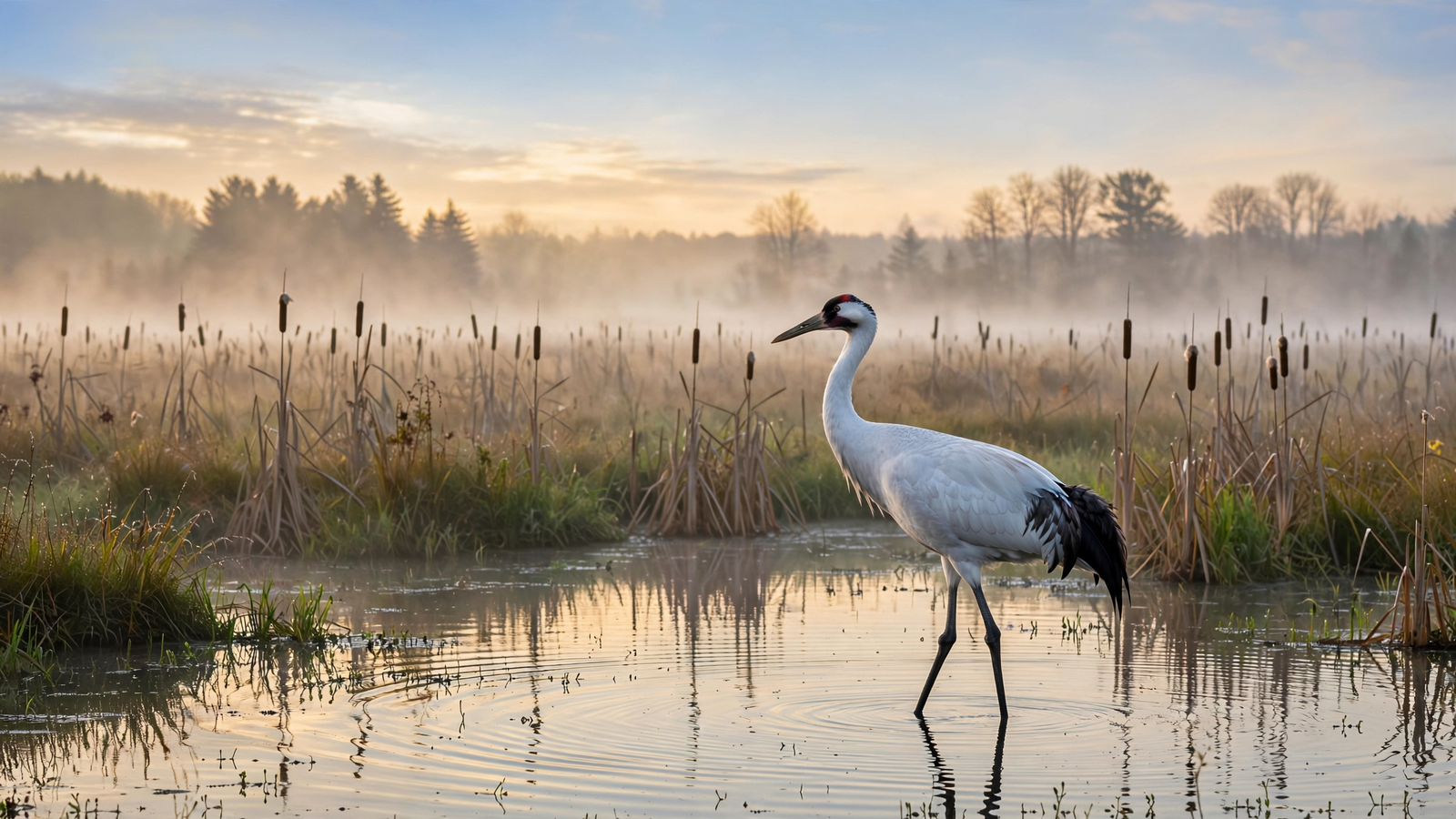
On a wetland morning, a whooping crane can look almost too large for the landscape around it. Its white body rises above the grasses on long black legs. A red crown catches the light. When the bird lifts off, its wings stretch nearly seven feet from tip to tip.
That size made the whooping crane unforgettable. It also made the species difficult to overlook as its numbers collapsed.
By 1941, hunting, habitat loss, and the conversion of wetlands had helped reduce the known wild population to just 21 birds. The crane stood at the edge of disappearing from North America altogether. Its recovery did not come from one dramatic intervention. It came through a long chain of decisions: protecting breeding grounds, safeguarding migration routes, managing winter habitat, raising birds in captivity, and giving small populations time to grow.
Today, the whooping crane remains endangered and its recovery is unfinished. But it is no longer represented by a handful of surviving birds. A naturally migrating population now travels between Canada’s Wood Buffalo National Park and the Texas coast, while conservation programs have established additional flocks. The species has become one of the clearest examples of what sustained, cooperative conservation can accomplish.
A bird shaped by wetlands
Whooping cranes are North America’s tallest birds, standing roughly five feet tall. Their name comes from their loud, carrying call, which can travel across open marshes and grasslands. They feed in shallow wetlands, wet meadows, agricultural fields, and coastal areas, eating a varied diet that can include plants, insects, fish, frogs, and small reptiles.
Their life cycle depends on more than one kind of place. The main wild flock breeds in the wetlands of Wood Buffalo National Park in northern Canada and migrates south to the Aransas National Wildlife Refuge and surrounding coastal areas in Texas. Along the way, the cranes need safe stopover habitat where they can rest and feed. For related reading, see The Bald Eagle: How America’s National Bird Found Its Way Back.
That dependence on a chain of habitats is one reason the species became vulnerable. A crane could be protected on its nesting grounds and still face danger months later on migration or in its wintering range. Conservation therefore had to become a continental effort rather than a single-refuge project.
When protection arrived late—but not too late
Whooping cranes once ranged across much of central North America. As wetlands were drained and grasslands changed, the birds lost places to nest, feed, and rest. Unregulated hunting added pressure, and the species’ slow reproduction made recovery difficult. Whooping cranes usually lay only a small number of eggs, and young birds require extended care before becoming independent.
The United States listed the whooping crane under the Endangered Species Preservation Act in 1967, and later protections under the Endangered Species Act strengthened the legal framework for recovery. Canada also protected important breeding habitat. The creation and management of refuges gave the remaining cranes places where disturbance and habitat destruction could be reduced.
One of the most important pieces of that work took place along the Texas coast. The Aransas National Wildlife Refuge and nearby coastal habitats provide wintering grounds where the cranes feed on blue crabs, clams, small animals, and other food. Protecting freshwater inflows into the coastal estuaries has also mattered, because the health of the marsh depends on the balance between river water and seawater.
Recovery required learning how to raise a crane
Protecting wild birds was essential, but conservationists also needed a way to increase the number of cranes. Zoos, wildlife agencies, and nonprofit organizations developed captive-breeding programs that could produce birds for carefully managed release efforts.
Raising a whooping crane is not as simple as hatching an egg and opening a cage. Young cranes must learn how to recognize suitable habitat, find food, avoid danger, and interact with their own species. Conservation workers use specialized methods to reduce the risk that birds will become overly accustomed to people. In some programs, handlers wear crane-shaped costumes and use remote tools during feeding so that human caretakers do not become the birds’ social model.
Scientists also had to address migration. Young cranes do not automatically possess a detailed map of where to go. Experimental programs used aircraft to lead captive-reared birds along a safe route between breeding and wintering areas. The famous “ultralight” projects drew public attention, but their deeper purpose was practical: help establish a new migratory tradition in a population that could not learn the route from older birds. For related reading, see The Iberian Lynx: How Europe’s Rarest Cat Found a Way Back.
Those efforts were part of a broader strategy to create more than one secure population. A second naturally occurring flock was established in Florida, and additional reintroduction work has taken place in the Midwest and elsewhere. Not every attempt produced a self-sustaining population, but each one added information about what the birds need.
A recovery measured in routes, not just numbers
The story of the whooping crane is often told through its population count, and the change is remarkable. From 21 known birds in 1941, the species has grown to a population numbering in the hundreds. The main wild flock is monitored each winter along the Texas coast, where biologists track the cranes and study threats to their food and habitat.
But a population can be growing and still be vulnerable. A storm, disease outbreak, drought, collision, or loss of wetland habitat can affect a species concentrated in a limited number of places. Young cranes also face natural dangers before they reach adulthood. For that reason, recovery plans focus on distribution as well as abundance.
More flocks in more places can reduce the risk that one event will affect the entire species. That principle has guided efforts to establish eastern and central migratory populations. It has also encouraged conservationists to protect wetlands beyond the best-known wintering refuge.
The quiet work behind a spectacular sight
Seeing a whooping crane is dramatic. Making that sight possible is usually not.
It involves landowners maintaining wetlands, refuge staff managing habitat, Canadian and American agencies sharing data, biologists banding and observing birds, and communities learning how development and recreation can affect sensitive areas. It involves decisions about water levels, prescribed fire, invasive plants, power lines, hunting regulations, and the protection of migration corridors. For related reading, see Arizona’s Condor Comeback: How the Grand Canyon Became a Second Chance for North America’s Largest Flying Bird.
The work is also collaborative across borders. The birds do not recognize the boundary between the United States and Canada, so conservation planning cannot stop at one country’s edge. Their annual journey turns distant wetlands into one connected system.
That connection gives the whooping crane story a wider meaning. A wetland protected for cranes can also support fish, amphibians, waterfowl, and native plants. A healthy coastal marsh can help buffer storms and provide nursery habitat for other wildlife. A safe migration stopover can preserve an entire patch of grassland or shallow water.
Still endangered, still moving forward
The whooping crane has not been saved in the sense of being beyond danger. The species remains listed as endangered, and conservationists continue to identify habitat loss, limited populations, severe weather, human disturbance, and changes in water availability as ongoing concerns.
Yet the crane’s recovery shows why endangered-species work is measured in decades. The first goal was to prevent extinction. The next was to protect the remaining wild birds. Then came captive breeding, reintroduction, migration training, habitat acquisition, and long-term monitoring. Each step made the next one possible.
The result is a bird once nearly erased from the continent now completing one of the world’s most recognizable migrations. Its return is not a finished story, but it is a real one: a species can come back when protection is patient, science is adaptable, and many people preserve the same chain of places.
For the whooping crane, that chain stretches from northern Canadian wetlands to the Texas coast and through the fields, marshes, and rivers in between. Every surviving route is evidence that recovery can be built one season at a time.
Use: Species status, biology, range, threats, and recovery information.
Use: Federal recovery efforts, conservation strategy, and population context.
Use: Species history, conservation programs, migration, and reintroduction work.
Use: Information about the Texas wintering habitat and refuge conservation role.