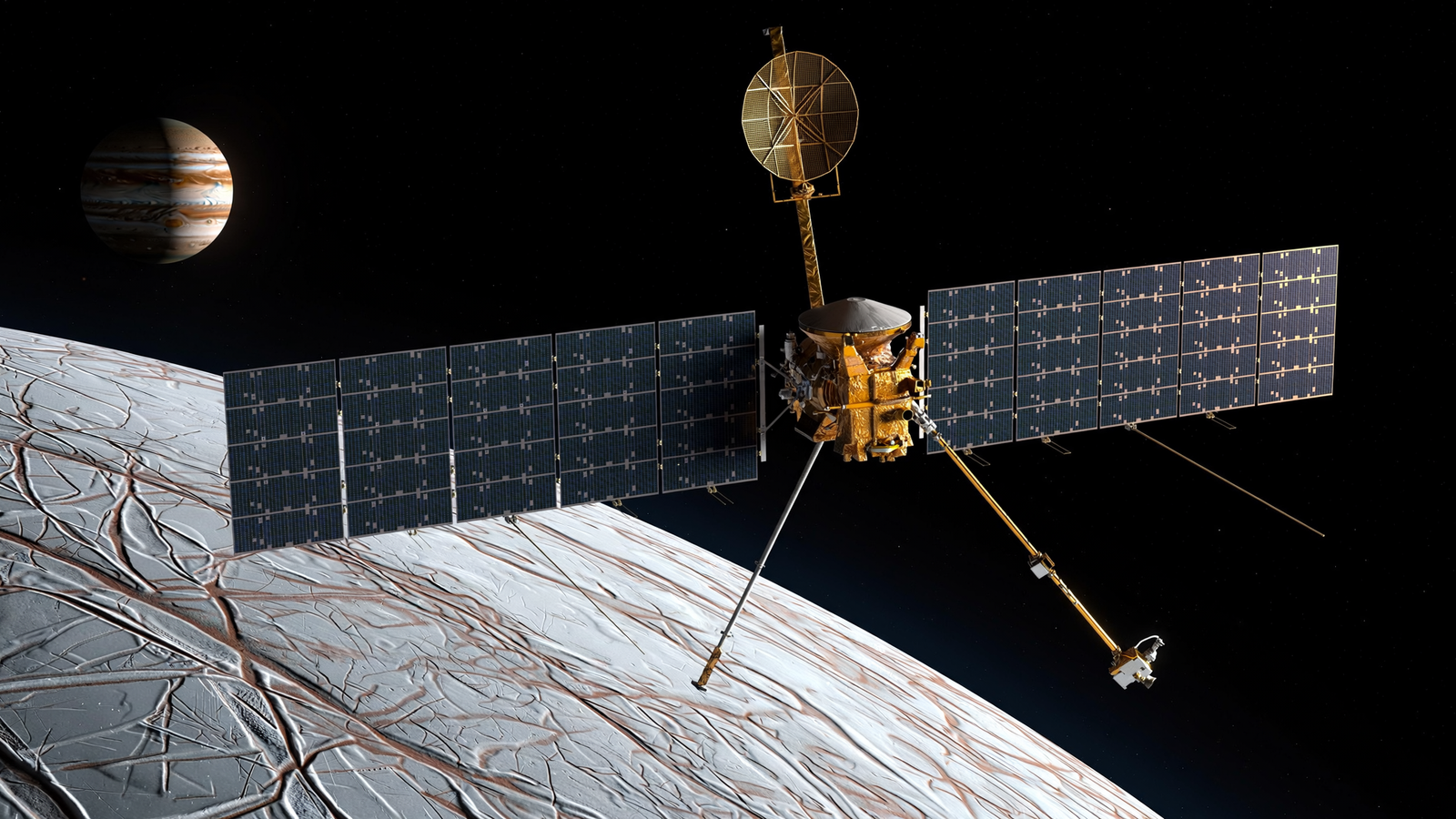
Some of the most intriguing water in the solar system is hidden beneath a shell of ice.
NASA’s Europa Clipper spacecraft is now traveling toward Jupiter, beginning a multiyear investigation of Europa, one of the planet’s largest moons. The mission will not land on Europa or search directly for living organisms. Instead, it will make repeated close passes, gathering evidence about the moon’s ice-covered ocean and whether its environment could support life.
A world with an ocean under ice
Europa is slightly smaller than Earth’s Moon, but its surface is very different. Images from earlier spacecraft show a bright, fractured crust marked by long ridges, bands and reddish-brown stains. Scientists believe the ice covers a global saltwater ocean that may contain more water than all of Earth’s oceans combined.
That ocean is one reason Europa has become a leading destination in the search for habitable environments beyond Earth. A possible source of energy may come from Jupiter’s powerful gravity, which continually flexes Europa and generates internal heat. Chemical exchanges between the ocean, the ice and the rocky seafloor could also provide ingredients useful to life.
What the spacecraft will look for
Europa Clipper launched from NASA’s Kennedy Space Center in Florida on October 14, 2024, aboard a SpaceX Falcon Heavy. The spacecraft is taking a carefully planned route through the solar system, using a gravity assist at Mars and a later flyby of Earth to build speed. It is expected to reach the Jupiter system in 2030.
Once there, Europa Clipper will enter an orbit around Jupiter rather than Europa. That approach will let it perform dozens of close flybys while limiting the spacecraft’s exposure to Jupiter’s intense radiation belts.
Its science instruments are designed to examine Europa from several angles. Cameras and spectrometers will map the surface and identify materials. A radar instrument will probe the ice shell for structure and possible water pockets. A magnetometer will study how Europa interacts with Jupiter’s magnetic field, helping scientists estimate characteristics of the hidden ocean. Other instruments will measure the moon’s gravity, temperature and extremely thin atmosphere, while a dust analyzer will examine particles that may be blasted from the surface.
A search for habitability, not a promise of life
The mission’s central question is carefully defined: does Europa possess the conditions that could make life possible? That is different from proving that life exists there.
Scientists want to learn how thick the ice is, how deep the ocean may be, whether water reaches the rocky interior and whether organic compounds or other chemical building blocks are present. The answers could reshape ideas about where habitable environments can exist. Life may not require a planet with a mild surface climate; it might also find a home in dark oceans sealed beneath ice.
Europa Clipper is therefore more than a journey to a distant moon. It is a test of an expanding scientific possibility: that potentially life-friendly worlds may be common, even when their surfaces appear frozen and lifeless. The spacecraft’s discoveries will help determine whether Europa deserves an even closer look from a future lander or other mission.