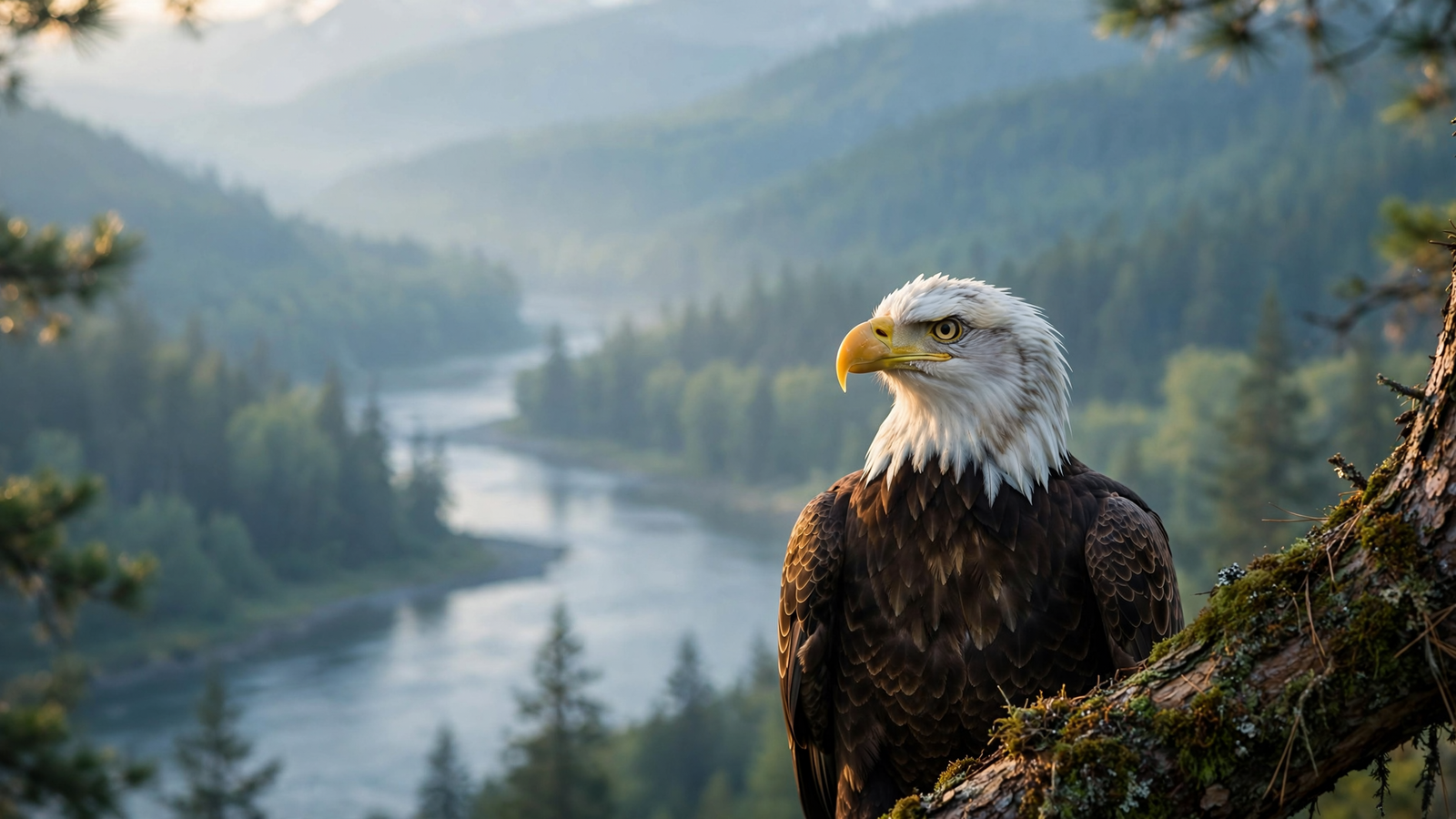
For much of the 20th century, the bald eagle seemed to be leaving the American landscape.
The bird remained visible in Alaska, Canada, and parts of the northern United States, but across much of the lower 48 states its numbers had fallen sharply. Nesting sites disappeared. Eggs failed to hatch. Rivers and lakes that had supported generations of eagles no longer offered a reliable future.
Today, the bald eagle is one of the most recognizable signs of recovery in American conservation. It still faces hazards, and its return is not a reason to stop protecting habitat. But the species has moved from the edge of national disappearance to a familiar presence around reservoirs, rivers, coastlines, and even urban waterways.
A national symbol in trouble
The bald eagle became the national bird of the United States in 1782, but symbolic importance did not protect it from environmental change. During the 19th and early 20th centuries, eagles were sometimes shot because they were viewed as threats to livestock or game. They also lost nesting habitat as forests were cleared and shorelines were developed.
The most consequential modern threat was DDT, a pesticide widely used after World War II. The chemical did not necessarily kill every adult eagle outright. Instead, it entered food webs and interfered with calcium metabolism, leaving affected birds unable to produce strong eggshells. Eggs broke under the weight of incubating adults, and entire nesting territories could become biologically quiet.
This kind of decline was difficult to see from a distance. An adult eagle could still circle above a lake, giving the impression that the species was secure. But a population cannot persist if too few young survive to replace older birds.
Protection arrived in stages
Federal protection for bald eagles began before the full scale of the decline was understood. The Bald and Golden Eagle Protection Act, first passed in 1940, prohibited killing, selling, or possessing eagles and their parts without authorization. The law remains an important foundation of eagle conservation. For related reading, see The American Chestnut: How Science Is Giving a Lost Forest More Than One Way Back.
In 1967, the bald eagle was placed on the federal list of endangered species in the lower 48 states, except in much of Michigan, Minnesota, Oregon, Washington, and Wisconsin, where its status was less severe. The Endangered Species Act of 1973 then provided a broader legal framework for protecting the bird and its habitat.
Still, legal protection could not repair the chemistry of an entire ecosystem by itself. The turning point came when the United States prohibited most uses of DDT in 1972. The ban was not aimed only at bald eagles; it addressed wider environmental and public-health concerns. But eagles benefited because they sit high in aquatic and terrestrial food chains, where persistent chemicals can become concentrated.
The result was gradual rather than dramatic. Adult birds lived longer. More eggs hatched. Young eagles began appearing in places where nesting had been absent for decades.
The recovery was built on ordinary-looking work
Conservation success often looks less like a single heroic intervention and more like a long list of practical decisions.
Biologists protected nest trees and communal roosts. Land managers limited disturbance near active nests during the breeding season. States and federal agencies monitored territories, counted young, and tracked where eagles were returning. Wildlife rehabilitators treated injured birds and released those capable of surviving in the wild.
Researchers also learned more about how eagles use landscapes. Bald eagles need large, sturdy trees or other elevated sites for nests, but they also need dependable food and open water. In winter, they may gather near rivers that remain unfrozen or around reservoirs where fish and waterfowl are available. Protecting a nest without protecting the surrounding feeding territory would provide only partial protection.
That ecological perspective helped turn the bald eagle from a single-species problem into a broader habitat effort. Cleaner water, healthier fish populations, mature forest, and protected shorelines all contribute to the bird’s prospects.
A measurable comeback
The numbers eventually made the recovery impossible to ignore. In the lower 48 states, the number of nesting bald eagle pairs rose from fewer than 10,000 in 2009 to more than 71,000 in the 2019 national survey conducted by the U.S. Fish and Wildlife Service. That survey estimated approximately 316,700 individual bald eagles in the lower 48, including adults, subadults, and juveniles.
Those figures are especially meaningful because they represent more than sightings. A bird seen passing through an area is not the same as a breeding population. Nest counts show that eagles are successfully occupying territory, raising young, and returning to a landscape over time. For related reading, see National Ignition Facility: How a California Laser Made Fusion Ignition Real.
The federal government removed the bald eagle from the endangered species list in 2007. Delisting did not remove all protections. The Bald and Golden Eagle Protection Act still prohibits unauthorized take, including killing, possession, or disturbance. The Migratory Bird Treaty Act also continues to protect bald eagles.
Delisting was a milestone, not a declaration that the work was over. The Fish and Wildlife Service continues post-delisting monitoring, and agencies still evaluate how development, contaminants, disease, changing water conditions, and other pressures affect eagle populations.
The eagle’s return changed public memory
One of the most striking parts of the recovery is how quickly a species can move from absence to familiarity when people are given the chance to notice it again.
A bald eagle perched beside a highway or flying over a suburban lake can seem ordinary now. In historical terms, it is not ordinary at all. It represents the return of a large predator that requires functioning habitat and enough food to support a demanding way of life.
The bird also became a living lesson in environmental cause and effect. The same landscape that supports bald eagles supports many other species that are less visible. When contaminants decline, wetlands remain intact, and shorelines retain mature trees, the benefits extend through an entire community of plants and animals.
Schools, parks, tribal nations, state agencies, conservation groups, and local volunteers have all helped make the recovery visible. Eagle watches and nest-monitoring projects turn an abstract population trend into something people can observe season by season. A nest that produces fledglings becomes both a biological event and a public reminder that conservation can work.
Recovery does not mean invulnerability
The bald eagle’s success can create a misleading impression that the species no longer needs attention. Eagles remain exposed to poisoned prey, lead from ammunition and fishing tackle, collisions, electrocution, habitat loss, and disturbance near nests. Oil spills and other pollution events can also affect birds directly or damage the food systems on which they depend. For related reading, see The North Aral Sea: How a Small Dam Helped a Lost Lake Find Its Way Back.
Some threats are local and preventable. A power pole can be redesigned to reduce electrocution. A nest buffer can keep construction activity away during the breeding season. Anglers and hunters can choose equipment that does not leave lead fragments in carcasses or water. Developers can account for mature nest trees and important shoreline habitat before projects are approved.
These measures may seem small compared with the nationwide ban on DDT or the creation of the Endangered Species Act. But recovery is maintained through exactly this kind of continuing care. A population can be large and still decline if the conditions that produced its success are gradually removed.
A practical kind of hope
The bald eagle’s comeback is sometimes told as a simple story: a national symbol was threatened, Americans protected it, and the bird returned. The fuller story is more useful.
It took scientific investigation to identify a hidden cause. It took legislation to restrict direct killing and protect habitat. It took monitoring to show whether the measures were working. It took decades of patience because ecosystems rarely recover on a convenient schedule.
Most of all, the recovery depended on treating wildlife protection as a shared responsibility rather than a task reserved for one agency. The eagle returned because laws, laboratories, public lands, private choices, and local observation reinforced one another.
There is no guarantee that every threatened species will follow the same path. Some face more severe habitat loss, slower reproduction, or dangers that are harder to control. But the bald eagle offers a grounded reason for optimism: environmental damage can sometimes be reversed, and a species that once seemed destined to disappear can become part of everyday American life again.
When a bald eagle rises from a riverbank and disappears above the trees, the sight carries more than patriotic symbolism. It is evidence that protection can outlast a crisis—and that recovery, given time and room, can become visible in the sky.
Use: Species history, legal protections, conservation status, and continuing threats.
Use: 2019 lower-48 population and nesting-pair estimates, plus recovery milestones.
Use: History of DDT regulation and its environmental significance.
Use: Background on the bald eagle’s decline, recovery, and ecological importance.