For generations, the American chestnut was one of the defining trees of the eastern United States. It grew quickly and straight, produced dependable nuts for wildlife and people, and helped shape the forests from Maine to Georgia and west into the Ohio Valley.
Then a fungus arrived.
By the middle of the 20th century, chestnut blight had swept through the tree’s range. The fungus killed mature trees by girdling their trunks, cutting off the flow of water and nutrients. The species did not disappear completely—living roots can still send up new shoots—but the great canopy trees that once dominated Appalachian forests largely vanished.
The American chestnut’s story is therefore not simply one of extinction. It is also a long, increasingly sophisticated effort to recover a native species and the ecological relationships surrounding it. Scientists and conservationists are combining traditional breeding, modern genetics, forest management, and biological research to give the tree more than one possible route back.
A tree that shaped the eastern forest
The American chestnut (Castanea dentata) was unusually valuable as a forest tree. It grew rapidly, tolerated a range of soils, and produced timber that was light, straight-grained, and naturally resistant to decay. Its nuts appeared in large crops and fed deer, turkeys, squirrels, bears, and other wildlife.
According to the American Chestnut Foundation, the tree once made up a significant share of forests across its native range. Its loss changed both the appearance and the function of those forests. An enormous source of food disappeared, and a canopy tree that had been capable of growing to impressive size was replaced by other species.
The blight was first identified in the United States at the beginning of the 20th century, after it was observed in New York City. The fungus, Cryphonectria parasitica, likely arrived on imported Asian chestnut trees. Asian chestnut species had coexisted with the fungus and evolved varying degrees of resistance. The American chestnut had not. For related reading, see The North Aral Sea: How a Small Dam Helped a Lost Lake Find Its Way Back.
The disease spread through forests with extraordinary speed. Mature trees were killed above ground, sometimes within only a few years of infection. Because the fungus attacks the bark and cambium rather than the roots, however, many trees continued to send up sprouts. Those sprouts can survive for years before becoming infected, preserving genetic material from the original forest even when they do not reach maturity.
The first strategy: breed resistance into a native tree
One of the most established approaches is conventional breeding. The idea is straightforward but technically demanding: cross American chestnuts with resistant Chinese chestnuts, then repeatedly breed the offspring back toward the American species while retaining resistance to the fungus.
This process is sometimes described as “backcross breeding.” Early generations may contain a mixture of traits from both parent species. With each additional cross to American chestnut, breeders try to recover the form, growth habit, timber qualities, and ecological character of the native tree while preserving the disease resistance inherited from its Asian relative.
The American Chestnut Foundation has organized much of this work through orchards and test plots. Breeders evaluate trees not only for whether they survive exposure to blight, but also for how closely they resemble American chestnuts and how they perform in different environments. The work takes time because a tree’s most important qualities—including mature form, flowering, nut production, and forest competitiveness—cannot be judged in a greenhouse alone.
Breeding programs also recognize that resistance is not necessarily a single trait. Several genes and biological mechanisms may influence how a chestnut responds to infection. That makes a genetically diverse population especially valuable: a forest restored with many resistant lineages may be better prepared for variation in the fungus, changing climate conditions, and other future pressures.
Looking beyond one genetic solution
Researchers at the State University of New York College of Environmental Science and Forestry have investigated another route: introducing a resistance-related gene into American chestnut tissue. The best-known research line involved a gene from wheat that helps break down oxalic acid, a chemical produced by the blight fungus during infection.
The goal of this work is not to create a tree that cannot be infected. Instead, the research has aimed to help the tree tolerate infection well enough to limit damage and continue growing. That distinction matters in conservation biology. A tree that remains part of a forest must interact with fungi, insects, soil organisms, and neighboring plants; eliminating every interaction would not necessarily be desirable or realistic. For related reading, see Nirsevimab: How One Injection Is Giving Infants a New Shield Against RSV.
Genetic engineering has also brought additional layers of review. Any proposed environmental release would require careful assessment of the tree’s biology, potential effects on ecosystems, and regulatory questions. Research trees and a restored wild population are not the same thing. Field trials must examine how trees behave outside controlled conditions, including whether they reproduce, compete, and support wildlife as expected.
That caution is not a sign that restoration has stalled. It reflects the scale of the decision. Returning a long-lived tree to millions of acres would be an ecological intervention, and the benefits need to be weighed alongside uncertainty.
Biological control and the forest’s own memory
Resistance breeding is not the only possibility. Scientists have also studied biological control, including naturally occurring viruses known as hypoviruses that can weaken the chestnut blight fungus. In Europe, related biological interactions have helped reduce the severity of chestnut blight in some settings.
Applying that knowledge in North American forests is complicated. A biological control agent must be able to move through local fungal populations and function under local conditions. Forests are diverse, and the behavior of a fungus can vary from one site to another. Even so, the research offers a reminder that disease outcomes are shaped by communities of organisms, not just by a battle between one tree and one pathogen.
Meanwhile, living American chestnut sprouts remain important. They carry genetic diversity from trees that survived in scattered locations, and conservation groups continue to locate, document, and incorporate those trees into breeding programs. A stump that sends up a shoot may appear small and temporary, but it can preserve a lineage that would otherwise be lost.
Restoration begins before the final answer
Even the most successful chestnut variety would not return to an unchanged forest. The eastern landscape has been altered by logging, development, invasive pests, deer browsing, fire suppression, climate change, and the spread of other tree diseases. A restored chestnut would need suitable places to grow and enough protection during its early years. For related reading, see Gene Therapy Is Giving Some Children Born Deaf a New Way to Hear.
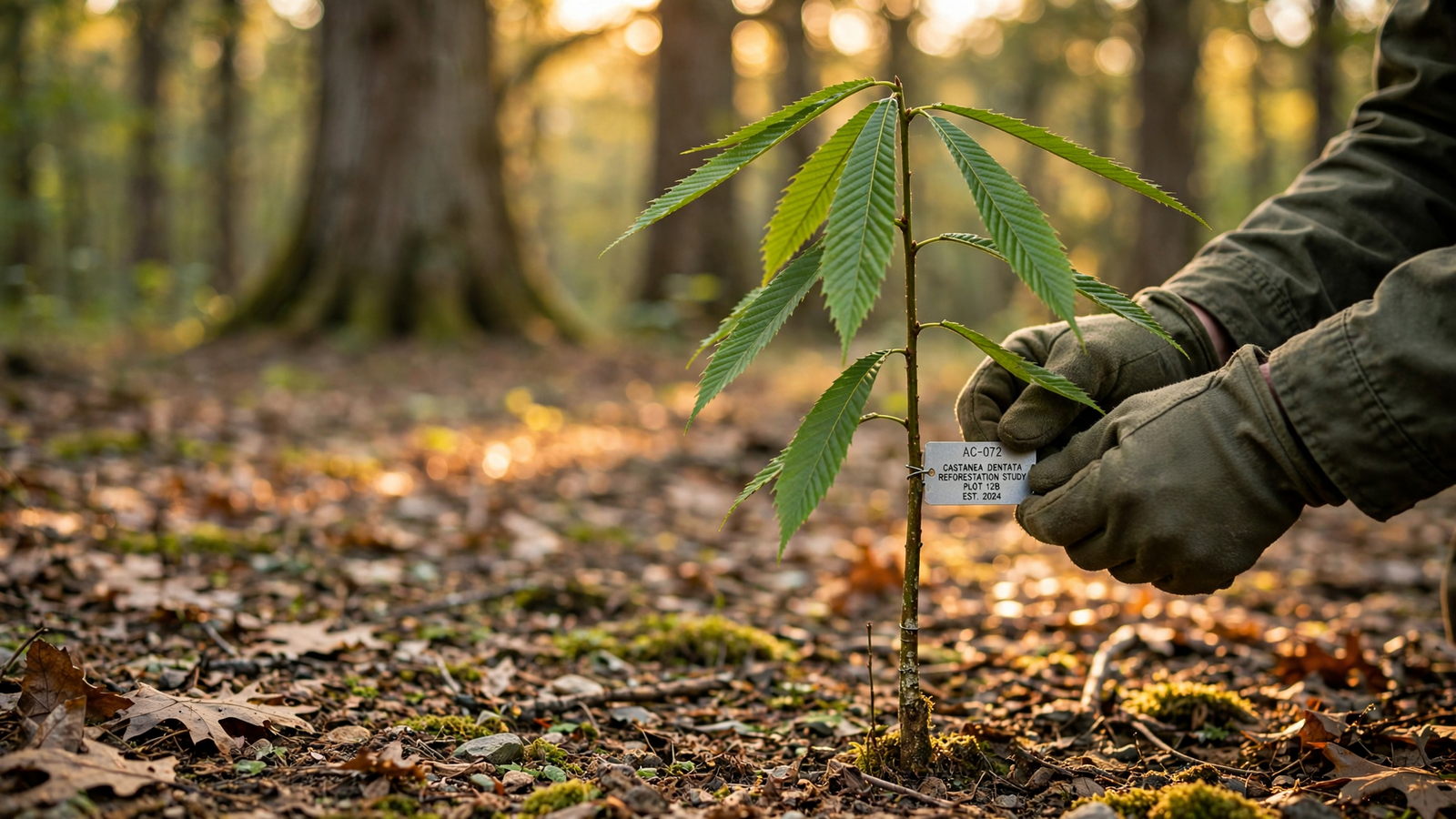
That is why restoration efforts include more than producing seedlings. Researchers test trees in different soils and climates. Volunteers plant and monitor orchards. Forest managers consider where chestnuts could complement existing species rather than simply replace them. Educational programs preserve the cultural memory of a tree that many people know only from photographs, family stories, or old timber records.
The work also has a practical advantage: it can improve understanding of forest resilience even before a fully blight-resistant chestnut is widely available. Breeding trials reveal how disease resistance works. Field plantings show which seedlings survive drought, browsing, and competition. Genetic studies help conservationists protect diversity rather than relying on a narrow group of nearly identical trees.
A return measured in generations
The American chestnut will not be restored by a single announcement or one shipment of seedlings. Trees take years to mature, and a forest is measured across decades. The most responsible goal is not to promise that the old forest can be recreated exactly as it was, but to build a future in which American chestnut once again has a durable place in eastern woodlands.
That future may come from a combination of approaches: conventionally bred resistance, carefully evaluated biotechnology, biological control, protection of surviving genetic lines, and better forest management. Each method addresses a different part of the problem. Together, they make recovery less dependent on one breakthrough.
There is something encouraging in that patience. The chestnut’s recovery is not an attempt to turn back time. It is an effort to carry a native species forward with a clearer understanding of genetics, disease, and ecological responsibility.
For a tree that seemed destined to survive only as a memory, that is already a meaningful change. The shoots are still appearing. The orchards are still growing. And in laboratories and forests across the eastern United States, the American chestnut is being given another chance to become part of the landscape—not as a symbol of what was lost, but as a living species with a possible future.
Use: Background on the species, its former range and ecological importance, the history of chestnut blight, and restoration efforts.
Use: Information on breeding programs, orchards, surviving trees, and conservation research.
Use: Research on genetic engineering, blight tolerance, and the development and testing of potentially resistant American chestnuts.
Use: Federal background on chestnut blight, forest restoration, and research into the species’ recovery.
Use: Historical and ecological context for the American chestnut and the effects of chestnut blight on eastern forests.