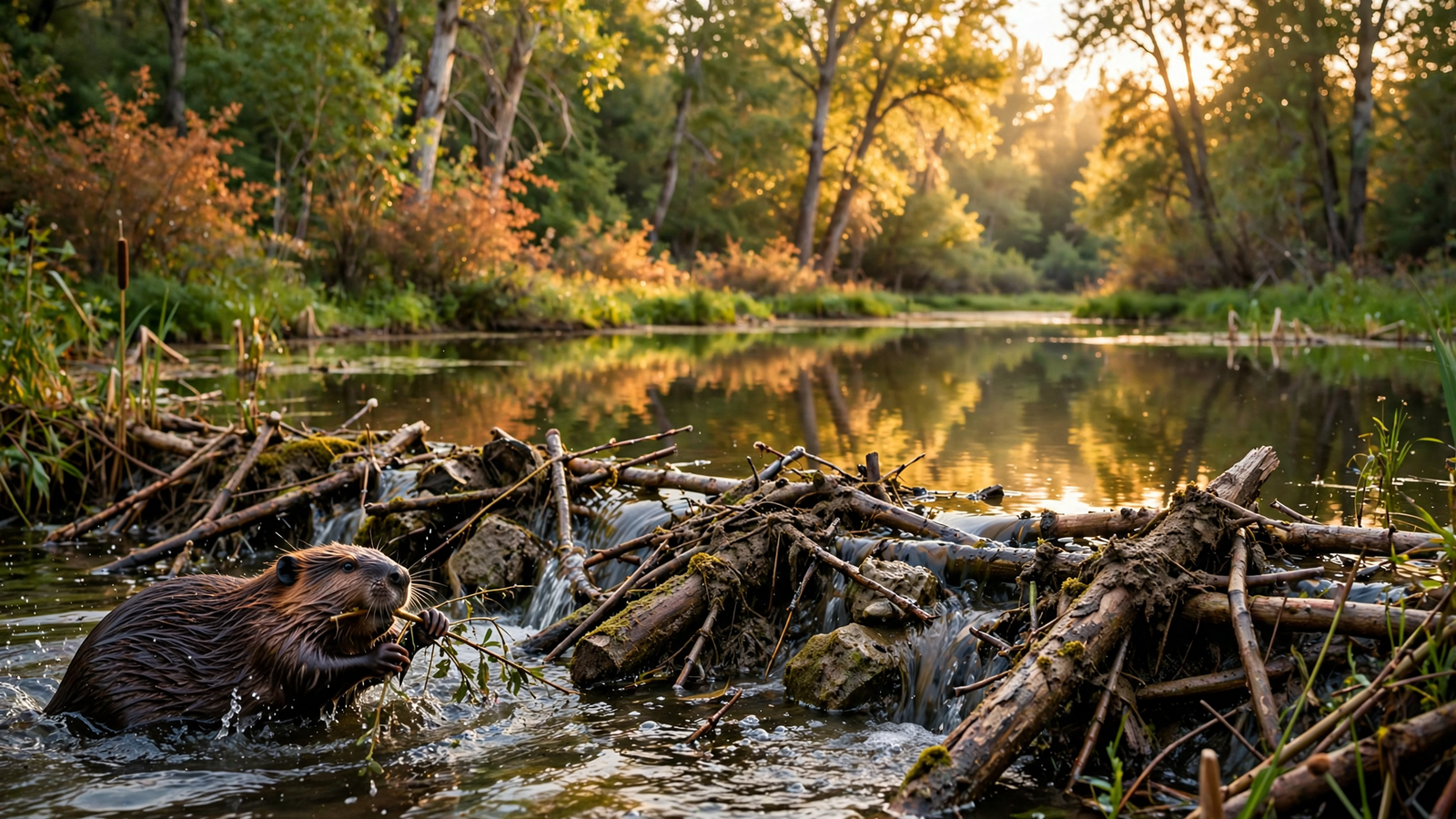
In a mountain stream, a beaver dam can look almost accidental: a weave of branches, mud, stones, and leaves pressed across moving water. But the structure is not random. It is a small piece of landscape engineering, built by an animal that has spent thousands of years reshaping North American wetlands. For related reading, see The Black-Footed Ferret: How Arizona’s Prairie Dogs Helped Bring Back a Native Predator.
For much of the 20th century, people often saw that engineering as a problem. Beaver dams flooded roads, fields, culverts, and timber stands. Beaver trapping had already removed the animals from large parts of their historic range, but where beavers remained, they were frequently treated as pests to be controlled or eliminated. For related reading, see The Navajo Code Talkers: How a Native Language Became a Wartime Secret.
A different idea is now gaining ground: in the right places, beavers can be partners in restoring waterways. Their dams slow runoff, spread water across floodplains, create ponds and wetlands, and provide shelter for fish, amphibians, birds, and other wildlife. The goal is not to put beavers everywhere. It is to understand where their natural work can help—and where careful management is needed. For related reading, see Carlos Montezuma: How an Arizona-Born Physician Turned Education Into Native Self-Determination.
A builder that changes the whole neighborhood
Beavers are often described as “ecosystem engineers” because their effect extends far beyond the dam itself. When a dam slows a stream, water has more time to settle into the surrounding soil. Channels can become more complex. Wet meadows and ponds may develop where there was previously a narrow, fast-moving creek.
Those changes can create a chain of benefits. Wet areas provide breeding and feeding habitat for amphibians and birds. They can support aquatic insects, which in turn feed fish and other wildlife. During dry periods, ponds and saturated soils may continue to hold water after smaller streams have stopped flowing at the surface.
Beaver ponds are not permanent lakes. They fill with sediment, leak, break, and eventually become meadows or new channels. That cycle is part of their ecological value. A single valley can contain patches of open water, willow thickets, wet grassland, and recovering streamside forest—different habitats at different stages.
The animal’s influence also reaches beyond wildlife. By slowing water during storms and spring snowmelt, beaver complexes can reduce the speed at which water moves downstream. That does not make beaver dams a substitute for flood-control infrastructure, and dams can fail. But in suitable landscapes, a connected series of small impoundments can act as a natural brake on runoff and help water remain in a watershed longer.
From fur trade to restoration tool
Before European settlement, North America supported an enormous beaver population. The animals were hunted intensively for their pelts, which were valuable in the hat trade and other markets. Trapping, land conversion, stream modification, and the removal of streamside vegetation changed many beaver habitats.
Beavers did not disappear everywhere, but their distribution and abundance were sharply altered in many regions. As wildlife protections expanded and trapping pressure declined, populations recovered in parts of the United States. Their return sometimes produced conflict precisely because the animals were rebuilding the kinds of wet landscapes that modern roads, farms, houses, and drainage systems had been designed to eliminate.
That tension has encouraged a more practical form of conservation. Instead of viewing every dam as either a blessing or a nuisance, land managers increasingly ask several questions: What is the dam doing to the stream? Who or what could be affected? Can infrastructure be protected without removing the animals? Is the site suitable for beaver activity over the long term?
Learning to make room
In the Methow Valley of Washington, the Methow Beaver Project has helped make beaver restoration a visible part of watershed work. The organization studies beaver behavior, relocates animals in some circumstances, and works with landowners and agencies to reduce conflicts. Its approach reflects a basic reality: restoration succeeds more often when people are included from the beginning.
Relocation is not a simple matter of catching a beaver and releasing it beside a stream. Animals need food, water, suitable bank conditions, and enough space to establish a territory. Moving them into an unsuitable location can fail for the beavers and create new problems for nearby residents. Good projects therefore combine habitat assessment, monitoring, and local planning rather than treating relocation as a quick fix.
Where beavers are already present, managers can sometimes protect roads, agricultural fields, and culverts without destroying the entire wetland system. Devices that allow water to pass through a dam in a controlled way—often called flow devices—can reduce flooding at a particular structure. Fencing or other barriers may protect trees and infrastructure. These tools do not eliminate every conflict, but they can make coexistence possible.
The same principle applies to restoration work that does not involve moving animals. In some degraded streams, people build low, porous structures that imitate parts of beaver dams. These “beaver-dam analogues” are intended to slow water and reconnect a stream with its floodplain. They are not a replacement for beavers, and they do not always work. But they can help restore conditions that make natural beaver activity more likely.
Why water managers are paying attention
Interest in beaver-based restoration has grown as western communities face hotter temperatures, longer dry seasons, severe wildfire, and increasingly variable precipitation. Healthy wetlands cannot solve those problems on their own. Still, they can provide useful ecological services in places where water retention and habitat connectivity matter.
Moist stream corridors may remain greener than surrounding uplands during dry periods. That can create refuge for wildlife and, in some landscapes, breaks in otherwise continuous fuels. Researchers and land managers are studying whether beaver-created wetlands can influence wildfire behavior, but the effects depend on local vegetation, weather, topography, and the condition of the wetland. It would be misleading to call every beaver pond a firebreak.
Beavers can also support cold-water habitat. Shaded ponds and connected wetlands may give young fish places to rest and feed, while complex channels can provide cover during high flows. Yet beaver dams can also block passage for some fish or raise water temperatures in certain conditions. The outcome depends on the species, stream, season, and design of the surrounding habitat.
That complexity is one reason the most promising work is collaborative. Biologists, hydrologists, tribal nations, farmers, ranchers, transportation agencies, and local residents may all experience the same beaver dam differently. A project that improves habitat but floods a road is incomplete. A project that protects a road by removing every dam may also discard an important ecological resource.
A conservation story with room for disagreement
Beaver restoration is sometimes presented as a cure-all. It is not. Beavers cannot compensate for polluted water, excessive groundwater pumping, destroyed riparian vegetation, or a stream channel that has been cut off from its floodplain. They also cannot be introduced responsibly without considering disease, genetics, land ownership, downstream effects, and the welfare of the animals themselves.
What beavers offer is more modest—and more useful. They are a native force already adapted to American waterways. When the landscape can accommodate them, their daily work can produce wetlands without the energy requirements of a mechanical project. Their dams change over time, respond to local conditions, and create habitat mosaics that are difficult to reproduce with a single engineered structure.
Working with beavers also changes the way people think about restoration. Instead of asking how to force a stream into a fixed shape, managers can ask what processes once helped the stream hold water, build soil, and support life. Sometimes the answer includes planting willows or reconnecting a floodplain. Sometimes it includes removing an obstruction. And sometimes it means allowing a beaver to carry a branch into the current.
The return of the beaver is therefore not simply a wildlife success story. It is a test of whether human communities can share functioning landscapes with an animal whose idea of improvement may involve flooding a low spot and building a wall across a creek.
Where the conditions are right, that wall can become the beginning of a larger recovery: water moving more slowly, wetlands returning to a valley, and a stream once again doing more than carrying water downhill.
Use: Background on beaver ecology, dams, and their role as ecosystem engineers.
Use: Species and conservation background, including the beaver’s historic importance and ecological effects.
Use: Practical restoration, planning, coexistence, and management considerations.
Use: A U.S. example of beaver research, relocation, watershed restoration, and conflict-reduction work.
U.S. National Park Service — Beavers — https://www.nps.gov/articles/beavers.htm — Background on beaver ecology, dams, and their role as ecosystem engineers.
U.S. Fish and Wildlife Service — Beaver — https://www.fws.gov/story/beaver — Species and conservation background, including the beaver’s historic importance and ecological effects.
U.S. Fish and Wildlife Service — Beaver Restoration Guidebook — https://www.fws.gov/media/beaver-restoration-guidebook — Practical restoration, planning, coexistence, and management considerations.
Methow Beaver Project — https://www.methowbeaverproject.org/ — A U.S. example of beaver research, relocation, watershed restoration, and conflict-reduction work.