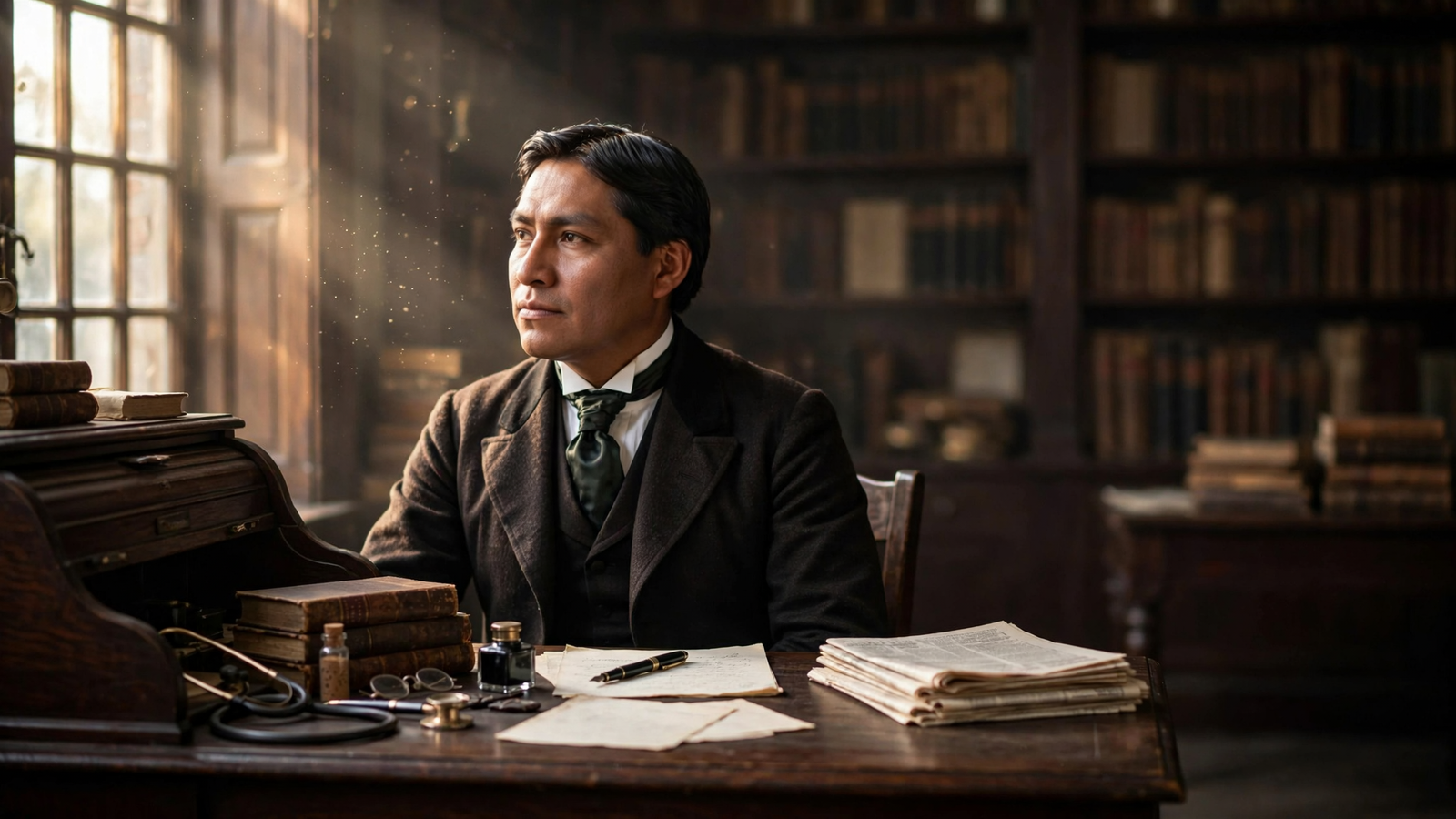
Before he became a physician, Carlos Montezuma was known by another name: Wassaja.
He was born around 1866 into the Yavapai community near the Four Peaks region of what is now central Arizona. As a young child, he was taken from his family during a period of violent conflict in the Arizona Territory. His life might have disappeared into a history written by other people. Instead, he became a doctor, an author, a publisher, and one of the most persistent Native advocates of his generation.
Montezuma’s story is not simply one of individual achievement. It is also a story about who gets to define education, citizenship, health, and freedom. He believed that schooling could help Native people build power—but he rejected the idea that education required abandoning Native identity or accepting permanent government control.
A child separated from his community
Details of Montezuma’s early life are difficult to separate from the larger violence of the nineteenth-century Southwest. Historical accounts agree that he was taken as a child and later came into the care of the Italian photographer Carlo Gentile, who gave him the name Carlos Montezuma.
Gentile recognized the boy’s intelligence and arranged for him to receive an education. Montezuma attended schools in Chicago and later studied at the University of Illinois. He went on to earn a medical degree from Chicago Medical College, now part of Northwestern University, in 1889.
That achievement was extraordinary. At a time when Native people were routinely denied educational opportunities and were often treated by federal policy as wards rather than full participants in public life, Montezuma entered one of the country’s most demanding professions. He became one of the earliest American Indian physicians trained in modern Western medicine and is widely recognized as the first Native American physician from Arizona.
His education also gave him a public platform. Montezuma understood that a degree could open doors, but he did not see professional success as permission to distance himself from his origins. He retained the name Wassaja and increasingly directed his attention toward the conditions facing Native communities.
Medicine as a form of service
Montezuma practiced medicine in Chicago and later worked for the federal government. His government service included assignments connected with Native communities in the American West. Those experiences exposed him to the limitations of the system he was expected to serve.
Federal officials often presented boarding schools, forced assimilation, and bureaucratic supervision as benevolent reforms. Montezuma saw something different: a structure that could separate children from their families, restrict Native decision-making, and treat Indigenous nations as problems to be managed.
His medical background made him especially alert to the relationship between health and political power. Poor health was not merely the result of personal choices, he argued. It could reflect poverty, inadequate services, displacement, and the loss of control over community life. A doctor could treat illness, but lasting health also required people to have a say in the conditions shaping their lives.
That perspective put him at odds with many mainstream reformers of the period. Some white reformers supported education for Native people while also advocating assimilation. Montezuma wanted Native people to have access to education and medicine without being required to surrender their communities, languages, or political rights.
Leaving the government behind
Montezuma eventually rejected federal employment. He believed that working inside the government system limited his ability to criticize it, and he became increasingly outspoken about federal control of Native affairs.
He criticized the reservation system, compulsory boarding schools, and policies that weakened tribal authority. He also opposed the idea that Native people needed to be remade into a different population before they could be considered American citizens. For Montezuma, citizenship and cultural survival were not opposites.
His arguments were sometimes uncompromising. He favored self-government and economic independence, and he wanted Native communities to build their own institutions rather than remain dependent on federal officials. Some of his ideas reflected the individualist language of his era, including a strong belief in education, property ownership, and personal advancement. Yet his central demand remained clear: Native people should have the authority to decide their own future.
Wassaja gives him a public voice
In 1916, Montezuma began publishing Wassaja, a newspaper named for the identity he carried before he became Carlos Montezuma. The publication allowed him to communicate directly with Native readers and supporters without relying on government reports or newspapers controlled by non-Native editors.
Wassaja covered Native rights, education, health, federal policy, and political organizing. It was not a neutral publication. Montezuma used it to challenge government authority and to make arguments that many officials preferred to keep outside the national conversation.
The newspaper also revealed the practical difficulty of sustaining reform work. Montezuma published it with limited resources and a small audience. His approach could be controversial, and he did not always agree with other Native leaders or reform organizations. But the paper gave him something he had rarely possessed as a child: control over the terms of his own public identity.
That control mattered. The name Wassaja connected his adult work to the child who had been separated from his family. Rather than treating that earlier identity as something to overcome, Montezuma made it part of his public authority.
A different idea of progress
Montezuma’s life complicates the familiar story that education simply lifted one exceptional person out of hardship. He did pursue education with remarkable determination, but he did not treat his success as proof that the existing system was fair.
Instead, he used the credentials the system valued to question the system itself. His medical degree gave him professional legitimacy. His writing gave him a means of reaching readers. His experience in government gave him firsthand knowledge of how policy affected Native families. Each part of his life became evidence in a broader argument for self-determination.
That argument remains relevant because the debate over Native education and health did not end with Montezuma. Native communities continue to address questions about access to medical care, control of schools, tribal sovereignty, and the preservation of cultural identity. Modern institutions and movements are not simply extensions of Montezuma’s work, but they operate in a landscape he helped describe.
Returning to Arizona
Montezuma spent much of his adult life away from Arizona, yet the territory remained central to his identity. He returned to the Southwest and maintained connections with Native people there. In his later years, he was increasingly affected by tuberculosis.
He died in 1923 and was buried in the Fort McDowell area of Arizona, near the Yavapai community with which his early life was connected. His burial place gave his story a geographical circle: a child taken from central Arizona had returned as a nationally known physician and advocate.
Montezuma did not live to see the major changes in federal Indian policy that would come later in the twentieth century. He also did not have the resources to build a large organization or institution bearing his name. His influence was quieter and more durable: an example of how professional knowledge could be redirected toward community freedom, and how a newspaper could challenge an entire system’s assumptions.
Carlos Montezuma’s achievement was not only that he became a doctor. It was that he refused to let the title define the limits of his responsibility. He treated medicine as a way to serve, education as a tool for independence, and public writing as a form of political action.
For Arizona, his life offers an especially powerful reminder that the state’s history is not only a story of territorial officials, military campaigns, and expanding institutions. It is also the story of Native people who pursued knowledge on their own terms and used that knowledge to demand a larger measure of freedom.
Use: Biographical background, medical education, professional career, and advocacy.
Use: Education at Chicago Medical College/Northwestern and historical context for his life and work.
Use: Arizona historical context and guidance for locating state-related materials on Montezuma and the Yavapai community.
Northwestern University Libraries — Carlos Montezuma materials — https://www.library.northwestern.edu/about/news/2018/carlos-montezuma.html — Biographical background, medical education, professional career, and advocacy.
Northwestern University Libraries, Carlos Montezuma materials — https://www.library.northwestern.edu/about/news/2018/carlos-montezuma.html — Education at Chicago Medical College/Northwestern and historical context for his life and work.
Arizona State Library, Carlos Montezuma and Arizona history resources — https://azlibrary.gov/ — Arizona historical context and guidance for locating state-related materials on Montezuma and the Yavapai community.