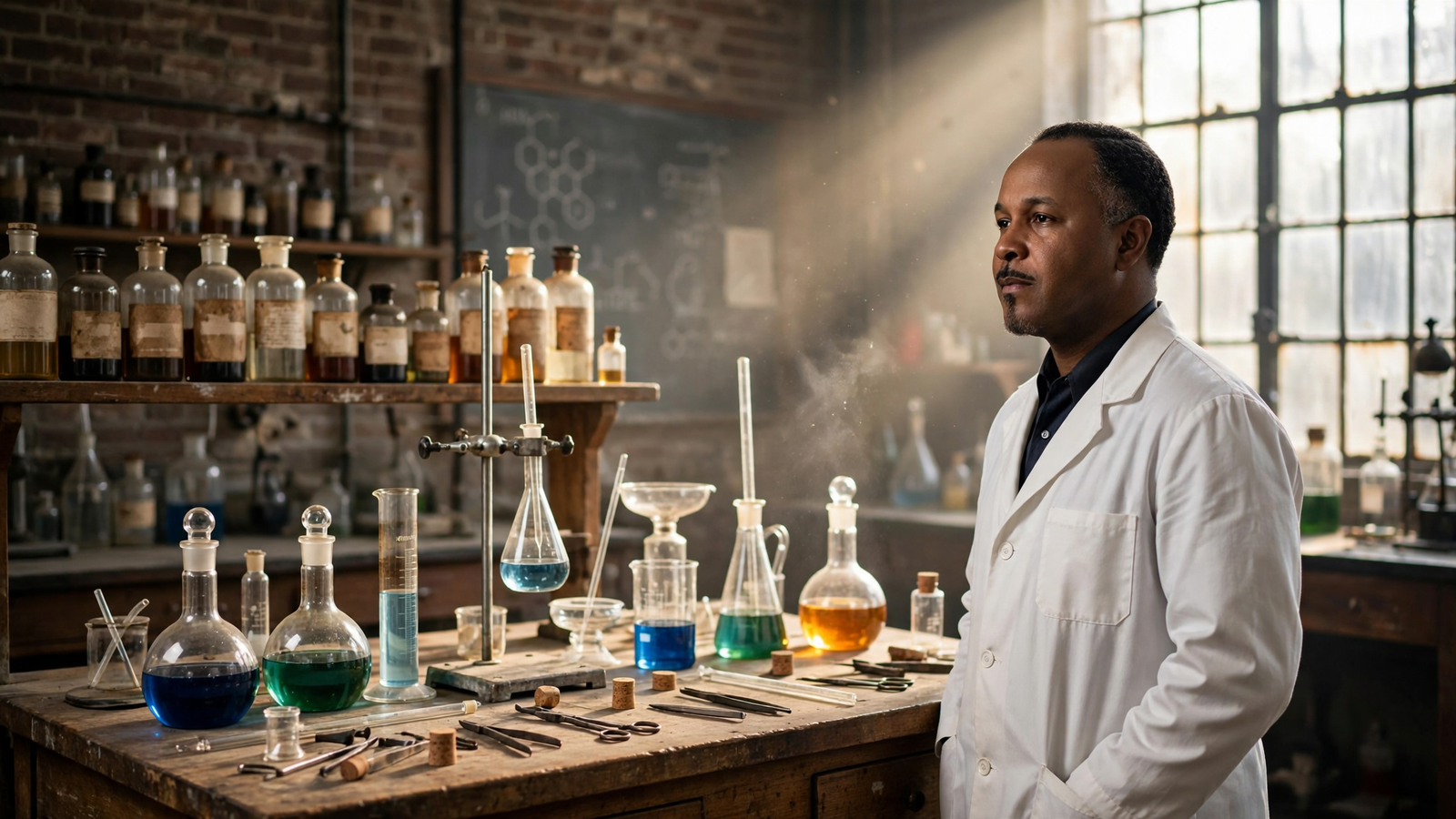
When Percy Lavon Julian began working in chemistry, the field offered him almost no clear path forward. He was a Black student born in Montgomery, Alabama, in 1899, at a time when American universities routinely denied African American students access to advanced scientific education. The laboratories that needed trained chemists were often no more welcoming.
Julian moved ahead anyway. Over the course of a long career, he helped synthesize a drug used to treat glaucoma, developed industrial methods that lowered the cost of steroid medicines, and created a soy-protein foam that protected ships and airplanes from fire. He also became one of the earliest Black scientists to lead a major private research laboratory.
His story is not simply about overcoming prejudice. It is about what happened when a gifted chemist found ways to connect academic discovery with practical needs: medicine that more people could afford, safer wartime equipment, and scientific knowledge that could move from a laboratory into everyday life.
A promising student in an unequal system
Julian was born into a family whose parents and grandparents had lived through slavery and Reconstruction. His father worked as a railway mail clerk, and education was treated in the family as a route toward independence. But the public schools available to Black children in Montgomery did not provide the same preparation offered to white students.
Julian entered DePauw University in Indiana in 1916 as a “sub-freshman,” taking additional preparatory classes before beginning the regular curriculum. He excelled, graduating as valedictorian in 1920. Yet even after that success, the next steps were restricted. He could find teaching work, but opportunities for graduate research were scarce.
At Howard University, Julian taught chemistry for a time. He later studied at Harvard University, where he earned a master’s degree, but the university did not allow him to complete a doctorate there. The barriers were not a reflection of his scientific ability. They were part of a wider system that limited Black scholars’ access to laboratories, faculty appointments, and professional networks. For related reading, see The World Wide Web: How a CERN Proposal Turned Information Into a Public Place.
Julian eventually found the opportunity he needed in Europe. At the University of Vienna, he worked with chemists who allowed him to pursue advanced research. He earned a doctorate in chemistry in 1931, then returned to the United States with expertise in organic chemistry and a determination to continue research despite the obstacles waiting at home.
The medicine hidden inside a bean
One of Julian’s most important early achievements involved physostigmine, a compound derived from the Calabar bean. The substance had medical value in treating glaucoma, a disease that can damage the optic nerve and cause vision loss. But obtaining enough purified physostigmine for reliable use was difficult.
Working with his former colleague Josef Pikl, Julian developed a way to synthesize the compound in the laboratory. Their work, published in the mid-1930s, helped establish a practical route to a substance that previously had to be extracted from a natural source in limited quantities.
The achievement was scientifically demanding because the compound’s molecular structure was complex and easily disrupted. It also carried personal significance. Julian had been denied a conventional academic path in the United States, but his research placed him in direct competition with some of the leading chemists of the day. His success demonstrated that a scientist excluded by American institutions could still produce work of international importance.
Julian returned to the United States and accepted a position at Howard University, but academic politics and difficult working conditions soon pushed him away from the institution. He ultimately joined the Glidden Company in Chicago in 1936, where he became director of research at the company’s Soya Products Division.
From soybeans to safer skies
Industrial chemistry did not have the prestige of university research, but it gave Julian something he had often lacked: the resources to develop ideas at scale. At Glidden, he explored the chemistry of soybeans and found uses for proteins that had previously been treated largely as agricultural byproducts.
One of the most consequential results was a soy-protein-based fire-suppressing foam. Known as Aero-Foam, the material could be used to smother fires by forming a layer over burning fuel. During World War II, related foam technology was used in situations where petroleum fires posed a major danger, including aboard ships and around aircraft.
The foam did not emerge from a single dramatic flash of inspiration. It grew out of patient work on how proteins behaved in water, how they formed films, and how those properties could be adapted for an urgent practical problem. Julian’s research showed how a material associated with food and agriculture could become part of a lifesaving industrial technology. For related reading, see Patricia Bath: How an Ophthalmologist Turned the Fight Against Blindness Into an Invention.
His work at Glidden also reflected a broader principle: the value of chemistry is not limited to discovering new substances. It includes finding affordable ways to produce useful materials in large quantities. That principle would become even more important in Julian’s later research on steroid hormones.
Making complex medicines more reachable
Hormones such as progesterone, testosterone, and cortisone were medically important, but their production was expensive and technically difficult. Julian and other researchers explored plant compounds that could serve as starting materials for making steroid drugs.
Julian helped develop processes for converting substances from soybeans and other plant sources into steroid intermediates. These methods did not mean that one researcher single-handedly created every modern steroid medicine. Their importance was more practical: they contributed to a growing industrial ability to produce complicated compounds in larger amounts and at lower cost.
That work mattered particularly for cortisone, which became a significant treatment for inflammatory conditions. Early supplies were scarce and costly. Improvements in chemical production eventually helped expand access, allowing the medicine to move beyond a treatment available only to a small number of patients.
Julian’s role connected two kinds of scientific progress that are sometimes separated in public memory. A discovery must first be understood, but it must also be made reproducibly, affordably, and safely. His career repeatedly occupied that space between the laboratory bench and the manufacturing floor.
Building a laboratory of his own
Julian left Glidden in 1950 and founded Julian Laboratories several years later. Establishing an independent company gave him greater control over the direction of his research and allowed him to employ scientists in an industry that had rarely offered Black chemists leadership positions. For related reading, see William Rathje: How a Tucson Archaeologist Turned America’s Trash Into History.
His success was hard-won. In 1950, while he was living in Oak Park, Illinois, his home was attacked with an incendiary device. A second attack followed. The violence revealed that professional achievement could not insulate a successful Black family from racism. Julian responded by continuing his work and by remaining active in efforts to improve educational and economic opportunities.
Julian Laboratories grew into a successful pharmaceutical business. Julian sold the company in 1961, but he continued to support scientific education and civic causes. He helped establish foundations that provided scholarships and promoted opportunities for Black students pursuing science and medicine.
Recognition arrived gradually. In 1973, Julian was elected to the National Academy of Engineering, becoming the first African American to join that organization. He died in 1975, leaving behind more than a list of patents and chemical processes. He had also created a model for scientific independence: learn deeply, solve tangible problems, and make room for others who have been kept outside the laboratory.
A legacy measured in access
Many accounts of scientific history focus on the moment a discovery is made. Julian’s career invites a wider view. His work on physostigmine mattered because it helped make a medically useful compound available through synthesis. His steroid research mattered because production methods could influence who received treatment. His fire-suppressing foam mattered because chemical knowledge became a tool for protecting lives.
Those achievements also show why representation in science is not merely symbolic. Julian’s opportunities were repeatedly narrowed by race, yet his ideas traveled across universities, factories, pharmaceutical companies, and public life. When he gained authority, he used it to widen the path for other students.
Percy Julian did not wait for the scientific establishment to become fair before contributing to it. He built a career in the gaps between institutions, disciplines, and industries—and used chemistry to turn difficult materials, neglected byproducts, and overlooked possibilities into tools people could use.
Use: Used for Julian’s education, physostigmine synthesis, soy-protein research, fire-suppressing foam, steroid chemistry, and broader scientific biography.
Use: Used to verify Julian’s engineering-related achievements, industrial research, and 1973 election to the National Academy of Engineering.
Use: Used for biographical background, Julian’s medical chemistry work, and the significance of his research.
Use: Used as an additional reference for chronology, career development, and major chemical contributions.