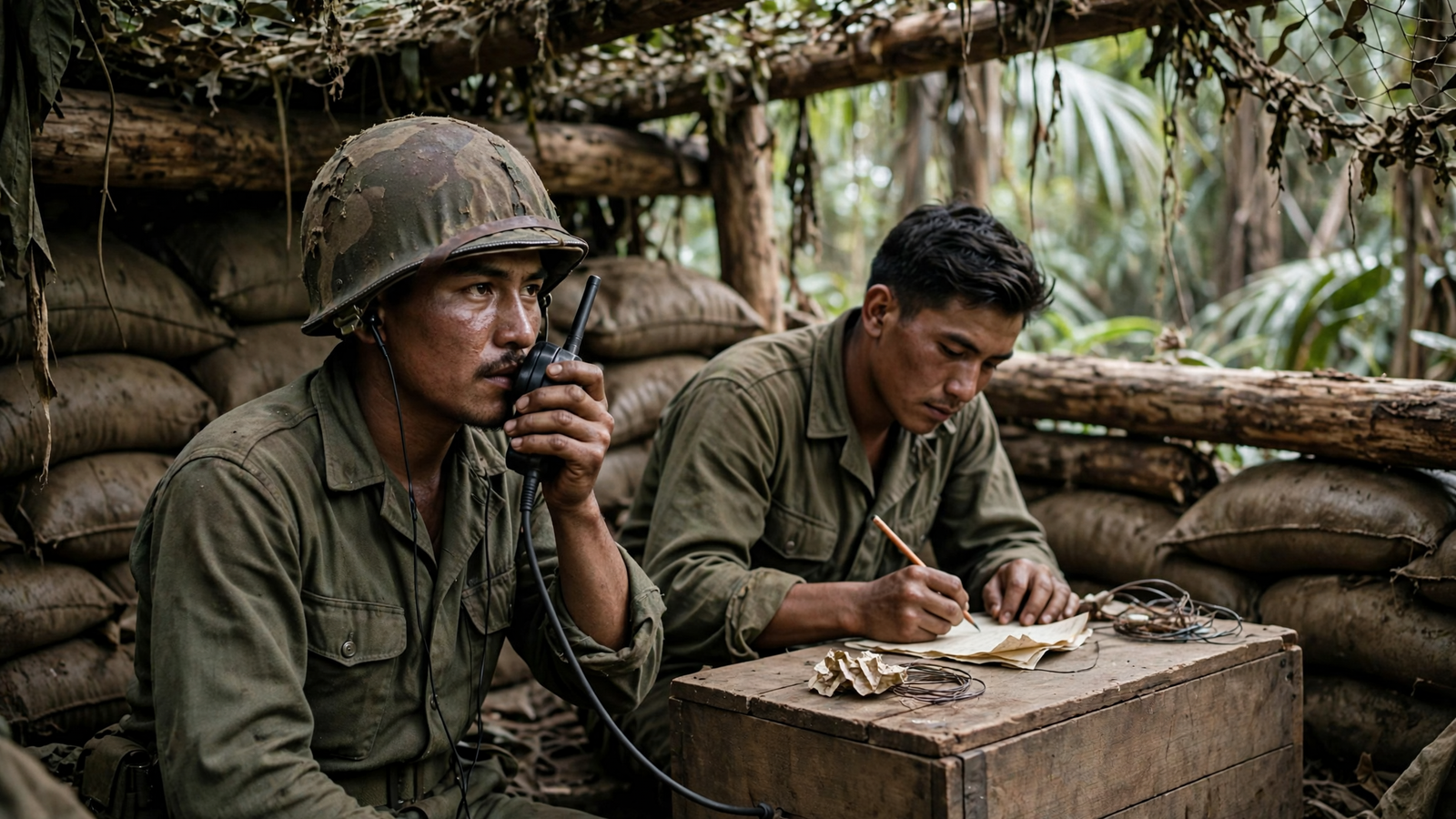
In the spring of 1942, the United States was searching for a way to move military information quickly without allowing the enemy to understand it. Radio offered speed, but Japanese forces had repeatedly shown that they could intercept and analyze American communications. Conventional encryption was useful, yet it could be slow to operate under combat conditions. For related reading, see Keep Calm and Carry On: How a Wartime Poster Became a Global Language of Composure.
The answer came from an unexpected source: the Navajo language.
Within months, a small group of Navajo Marines had designed a communications system that combined their Indigenous language with newly invented military vocabulary, memorized procedures, and a phonetic alphabet. The system was fast enough for battlefield use and unfamiliar enough to Japanese codebreakers that it remained secure throughout World War II. For related reading, see Uncle Sam Wants You: How a Wartime Poster Became America’s Most Persistent Face.
It became one of the most distinctive military contributions associated with the American Southwest. The men who carried it into battle are now widely known as the Navajo Code Talkers. For related reading, see The Po’ Boy: How a Strike-Era Sandwich Became New Orleans’ Shared Language.
A language the enemy did not know
The Navajo Nation stretches across parts of Arizona, New Mexico, and Utah. By the 1940s, Navajo was spoken by a large community but understood by very few people outside it. That made the language valuable to military planners looking for a communications method that did not depend entirely on mechanical encryption.
The idea was proposed in early 1942 by Philip Johnston, a World War I veteran and the son of a missionary who had grown up around Navajo speakers. Johnston understood that the language’s structure and limited number of non-Navajo speakers could make it useful for military communication. He approached the U.S. Marine Corps with the proposal.
To demonstrate the idea, Navajo speakers translated military messages in a Marine office. The translations were completed rapidly, and the messages were then translated back into English with accuracy. The demonstration persuaded Marine officers that the concept deserved a serious test.
That decision did not mean the Marines simply handed military messages to Navajo speakers. The system had to be designed from the ground up. Ordinary Navajo words did not always correspond to aircraft, ships, weapons, or military commands. The code talkers therefore created substitute terms that could be remembered and spoken quickly.
A fighter plane, for example, could be represented by a word associated with a hummingbird, while a bomber might be represented by a term connected to a different bird. These associations gave the code talkers a practical vocabulary for equipment that did not exist in traditional Navajo life.
The first 29
In 1942, the Marine Corps recruited the first group of Navajo men for the experiment. Twenty-nine of them became the original code developers. Among them was Chester Nez, a young Navajo from New Mexico who would later become one of the best-known surviving members of the group.
The men worked at Camp Elliott near San Diego, where they developed the initial code. Their work had two parts. The first was a vocabulary of terms for military objects and situations. The second was a phonetic alphabet that allowed them to spell unfamiliar English words, including names and place names, over the radio.
In the phonetic system, a single English letter could be represented by several Navajo words. A word beginning with the sound associated with “A,” for instance, could stand for that letter. Using multiple words for some letters reduced the chance that a poor radio signal or a misunderstood word would produce an error.
The original code contained more than 200 terms. It was later expanded to more than 400 as the Marines encountered new operational needs. Unlike a codebook that could be seized and studied, much of the system depended on memorization. The code talkers had to know the vocabulary, the procedures, and the correct rhythm of communication.
That combination gave the system its strength. Navajo was the foundation, but the military code was a carefully constructed layer placed on top of it.
From Arizona and the Southwest to the Pacific
The Marines eventually recruited hundreds of Navajo men. Estimates vary by source and by whether they count only active code talkers or all Navajo Marines who served in communications roles, but the number was more than 400.
Many came from communities across the Navajo Nation, including Arizona. They brought with them a language learned at home and within their communities, then used it in a setting that demanded absolute speed and accuracy.
The code talkers served in nearly every major Marine campaign in the Pacific after the program was established. They transmitted orders, reported troop movements, coordinated artillery, and relayed information during amphibious assaults. Messages that might have required lengthy encryption could be sent in a matter of seconds.
The work was dangerous even when the radio operators were not directly fighting. A code talker needed to remain close to the action, carry communications equipment, and continue transmitting while battles moved around him. Some code talkers were also assigned as regular Marines and fought as infantrymen.
The system’s reputation grew because it worked under pressure. Marine accounts described messages being sent and received quickly, with fewer delays than some conventional systems. Navajo code talkers were also paired with guards in some situations because commanders feared that a Navajo Marine might be mistaken for an enemy soldier or, in the confusion of combat, be captured and forced to reveal the code.
The code was not a magical translation of every English sentence into ordinary Navajo. It was a military system with a controlled vocabulary, spelling procedures, and strict operating rules. Its success came from the combination of linguistic knowledge, disciplined training, and the code talkers’ ability to use the system rapidly in real combat.
Why the code remained secret
For decades, the public knew little about the Navajo Marines’ work. The program remained classified after the war, and the code talkers generally could not describe their assignments. Their silence was not simply personal modesty; it was part of protecting military communications practices during the early Cold War.
The secrecy also meant that the men returned home without the public recognition later generations would consider natural. The language that had helped them serve their country was often treated dismissively in other settings, especially by institutions that had spent years pressuring Native children to abandon their languages and cultures.
When the military finally declassified the program in 1968, the story could begin to enter public history. Recognition came gradually. In 1982, the federal government designated August 14 as National Navajo Code Talkers Day. In 2000, Congress authorized the presentation of Congressional Gold Medals to the original 29 code talkers and Silver Medals to other Navajo men who served in the program. The medals were presented in 2008.
The awards acknowledged military service, but they also recognized something larger: a Native language had been treated not as an obstacle to American life, but as a source of knowledge and strategic capability.
Chester Nez and the return of the story
Chester Nez became an important public witness to the code talkers’ history. Born in 1921, he was among the original 29 men recruited to develop the code. After the war, he continued his education and worked for the Veterans Administration before eventually speaking publicly about his service.
Nez’s memoir, published late in his life, helped bring the experience to a new audience. His story placed the code talkers within the larger history of Native American military service, while also showing the personal discipline required to carry a secret for decades.
His account and the work of other code talkers helped correct a common misunderstanding. The achievement was not simply that Navajo happened to be difficult for outsiders to understand. The achievement belonged to the men who transformed their language into a precise, expandable, battlefield communications system—and then used it reliably when lives depended on it.
A legacy larger than a wartime code
The Navajo Code Talkers’ story is often told as a technological curiosity: an unusual language that helped defeat enemy intelligence. That description is incomplete. The program was also a moment in which cultural knowledge, military innovation, and personal courage met under extraordinary circumstances.
Its legacy can be seen in museums, veterans’ memorials, school programs, and public history projects across the Southwest. It has also encouraged broader recognition of Native code talkers from other nations, including Choctaw, Comanche, Kiowa, Hopi, and other Indigenous communities whose languages were used in American military communications.
The Navajo program stands out because of its scale and the complexity of the system developed by its first recruits. Yet its central lesson is straightforward. Innovation does not always begin with a new machine. Sometimes it begins with people recognizing the value of knowledge that has been present in a community all along.
For Navajo Marines in World War II, that knowledge traveled from homes and schools across the Southwest to the beaches, airfields, and command posts of the Pacific. Spoken over radios, carried in memory, and protected by discipline, it became one of the war’s most effective communications achievements—and a lasting source of pride for Arizona and the Navajo Nation.
Use: Background on Native military service, the Navajo Code Talkers, the code’s development, and its wartime use.
Use: Federal historical context on Native code talkers and wartime communications.
Use: Marine Corps history of recruitment, training, code development, and Pacific service.
Use: Legislative record for the Congressional Gold Medals and Silver Medals authorized for Navajo Code Talkers.
Use: Historical and cultural context for Native American code talkers and public recognition of their service.
Smithsonian National Museum of the American Indian — Native Words, Native Warriors: Code Talkers — https://americanindian.si.edu/nk360/code-talkers/ — Background on Native military service, the Navajo Code Talkers, the code’s development, and its wartime use.
National Archives — Native American Code Talkers — https://www.archives.gov/research/native-americans/military/code-talkers.html — Federal historical context on Native code talkers and wartime communications.
U.S. Marine Corps — Navajo Code Talkers — https://www.marines.mil/History/History-Division/People/Navajo-Code-Talkers/ — Marine Corps history of recruitment, training, code development, and Pacific service.
Congress.gov — Navajo Code Talkers Congressional Gold Medal Act — https://www.congress.gov/bill/110th-congress/house-bill/4544 — Legislative record for the Congressional Gold Medals and Silver Medals authorized for Navajo Code Talkers.
Library of Congress — Code Talkers — https://www.loc.gov/item/2020748744/ — Historical and cultural context for Native American code talkers and public recognition of their service.