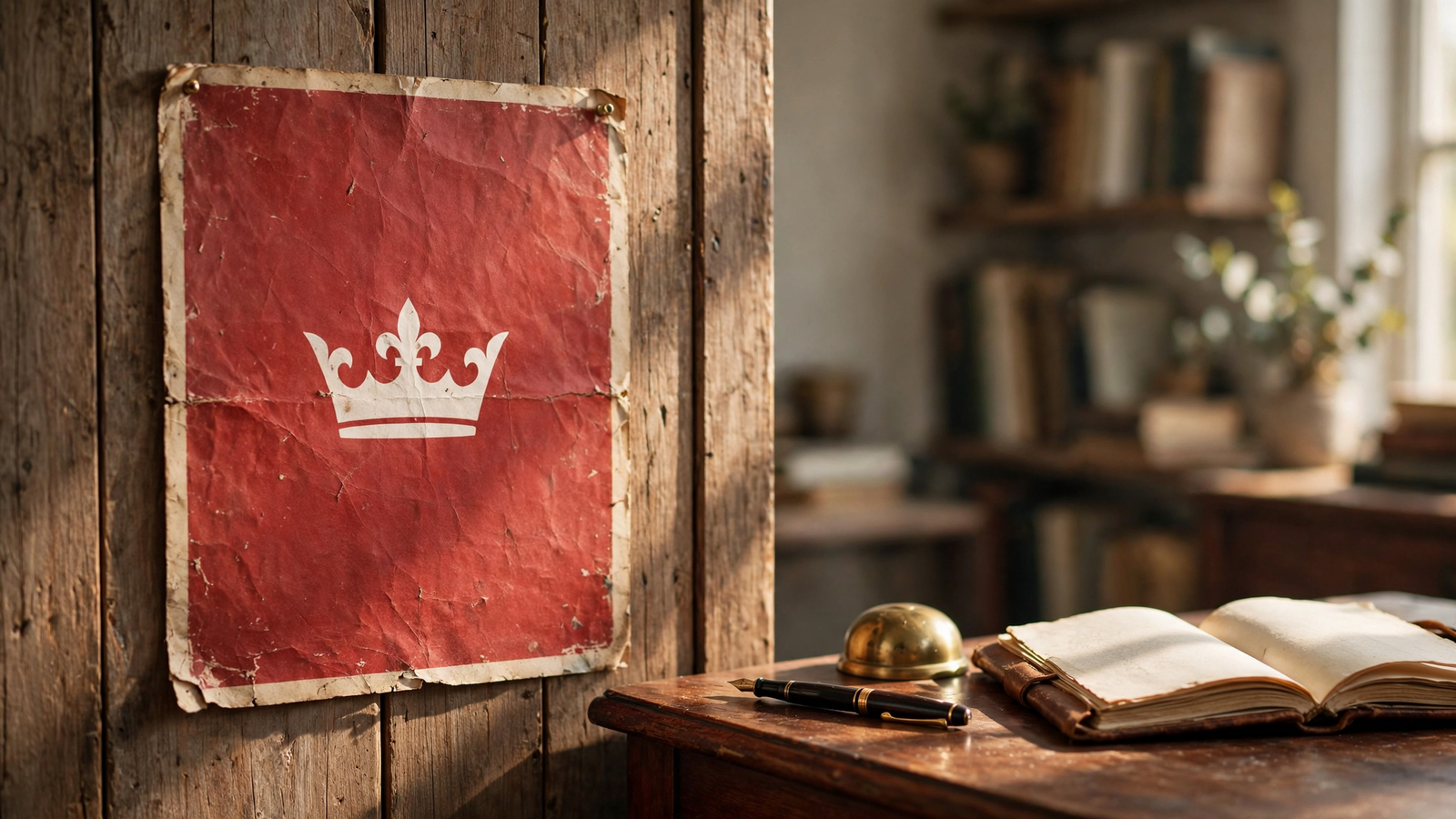
Few posters have traveled farther than “Keep Calm and Carry On.” Its design is almost startlingly simple: a red field, a white crown, and five words set in a restrained, authoritative typeface. Today, the phrase appears on mugs, notebooks, signs, clothing, and digital graphics around the world. But the poster was not originally made to decorate kitchens or offices. It was designed for a Britain preparing to endure an invasion, aerial bombardment, and the disruption of daily life.
The British government created the poster in 1939, as war with Nazi Germany approached. It belonged to a planned series of public-information posters intended to steady the population during an emergency. Two related messages were also produced: “Your Courage, Your Cheerfulness, Your Resolution Will Bring Us Victory” and “Freedom Is in Peril / Defend It with All Your Might.”
The posters shared a visual system meant to be recognized quickly. A crown placed above the lettering connected the message to the state, while the typography avoided illustration, humor, or elaborate decoration. The goal was not persuasion through spectacle. It was reassurance through order.
The poster that mostly stayed in storage
Although millions of British wartime posters were printed, “Keep Calm and Carry On” was not distributed as widely as its companions. The government reserved it for a moment of national crisis, such as a major invasion or sustained attack. When that particular moment did not arrive in the form officials expected, most copies remained in storage.
That quiet fate is part of the poster’s unusual history. It was designed to be public, yet its first life was largely private: folded, stored, and forgotten. Many original copies were later destroyed as part of wartime paper-recycling efforts. The design survived, but not as a widely recognized symbol.
A second life in a Northumberland bookshop
The poster’s revival began decades later. In 2000, booksellers Stuart and Mary Manley discovered an original copy in a box of secondhand books bought at auction. They displayed it at Barter Books, their shop in Alnwick, Northumberland. Customers responded to the calm, direct message, and reproductions soon began appearing beyond the shop.
The timing helped. In the early 2000s, the design’s clean geometry and unhurried command fit a growing taste for vintage graphics. The words also proved unusually adaptable. They could be read as stiffly British, gently comic, genuinely encouraging, or all three at once.
That flexibility transformed a government instruction into a piece of everyday visual language. The crown could be removed, colors could change, and the sentence could be adapted to new situations. Yet the original remained recognizable because its power lay less in ornament than in rhythm: three short words followed by a steadying pair of verbs.
“Keep Calm and Carry On” now belongs to a larger history of ephemera—objects made for a particular moment that acquire new meaning when that moment has passed. Its first purpose was to prepare civilians for danger. Its later purpose became broader and more personal: a small reminder that composure can be practiced, shared, and carried into uncertain days.