Some of the most important oceans in the solar system may be hidden beneath ice.
Europa, one of Jupiter’s largest moons, appears from a distance to be a frozen world: bright, smooth, and crossed by long reddish-brown markings. But beneath its shell of water ice, scientists have found strong evidence for a deep global ocean. That ocean may contain more water than all of Earth’s oceans combined.
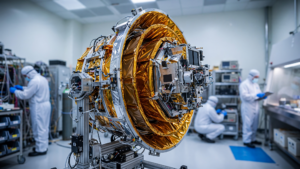
NASA’s Europa Clipper is the first spacecraft designed specifically to investigate whether Europa has the conditions needed for life. It is not carrying a lander, and it will not drill through the ice. Instead, the spacecraft will repeatedly sweep past the moon, using cameras, spectrometers, radar, magnetometers, and other instruments to examine Europa from above and determine what lies beneath its surface.
Europa Clipper launched from Florida on October 14, 2024. Its destination is still years away. The spacecraft is scheduled to reach the Jupiter system in 2030, after using carefully planned planetary gravity assists to build speed and shape its path.
A moon that looks quiet but is anything but simple
Europa is about the size of Earth’s Moon, but its story is very different. Its surface is among the brightest in the solar system because it is coated in relatively clean water ice. At the same time, the surface is broken by ridges, fractures, stains, and enormous bands that suggest the ice has been moving and renewing itself.
The moon’s unusual appearance is connected to Jupiter’s immense gravity. Europa travels around Jupiter in an orbit that brings it into a constantly changing gravitational tug-of-war with the planet and neighboring moons. Those forces flex Europa’s interior, producing heat through tidal energy. Scientists think that internal warmth may help keep a liquid ocean from freezing solid. For related reading, see Bennu’s Dust: How NASA’s Asteroid Sample Is Rewriting the Recipe for Life.
The possible ocean is the reason Europa has become such an important target in planetary science. Life as we know it requires more than water. It also needs an energy source and useful chemical ingredients. Europa may have all three: liquid water, energy generated by tidal heating, and minerals or compounds exchanged between the ocean, the rocky seafloor, and the icy shell.
That does not mean scientists have found life there. Europa Clipper is not a life-detection mission in the narrow sense. Its job is to establish whether Europa’s environment could be habitable and to identify places where future missions might search more directly.
Why repeated flybys matter
Europa Clipper will not settle into orbit around Europa. Jupiter’s radiation environment is so intense that a spacecraft spending too much time close to the moon would face serious risks to its electronics. Instead, Clipper will orbit Jupiter and make repeated close passes by Europa, then retreat to safer distances before returning.
NASA expects the mission to conduct dozens of Europa flybys during its main science campaign. Each pass will offer a different viewing angle, altitude, and set of lighting conditions. Together, those encounters should create a much more complete picture than a single visit could provide.
The spacecraft’s cameras will map the surface in high detail and look for geological features that may have formed recently. Spectrometers will study the composition of ice and dark material on the surface. A thermal instrument will search for warmer regions that could point to active geology or material rising from below.
One of the most distinctive tools is an ice-penetrating radar. Radar waves may reveal the thickness and structure of Europa’s ice shell, including pockets of water or layers created as the surface shifts. The instrument cannot simply produce a picture of the entire ocean, but it may show how the ice behaves and where the boundary between surface and interior becomes especially complex.
Listening for an ocean with magnetism
Europa Clipper will also carry a magnetometer to investigate the moon’s magnetic environment. A salty ocean can conduct electricity. As Europa moves through Jupiter’s changing magnetic field, that ocean may generate a measurable induced magnetic signal. For related reading, see DART: How NASA Turned an Asteroid Impact Into a Planetary Defense Test.
Earlier observations by the Galileo spacecraft provided important evidence for such a signal. Clipper’s magnetometer is designed to study it in much greater detail, helping scientists estimate the ocean’s depth, conductivity, and relationship to the ice above it.
The spacecraft will combine that information with measurements of Europa’s gravity and interior structure. A radio science experiment will track tiny changes in the spacecraft’s motion as Europa’s gravity pulls on it. Those changes can help researchers understand how mass is distributed inside the moon, including the relative sizes of its ice shell, ocean, and rocky interior.
No single instrument will answer every question. The mission’s strength comes from comparing different kinds of evidence. A surface crack seen by the cameras may look different when examined through infrared wavelengths. A possible plume or thin atmosphere may be investigated by the spacecraft’s particle and magnetic-field instruments. A region that appears geologically young may receive particular attention from radar and thermal observations.
The challenge of exploring Jupiter
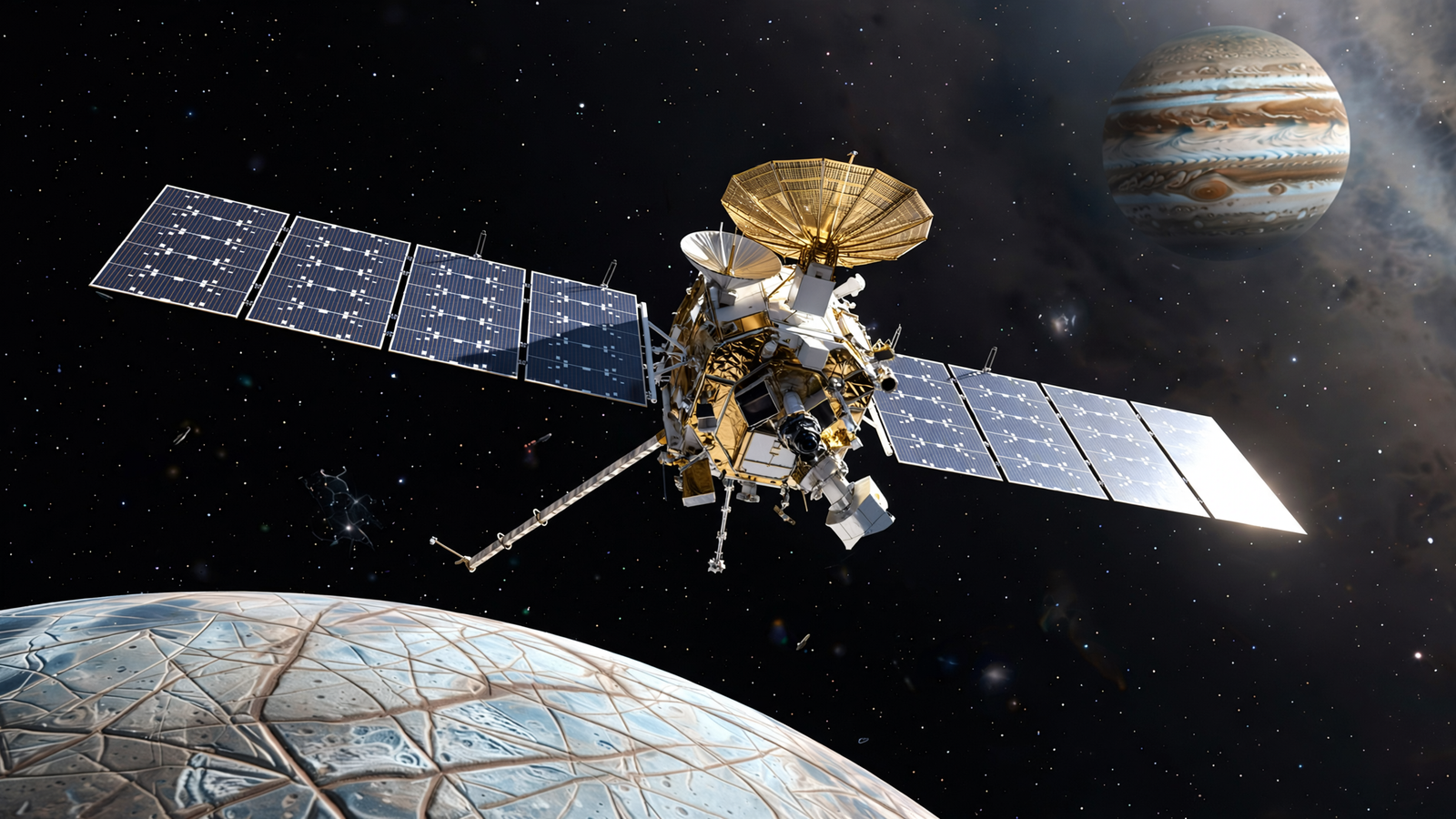
Getting to Europa is only part of the problem. Jupiter is nearly five times farther from the Sun than Earth is, so sunlight is weak there. Europa Clipper uses large solar arrays to generate power, making it NASA’s largest planetary spacecraft to rely on solar energy.
The spacecraft must also protect its electronics from Jupiter’s radiation belts. Critical components are housed inside a shielded enclosure, sometimes described as an electronic vault. The protection adds mass, but it is necessary for a mission that will repeatedly approach one of the harshest radiation environments visited by a NASA spacecraft.
Navigation presents another challenge. Europa Clipper must arrive at Jupiter with the right speed and timing to enter its planned orbit. Its route includes a gravity assist at Mars and another at Earth, allowing the spacecraft to gain energy without carrying enough fuel to make the entire journey through engine burns alone. For related reading, see Parker Solar Probe: How a Small Spacecraft Reached the Sun’s Unexplored Frontier.
Once it reaches Jupiter, the mission team will need to coordinate encounters with Europa while managing the spacecraft’s radiation exposure, communications, power, and thermal conditions. The result is less like a direct road trip than a long sequence of carefully timed orbital maneuvers.
What the mission could change
Europa Clipper could transform the map of the moon’s surface. Planetary scientists expect to identify regions where the ice is unusually thin, fractured, or connected to material from below. Those locations could become priorities for later exploration.
The mission may also reshape scientists’ understanding of icy worlds beyond Jupiter. Europa is part of a larger family of ocean worlds that includes Saturn’s Enceladus and Titan, as well as several moons farther out in the solar system. If Europa’s interior proves active and chemically rich, it would strengthen the case that hidden oceans are common places for complex planetary processes.
Yet the most valuable result may be a more precise definition of what scientists do not know. The depth of Europa’s ocean, the thickness of its ice, the nature of its seafloor, and the movement of material between those layers all remain uncertain. Good planetary exploration does not begin by assuming an answer. It builds the evidence needed to ask a better question next.
Europa Clipper will not land, scoop up ice, or send a message from beneath the ocean. Its work will be more patient. Over years of flybys, it will assemble clues from light, heat, gravity, magnetism, and radar. Each measurement will bring a hidden world into sharper focus.
For now, Europa remains a bright point circling Jupiter, its ocean concealed beneath kilometers of ice. But the spacecraft launched from Earth has begun the long journey toward that barrier. When it arrives, humanity will have a new way to examine one of the solar system’s most intriguing possibilities: that a world covered in ice may still contain an environment where life could find a way to begin.
Use: Mission purpose, spacecraft instruments, Europa’s ocean evidence, planned flybys, and arrival timeline.
Use: Launch date, mission objectives, spacecraft design, and journey to the Jupiter system.
Use: Mission operations, science goals, Europa’s environment, and instrument descriptions.