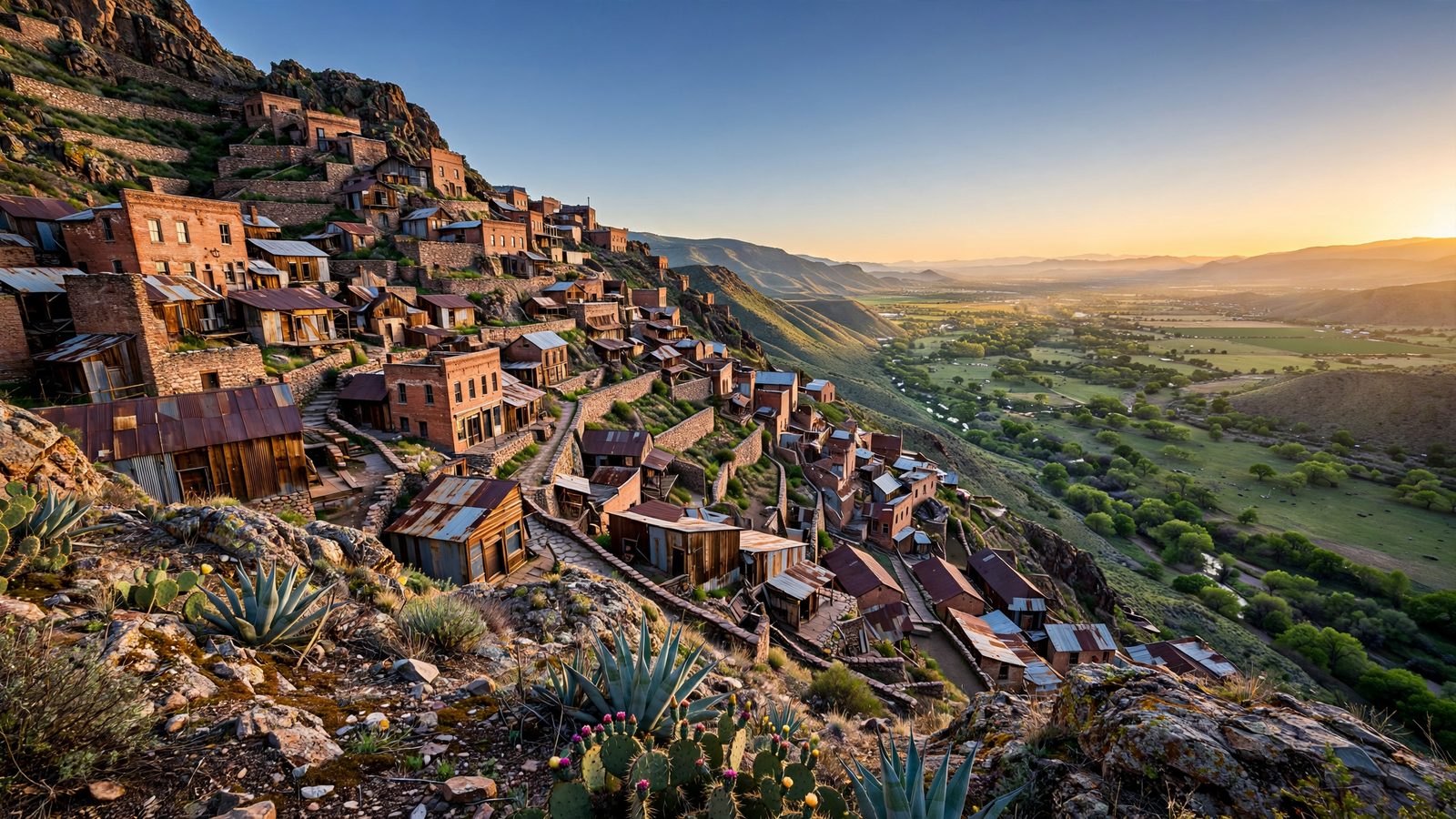
Jerome is hard to mistake for a town built on level ground. Its streets climb Cleopatra Hill above the Verde Valley, following a landscape shaped by steep slopes and a long history of copper mining. The old mining town is not simply a collection of preserved buildings: it is a community whose present-day character remains closely tied to the industry that first drew people here.
A town built around copper
The story of modern Jerome centers on the United Verde mine, whose development made the hillside a major mining center. Copper shaped the town’s growth, bringing workers, businesses and the infrastructure needed to support them. It also left a physical imprint: Jerome’s location and street pattern reflect the demands of a settlement built beside its mines rather than laid out across a broad, flat plain.
The Jerome State Historic Park offers one way to understand that industrial history. Its central building is the Douglas Mansion, built in 1916 by mining entrepreneur James S. Douglas. The mansion now anchors exhibits about the mining district and the people and work that made it important. From this vantage point, the landscape itself helps explain the story: the mines were not distant abstractions but part of the town’s immediate surroundings.
Life after the boom
Mining towns can face a difficult question when their defining industry contracts: what remains when the work that brought people there is no longer the center of daily life? Jerome’s history did not end with mining’s decline. Instead, its steep streets, historic buildings and dramatic setting became part of a different local identity—one that includes preservation and visitors, while the town continues to be a place where people live.
That transition is not the same as freezing a town in time. Historic buildings can be cared for and reused, but they still belong to a community with everyday needs. Jerome’s story is therefore more than a tale of old machinery or a picturesque main street. It is also about how a place can recognize the industry that formed it without being defined only by its past.
Reading the hillside
For visitors from Prescott and other nearby communities, Jerome offers a close-up look at how geology, work and settlement can shape one another. The park’s exhibits provide historical context; the town’s location makes the terrain part of the lesson. The climb, the close-set streets and the views down toward the valley all point back to the practical realities of building a community on a mineral-rich slope.
Jerome’s appeal today rests partly on that visible continuity. The mining era remains present in the historic landscape, while the town has made room for a life beyond the mines. Its lasting achievement is not that it escaped change, but that it kept a distinct sense of place through it.