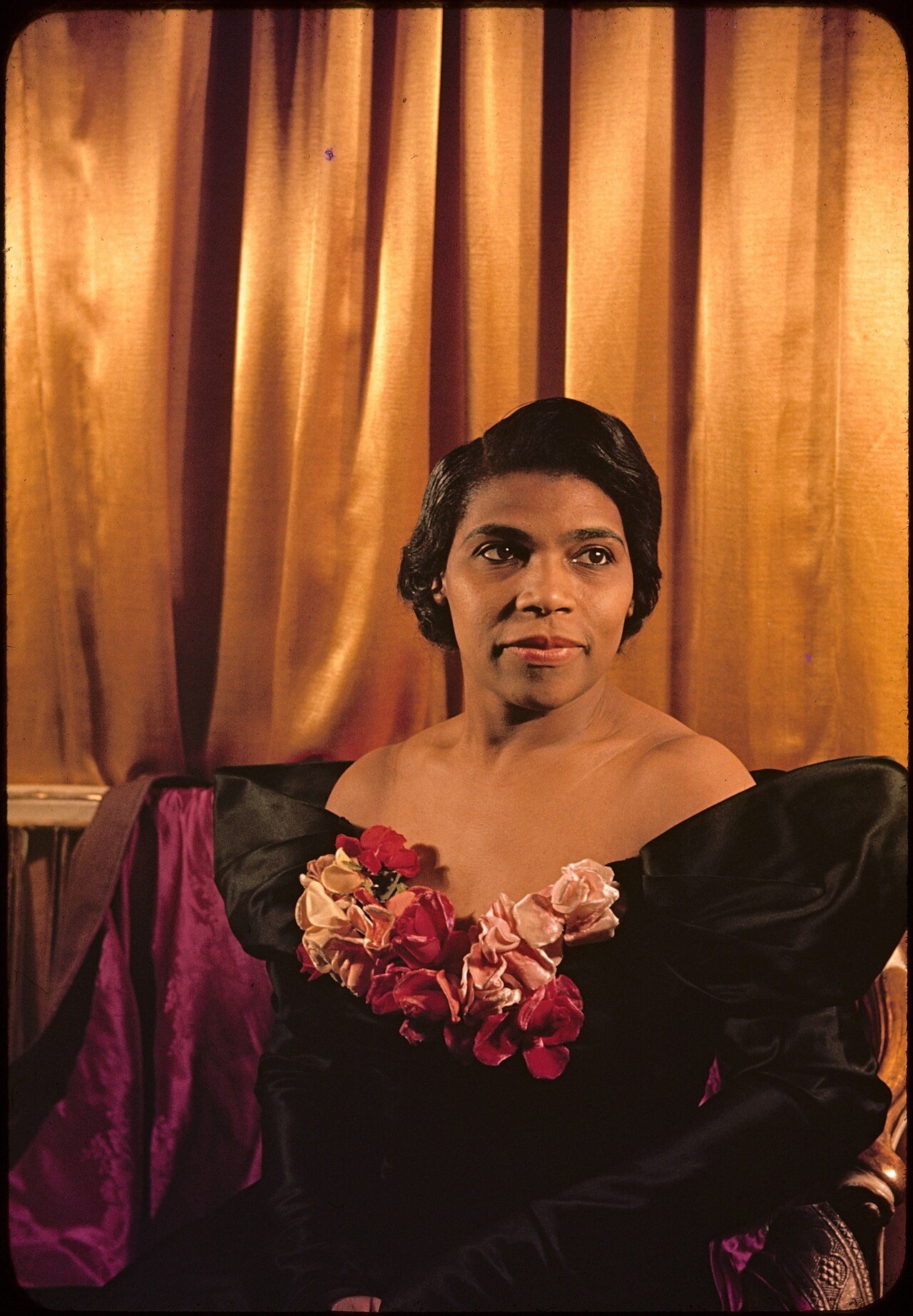
On Easter Sunday in 1939, Marian Anderson stood on the steps of the Lincoln Memorial and sang to a crowd spread across the National Mall. The celebrated contralto was already an international performer. But the concert became more than a showcase for her voice: it brought a dispute over racial exclusion into the open, in a setting associated with the nation’s ideals.
Anderson’s career did not begin with that afternoon, and it did not end with it. Her story is one of long preparation, artistic distinction and a public performance whose meaning grew beyond the music.
A singer who built her craft over time
Born in Philadelphia in 1897, Anderson sang in church as a child and developed her musical skills in a community that helped support her early ambitions. She pursued vocal training and performed locally before wider audiences began to recognize the power and range of her voice. Her repertoire included opera and art song as well as spirituals, which she presented as concert music rather than as a separate or lesser form.
Racism shaped the opportunities available to her. Anderson was denied admission to a Philadelphia music school because she was Black, a barrier she later described publicly. She continued her studies through private instruction and performance opportunities. The refusal did not define the limits of her ability; it revealed the limits imposed by the institutions around her.
By the 1930s, Anderson had toured widely in Europe and earned admiration from audiences and critics. That background matters when recalling the Lincoln Memorial concert. She was not an unknown singer whose career was created in a single afternoon. She was a mature artist, and the concert offered an unusually large audience the chance to hear a performer whom discriminatory practices had kept from a prominent Washington venue.
A closed hall, and a concert outdoors
The immediate dispute concerned Constitution Hall, a major Washington performance space owned by the Daughters of the American Revolution. The organization refused to let Anderson perform there, citing its policy against Black artists appearing on the hall’s stage. The decision drew public criticism. First Lady Eleanor Roosevelt resigned from the DAR and helped bring attention to the exclusion, while other advocates worked to find a place where Anderson could sing.
The concert was arranged at the Lincoln Memorial with support from the Department of the Interior and Secretary Harold Ickes. On April 9, 1939, Anderson performed before an estimated 75,000 people, with many more listening through radio coverage. The scale transformed the event: a dispute over access to one hall had become a performance witnessed by a national audience.
Anderson opened with “My Country, ’Tis of Thee.” The choice carried special weight in that setting. The familiar patriotic song asks listeners to imagine a country whose promises belong to everyone; Anderson’s presence made the distance between that ideal and the discrimination she had faced visible. She continued with classical and spiritual selections, making the concert an artistic performance in its own right, not simply a political statement.
The setting also mattered. The Lincoln Memorial was already a place where Americans gathered to remember the president associated with emancipation. With Anderson singing from its steps, the monument became a concert hall open to a crowd that could not be turned away by a venue’s admission policy.
What the moment changed—and what it did not
The concert became a landmark in the public history of civil rights and American music. Its reach came partly from the contrast at its center: a singer of international standing had been denied a Washington stage because of her race, then performed at one of the capital’s most visible landmarks. The event made that contradiction difficult to keep private or local.
Still, a powerful performance was not a substitute for lasting change. Anderson continued to work within a music world where Black artists faced unequal access and opportunity. The concert did not, by itself, dismantle those barriers. Its significance lies instead in the way it gave the exclusion a public setting and gave Anderson’s artistry an audience on an extraordinary scale.
She went on to break another important barrier in 1955, when she became the first Black singer to perform a leading role with the Metropolitan Opera. That achievement, like the Lincoln Memorial concert, followed years of work. It was not simply a prize awarded after one famous appearance, but a new opening in an institution where Black performers had been largely shut out.
A legacy carried by the music
Anderson’s legacy is sometimes reduced to a single image: the singer in a dark coat, standing before the Lincoln Memorial. The image is memorable, but the career behind it deserves equal attention. She had spent decades developing a voice that could move between musical traditions and performing for audiences across continents. The 1939 concert mattered because the artist was already fully formed—and because the country’s refusal to make room for her had become a story of its own.
That afternoon also shows how a public performance can hold more than one meaning without losing its artistic purpose. Anderson did not have to stop being a musician to become part of a civic turning point. She sang, and the audience heard both the music and the circumstances that had brought her there.
More than eight decades later, the concert remains a reminder that access to cultural stages is never merely a question of rooms and schedules. It determines who is heard, where a public gathers, and which voices become part of a nation’s shared memory. Anderson’s voice reached far beyond the steps that day—but it was the quality of the singing, as much as the symbolism of the setting, that gave the moment its enduring force.