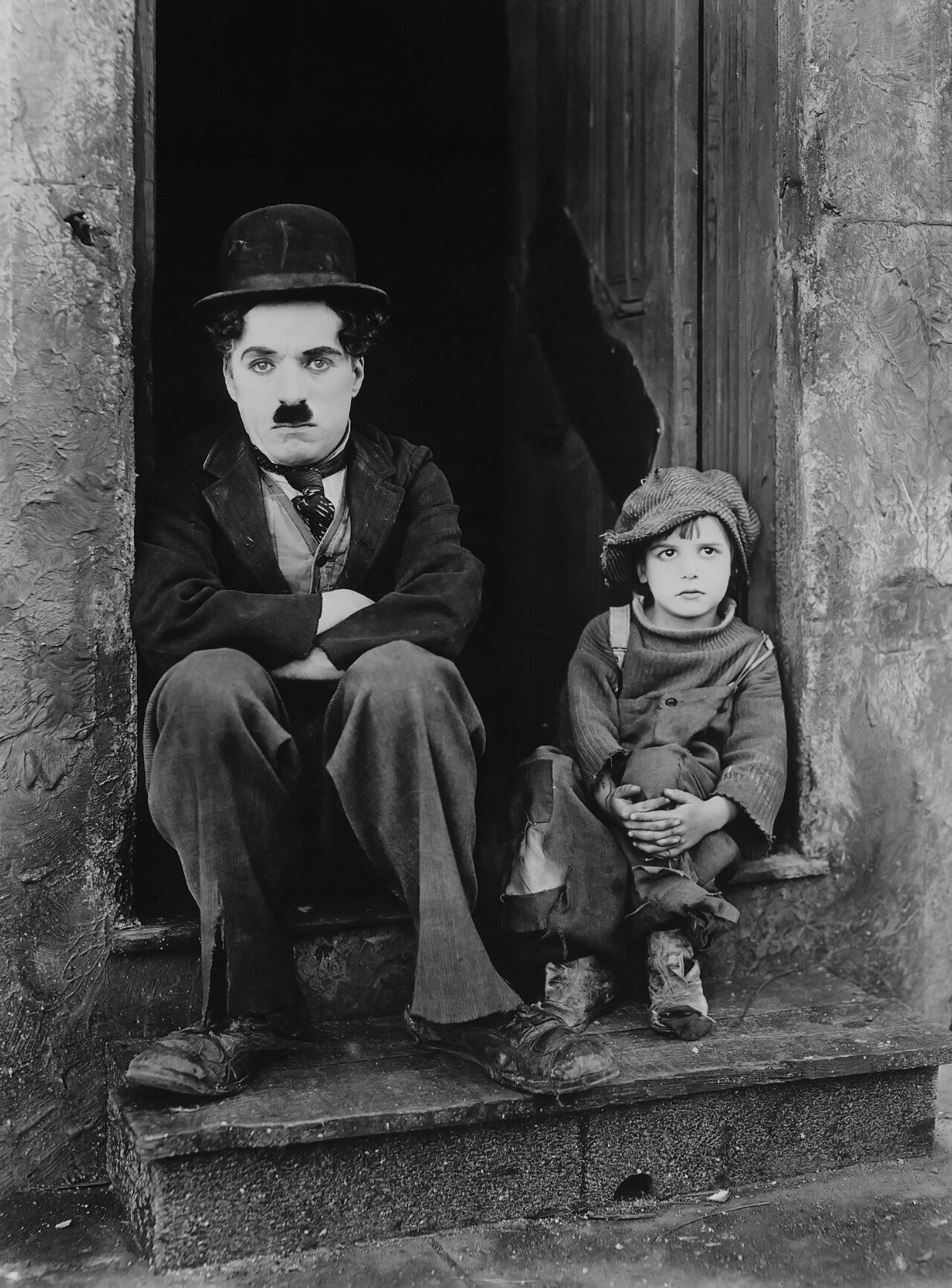
In The Kid, released in 1921, a small boy helps Charlie Chaplin’s Tramp navigate a world of hard knocks. The child actor playing him was Jackie Coogan, whose expressive face and assured comic timing made him an international star while he was still very young.
Coogan’s career is remembered for more than its early success. As his childhood fame gave way to adulthood, a dispute over the money he had earned drew attention to a difficult question: when a child’s work brings in substantial income, who has the right to keep it? California’s response became known as the Coogan Law. The story links one performer’s remarkable rise to a wider effort to protect young actors.
A young performer in a new kind of film
Born in Los Angeles in 1914, Coogan was already performing as a child when he appeared in The Kid. Chaplin’s film asks audiences to laugh at the Tramp’s improvisations while also caring about the vulnerable boy he takes in. Coogan had to hold his own opposite one of the era’s most celebrated screen performers, shifting between comedy and moments of distress without losing the character’s warmth.
The film’s success made Coogan a major attraction. He went on to star in other productions, including the 1922 adaptation of Charles Dickens’s Oliver Twist. At a time when movies were becoming a global popular art form, his popularity crossed national borders. To viewers, he was not simply a child appearing in a film; he was a draw in his own right.
That fame came with an unusual economic reality. Coogan’s work generated income when he was too young to manage contracts or make independent decisions about the proceeds. Adults around child performers commonly handled those matters. But the arrangements that made it possible for children to work did not necessarily ensure that the children would retain their earnings when they grew up.
When a star grew up
Coogan’s later dispute with his mother and stepfather over his earnings brought that imbalance into public view. The case became a prominent example of the risks faced by young performers: money earned through a child’s labor could be controlled by adults, leaving the performer with little say over what was saved for the future.
Accounts of the dispute often repeat dramatic estimates of the fortune Coogan earned and what remained. Such figures vary across retellings, so they should not be treated as settled fact without strong documentation. The central issue does not depend on a precise total: Coogan had been a successful working performer as a child, yet the question of who controlled the fruits of that work became a serious conflict once he was an adult.
California enacted legislation in 1939 that came to be called the Coogan Law. The law’s protections have changed over time, and today’s rules are more useful to understand as part of a broader system than as a perfect solution created all at once. California’s current guidance says that a portion of a minor performer’s earnings must be placed in a protected trust account, commonly called a Coogan account. The measure is intended to reserve money for the young performer rather than leave every dollar subject to an adult’s control.
That distinction matters. A law bearing a performer’s name is not a guarantee that every workplace is safe or that every young actor will have the same opportunities. Child performers still need permits, limits on working conditions, responsible adults and financial safeguards. The Coogan account addresses one specific vulnerability: keeping some earnings set aside for the child who made them.
A career beyond the child-star years
Coogan’s story did not end with silent films or the legal fight. He continued acting as an adult and found a new audience decades later as Uncle Fester in the television series The Addams Family. For viewers who knew him from the 1960s show, the eccentric, bald-headed Fester was a familiar television character; for older film fans, Coogan had once been the boy beside Chaplin.
The long arc of his career complicates the familiar child-star narrative. Coogan was not only a symbol of early fame followed by hardship. He was a working actor whose public identity changed with the entertainment industry, from silent cinema to television. His later role introduced him to audiences who may never have seen The Kid, while the earlier film remains a record of how much a young performer could contribute to a movie.
His name also remains attached to a practical protection. California’s labor rules now describe how young performers’ earnings are handled, and the state’s statutory framework sets out protections for minors working in entertainment. These safeguards reflect a continuing recognition that a child’s career and a child’s financial future are not the same thing. The work may be visible to millions; the arrangements behind it are not.
What the name represents
“Coogan Law” is a compact label for a complicated history. It recalls a real performer, but it also points to a problem larger than one family or one era: children can help create valuable work without having the power to manage its rewards. Setting aside part of a young actor’s income cannot settle every question about fairness in show business. It can, however, make one important promise more concrete—that at least some of the earnings belong to the person whose work produced them.
More than a century after Coogan played the boy in The Kid, audiences can still watch that performance as both cinema and a glimpse of a very young professional at work. His legacy reaches beyond the screen: it is also a reminder that protecting young performers means thinking about what happens after the applause, the contracts and the childhood fame have passed.