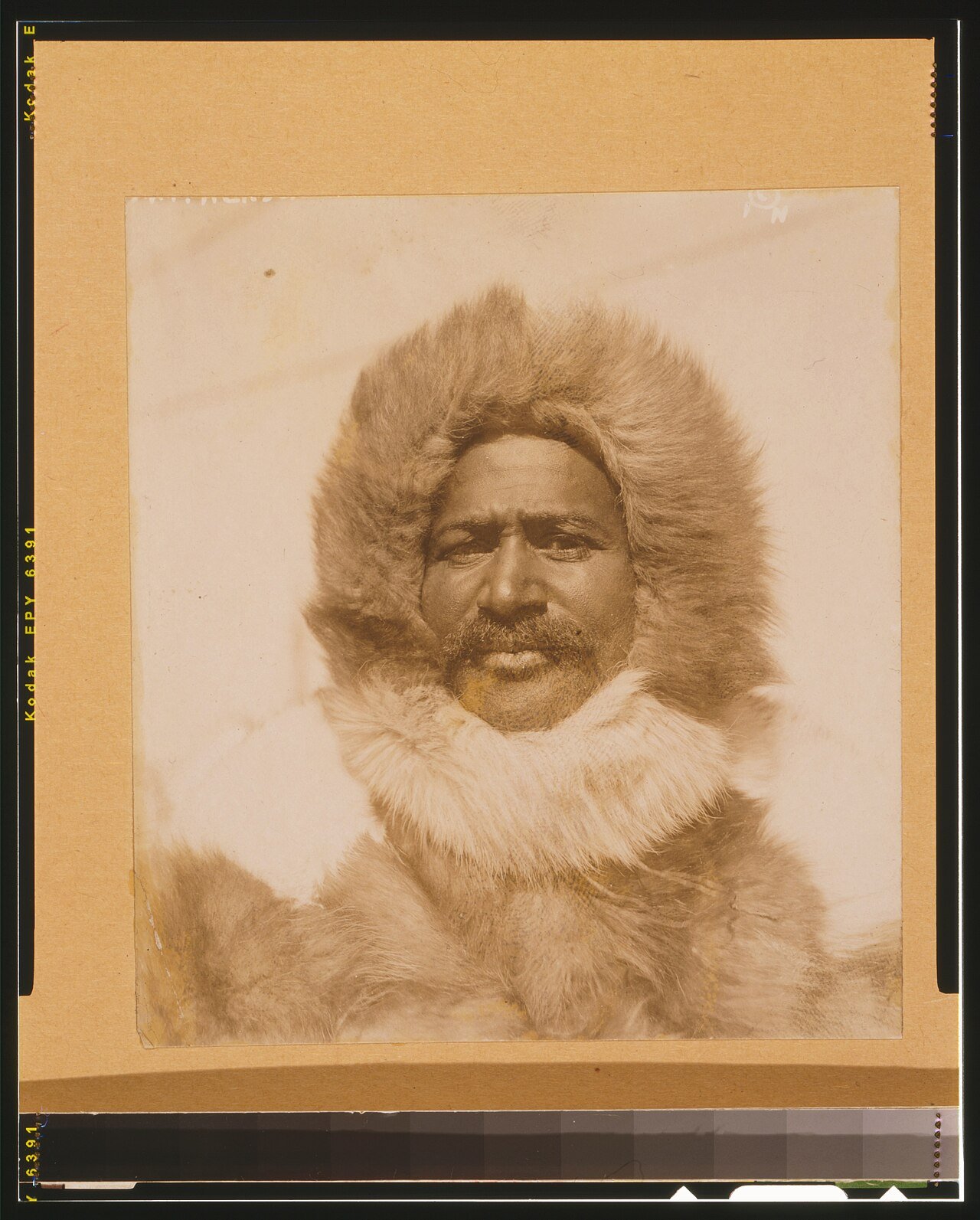
In the late 19th century, Arctic travel demanded more than a bold destination. It required people who could build and manage sledges, travel across shifting ice, find food and work with the region’s Inuit communities. Matthew Henson became exceptionally skilled at that work. Yet for much of his life, the African American explorer was known mainly as a member of expeditions led by Robert E. Peary.
Henson’s story is not simply a matter of correcting a name on a map. It is a reminder that exploration depends on practical expertise and cooperation—and that public credit has not always followed the work.
From Maryland to a life at sea
Henson was born in Maryland in 1866. After losing his parents while young, he eventually went to sea as a teenager. Working aboard merchant ships exposed him to navigation and life far beyond his home. His maritime experience would later prove valuable in a very different setting.
In 1887, Henson met Peary, a U.S. Navy officer preparing for an expedition to Nicaragua. Peary hired him as an assistant. Henson’s work on that journey led to a lasting professional relationship, and he joined Peary’s subsequent Arctic expeditions.
The North was not a place where determination alone could keep a party alive. Ice shifted, weather changed quickly, and routes that looked passable could become dangerous. Henson developed skills in handling sledges and equipment and learned to travel effectively in Arctic conditions. He also learned Inuktitut and built relationships with Inuit people whose knowledge of the region was essential to the expeditions.
Experience measured in miles and winters
Henson’s importance grew through years of repeated travel, not a single dramatic moment. He took part in expeditions that pushed northward through Greenland and the Arctic. The long experience helped him understand how to manage the practical demands of travel on ice—knowledge that mattered to the whole party.
Accounts of the expeditions describe Henson as a capable mechanic, hunter and sled driver. Those roles were not background details. A team’s progress depended on functioning equipment, reliable transport and the ability to respond to conditions far from outside help. Henson’s experience made him one of the expedition’s most seasoned members.
That work also took place within a complicated arrangement. Peary was the expedition leader, but no one person could supply all the knowledge needed to cross the Arctic. Inuit guides and other members of the party contributed vital skills and labor. Henson’s story is often told as a partnership between him and Peary; a fuller account also recognizes the wider network of people who made the journeys possible.
The 1909 expedition and a contested claim
In 1909, Peary led an expedition that announced it had reached the North Pole. Henson was part of the team, and his later account described him as reaching the goal ahead of Peary. The precise details of who arrived first—and the expedition’s exact position—have been debated. There was no independent observer at the claimed point, and historians have questioned whether the party’s measurements established that it reached the geographic pole.
That uncertainty matters. It is more accurate to say that Peary’s party claimed to reach the pole than to present the achievement as beyond dispute. It also does not erase Henson’s documented role in the expedition or the years of Arctic work that preceded it. His experience was central to the party’s capacity to travel through demanding conditions.
Henson published his account, A Negro Explorer at the North Pole, in 1912. The title put his race and his achievement together at a time when Black Americans faced pervasive discrimination. Although he had become famous in some circles, his place in the public story of Arctic exploration remained smaller than Peary’s.
Recognition that came slowly
In later life, Henson received honors that acknowledged his part in Arctic exploration. But recognition was uneven and delayed. His experience illustrates how the history of exploration can center the person who led an expedition while leaving the expertise of other participants less visible.
Henson died in 1955. In 1988, his remains were reinterred at Arlington National Cemetery, near Peary’s grave. The move brought renewed attention to a career that had taken Henson from a childhood in Maryland to some of the most remote landscapes on Earth.
Today, Henson’s legacy is strongest when it is told with care: he was an accomplished explorer and an important member of Peary’s Arctic expeditions, while the 1909 pole claim remains a subject of historical debate. His life also widens the usual picture of exploration. The story is not only about who stood at a destination, but about who learned the terrain, solved problems along the way and helped a party keep moving.
That is a substantial achievement in its own right. Henson’s name belongs in the history of Arctic exploration not as a footnote to someone else’s journey, but as a skilled traveler whose work helped make those journeys possible.