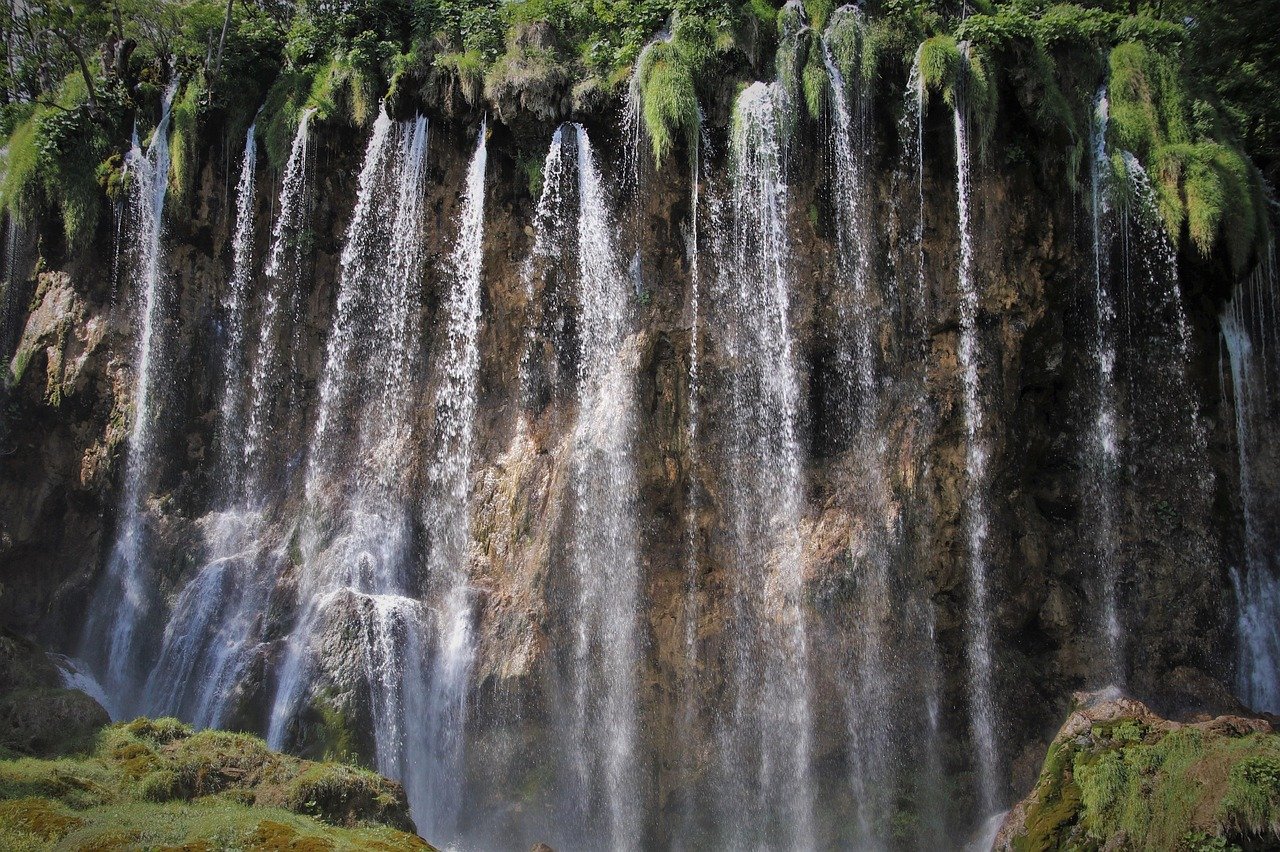
At first glance, Plitvice Lakes National Park in central Croatia looks like a landscape paused in mid-motion: clear water spills over pale ledges, gathers in a lake, then drops again. But those ledges are not merely scenery. They are natural dams, formed as mineral deposits accumulate across the water’s path. The waterfalls and lakes are part of a process that is still unfolding.
The park lies in the Dinaric karst region, where water moves through limestone and other soluble rock. At Plitvice, that geology meets a complex community of water, minerals and living organisms. The result is a chain of lakes held apart by barriers that grow and change rather than by concrete or bedrock alone.
How water makes a natural dam
The key material is tufa, a porous limestone deposit rich in calcium carbonate. Rainwater moving through limestone can carry dissolved minerals. When that water reaches the surface and conditions change, some of the dissolved calcium carbonate comes out of the water and settles onto surfaces in the stream.
That process is not simply a matter of minerals dropping out like sediment in a jar. Algae, mosses and bacteria living in the water and on submerged surfaces help provide places for deposits to form. Layer after layer, the material builds up into ridges across channels. Those ridges slow or redirect water, and can become barriers separating one lake from another.
The park’s own descriptions emphasize the role of this biological activity in tufa formation. It helps explain why the landscape can be both geological and ecological at once: the shape of a barrier depends on water and rock, but also on the organisms living where they meet.
A chain of lakes, not a static display
UNESCO describes Plitvice as a system of 16 lakes linked by waterfalls and separated by natural dams. The lakes are commonly grouped into upper and lower sections. Water moves through the connected landscape, crossing barriers and continuing downstream toward the Korana River.
Because the dams are built by deposits that continue to form, a waterfall is not a permanent sculpture with an unchanging edge. Tufa may accumulate in one place, water may begin to favor another route, and a barrier’s profile can shift over time. The broad pattern of lakes and cascades persists, while its individual details remain subject to change.
That slow construction makes Plitvice different from a landscape defined only by erosion. Water does wear away rock, but here it also helps build the structures that hold water back. The same stream can contribute to a barrier’s growth and flow over it as a cascade.
Why the living part matters
Tufa formation depends on conditions in the water, including its chemistry and the communities of organisms that occupy submerged surfaces. That connection gives the park’s bright pools and waterfalls a deeper significance: clear water is not just a visual feature. It is part of an ecological setting where the natural dams can develop.
It also means the scenery should not be mistaken for a self-contained collection of lakes. The system is connected to the land and water around it. What enters a stream’s catchment can ultimately affect the water moving through the park. Protecting the landscape therefore means looking beyond the most photographed cascades to the processes that sustain them.
UNESCO inscribed Plitvice Lakes on the World Heritage List in 1979, recognizing its exceptional natural features and ongoing geological processes. That recognition reflects more than the beauty of a single viewpoint. The park is valuable as a functioning system: water, limestone, microorganisms and plants together help create the barriers that shape its lakes.
A landscape visitors can witness, but not freeze
Boardwalks and trails offer visitors close views of water moving over tufa, but the most important changes often happen too slowly to notice during a visit. A ledge’s growth is not a show with a visible beginning and end. It is an accumulation of small interactions, repeated across seasons and over longer spans of time.
That pace invites a different way of looking. A waterfall is not only a drop in the river; it is also water passing over a structure made by earlier flows and living communities. A lake is not just a blue basin; it is one part of a chain whose natural partitions are continually being built and reshaped.
Plitvice’s appeal rests partly in its color and movement, but its deeper wonder is architectural. The landscape is making itself, one mineral deposit at a time. Its lakes and cascades are not finished monuments. They are the visible expression of a process that continues whenever water, rock and life meet.