Across remote atolls and coastal islands, scientists are assembling a clearer picture of a simple ecological truth with big implications: seabirds move ocean nutrients onto land, and those nutrients can flow back into the sea to fertilize and speed the recovery of nearby coral reefs.
A measurable boost from bird guano
A comprehensive field study in the Chagos Archipelago quantified how seabird colonies change reef chemistry and function. Between islands with dense bird populations and those without, researchers found higher coral calcification and greater reef carbonate production next to seabird‑rich islands—enough to raise framework production by multiple kilograms of calcium carbonate per square metre per year in lagoon and shallow fore‑reef habitats. The paper frames seabirds as a natural nutrient subsidy that can shift reef productivity and sediment dynamics in ways that support island and reef resilience. ([pubmed.ncbi.nlm.nih.gov](https://pubmed.ncbi.nlm.nih.gov/42031963/))
Other recent ecological work reaches the same conclusion from different angles: seabird‑derived nitrogen and phosphorus alter food‑web routing on reefs, boosting some fish groups and changing the abundance and behaviour of small cryptic species that underpin reef food chains. Together, these studies show the nutrient subsidy is not just a localized fertilizer effect but a re‑wiring of energy flows that can help reefs rebuild after heat stress or other disturbances. ([esajournals.onlinelibrary.wiley.com](https://esajournals.onlinelibrary.wiley.com/doi/10.1002/ecy.70453?af=R&utm_source=openai))
From papers to projects: removing rodents to restore a circular economy
The ecological payoff from seabirds matters because seabird populations on many islands were decimated by invasive rats and mice. Recent restoration campaigns are now reversing that pattern. On Tetiaroa Atoll in French Polynesia, a multi‑year program to remove invasive rats and restore seabird habitat has reduced rat numbers dramatically; project updates note that much of the atoll has been rat free for more than a year and that managers see strong responses in birds and other native species. As the site’s managers point out, those recovering seabird colonies may in turn help the adjacent reefs by returning marine nutrients to nearshore waters. ([tetiaroasociety.org](https://www.tetiaroasociety.org/programs/conservation/tarp-rat-eradication))
In Western Australia, state authorities carried out a drone‑assisted baiting campaign in May 2026 on Beacon and Gun Islands (Houtman Abrolhos) to remove invasive mice. Early monitoring detected no mice on Beacon Island in the three months that followed, an encouraging sign for seabird nesting habitat in a region that supports several at‑risk species. Officials described the operation as part of broader island biosecurity work meant to strengthen both bird health and island resilience. ([minister.agriculture.gov.au](https://minister.agriculture.gov.au/collins/media-release/joint-statement-wa-rodent-eradication-boost-h5-bird-fli))
Pairing island restoration with coral science
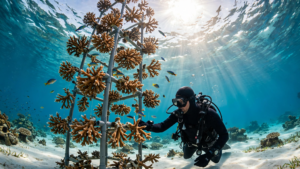
Conservation practitioners are beginning to treat seabird restoration and coral restoration as complementary. That approach is also showing results in active coral projects. The CORALADAPT consortium—a multi‑country research and restoration effort—has been explicitly testing how to select and propagate heat‑tolerant corals and then outplant them to build reefs that stand a better chance under warming oceans. In 2025 the project outplanted roughly 1,800 coral fragments across six sites and reported high short‑term survival (about 80% after four months), evidence that restoration methods informed by local heat‑tolerance can work at operational scale. ([cordap.org](https://cordap.org/projects/coraladapt-identifying-heat-resistant-corals/))
U.S. federal funding and university partnerships are backing similar work farther east: a $4.6 million NOAA‑funded collaboration launched in early 2026 to scale coral restoration in American Samoa focuses on locally robust, heat‑tolerant corals and on training Pacific Island students and managers. Those investments are designed to keep reefs functioning as natural coastal barriers as seas rise and heatwaves intensify. ([soest.hawaii.edu](https://www.soest.hawaii.edu/soestwp/announce/news/4-6m-to-restore-coral-reef-in-american-samoa/))
Why restoring birds and reefs together makes sense
- Complementary processes: seabirds concentrate ocean nutrients on islands; rainfall and runoff carry a portion of those nutrients onto reefs where they can boost coral growth and the productivity of reef fishes. ([pubmed.ncbi.nlm.nih.gov](https://pubmed.ncbi.nlm.nih.gov/42031963/))
- Feedback loops: healthier reefs produce more sediment and structure that protect islands, while richer island soils support vegetation and nesting habitat for seabirds—creating a positive feedback that stabilizes both land and sea. ([doi.org](https://doi.org/10.5194/bg-23-1527-2026?utm_source=openai))
- Practical synergy: removing invasive rodents is often less expensive and technically simpler than large‑scale reef engineering; when paired with targeted coral outplanting and selection for heat tolerance, the combined approach multiplies ecological benefits. ([tetiaroasociety.org](https://www.tetiaroasociety.org/programs/conservation/tarp-rat-eradication))
Limits and next steps
Scientists caution that seabird subsidies are context dependent. Nutrient enrichment can help coral growth on nutrient‑poor atolls, but in eutrophic coastal systems excess nutrients can favour algae and harm corals. Long‑term monitoring is essential to make sure interventions produce the intended outcomes, and biosecurity remains a persistent challenge for remote islands. ([pubmed.ncbi.nlm.nih.gov](https://pubmed.ncbi.nlm.nih.gov/42031963/))
Still, the convergence of rigorous field studies and on‑the‑ground eradication and restoration campaigns offers a pragmatic playbook: protect and restore the land, then help the sea. For island nations and reef managers, that means investing in both biosecurity (to keep seabird colonies safe) and coral restoration that prioritizes resilient genotypes and local stewardship. Funders and governments are starting to move in this direction, and early results suggest the payoff can be rapid and measurable. ([minister.agriculture.gov.au](https://minister.agriculture.gov.au/collins/media-release/joint-statement-wa-rodent-eradication-boost-h5-bird-fli))
What success looks like
Success is not a single miracle reef—it’s a growing portfolio of places where seabird recovery, careful coral selection, and community‑led restoration together maintain reef carbonate production, support fish populations, and keep islands buffered from waves. In an era when marine heatwaves are becoming routine, that integrated, land‑to‑sea approach offers one of the clearest, evidence‑based routes to keeping reefs functioning for people and nature alike. ([pubmed.ncbi.nlm.nih.gov](https://pubmed.ncbi.nlm.nih.gov/42031963/))