A bathroom exhaust fan has one important job: move damp, stale air out of the house. But a fan can sound as if it is working while its airflow is weak, its duct is disconnected, or the duct releases moist air into an attic instead of outdoors. That last problem can put moisture where it does not belong.
You can do a useful first check without opening walls or taking apart the fan. Start at the room-side grille, then look for evidence of where the air goes. If the duct disappears into an inaccessible space, electrical work is needed, or you find signs of water damage, stop and bring in a qualified professional.
Why the exhaust route matters
Warm, humid air from a shower can condense on cooler surfaces. If that moisture builds up, it can contribute to dampness and mold growth. The U.S. Environmental Protection Agency’s guidance on mold and moisture emphasizes controlling moisture and fixing the source of water problems; ventilation is one way to help remove bathroom moisture.
The fan’s duct should carry air to an outdoor termination—not simply into an attic, crawlspace, wall cavity or garage. A duct that ends indoors has moved the moisture rather than removed it from the building. A disconnected, crushed or sharply bent duct can also reduce how much air the fan moves.
Start with a simple airflow check
- Turn the fan on. Listen for unusual rattling, scraping or a change in sound. Noise alone does not prove that the fan is moving enough air.
- Check for suction at the grille. Hold a small piece of toilet tissue near the grille while the fan runs. If it is pulled toward the grille, that is a basic sign of airflow. Keep the tissue clear of moving parts and do not use an open flame.
- Notice what happens in the room. If a mirror stays fogged long after showers, or the room regularly feels damp, the fan may not be removing moisture effectively. Those clues do not identify the cause on their own: the fan could be dirty, undersized for the space, poorly ducted, or affected by other conditions.
The tissue check is only a quick screening test. It does not measure airflow, prove that the duct is intact, or show where the air exits. A fan can pass this check and still have a problem farther along the route.
Clean the grille before assuming the fan has failed
Dust and lint can collect on the grille and restrict airflow. Follow the fan manufacturer’s instructions for cleaning; if you do not have the manual, look up the model before removing parts.
- Switch off the fan. If cleaning requires reaching inside the housing or removing electrical components, turn off the circuit at the breaker as well.
- Remove the grille only as the manufacturer directs. Many grilles are held by spring clips, but don’t pull hard or force a part that does not release easily.
- Clean the grille using an appropriate method for its material, and let it dry completely before reinstalling it.
- If the instructions allow it, gently remove accessible dust from the fan housing with a vacuum attachment. Do not wet the motor or wiring, bend the fan blades, or reach into a moving fan.
- Restore power and repeat the airflow check.
If you are unsure how to remove the grille, cannot safely reach the fan, or see damaged wiring, leave the unit alone and ask an electrician or ventilation professional. A routine cleaning should not require you to handle live wiring or dismantle the motor.
Find out where the air goes
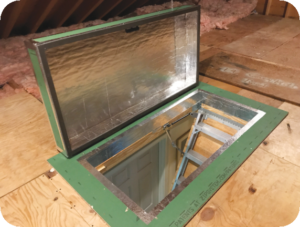
When it is safe and practical, look for the fan duct in an accessible attic or service space. You are looking for a connected duct that continues to an outdoor vent, not a duct that stops in the space. Do not walk on ceiling drywall, climb onto an unstable ladder, or enter an attic that is too hot, poorly lit or otherwise unsafe.
From outdoors, you may be able to spot the fan’s termination on a roof or exterior wall. A vent cover can be hard to identify among other openings, so don’t assume that any nearby vent belongs to the bathroom fan. A building professional can trace the route if it is unclear.
Signs worth investigating include a loose duct connection, a crushed or sagging section, visible moisture, or an outlet that appears to discharge into an attic. Don’t disconnect or reroute ductwork as a guess. The correct route, duct material and termination details depend on the home and local requirements. A professional can assess the setup and make repairs that carry the exhaust outdoors.
Use the fan, and watch for results
Run the fan during showers and continue afterward to help clear humid air. If the fan has a timer, use it according to its instructions. If it does not, a simple routine is to leave it on after bathing and check whether the room clears; persistent fogging or dampness is a reason to investigate, not a cue to run the fan indefinitely without finding the cause.
Also make sure the room has a way for replacement air to enter, such as a gap beneath the door or another intended air path. If the door seals tightly, a fan may struggle to move air. Don’t cut or alter a door without checking the home’s ventilation needs and any relevant building requirements.
Cleaning can improve a dusty grille, but it cannot fix a failed motor, blocked duct or indoor discharge. If airflow remains weak after safe cleaning—or moisture marks, musty odors or visible growth keep returning—get the fan and its exhaust route inspected. The most useful question is not only whether the fan turns on, but whether it carries bathroom air all the way outdoors.