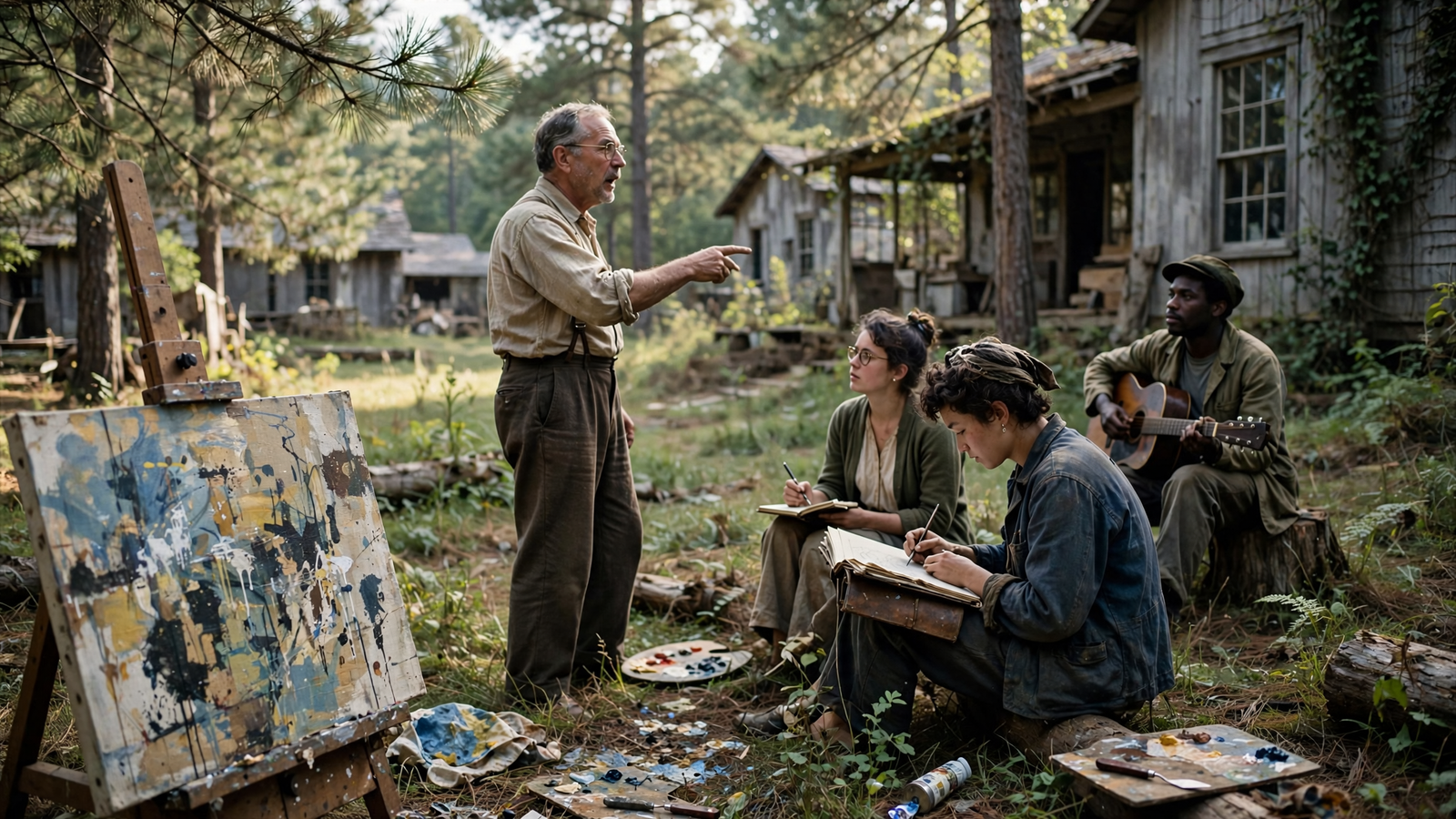
In the mountains of western North Carolina, a small college once treated art not as an ornament to education but as one of its central ways of thinking. For related reading, see W.E.B. Du Bois’s The Souls of Black Folk: How Essays Made a Nation Look at Itself.
Black Mountain College opened in 1933 with an unusually broad ambition. Students were expected to take part in practical work, shared decision-making, and intellectual study, but they were also encouraged to make things: paintings, poems, buildings, performances, photographs, furniture, gardens, and new forms of music. For related reading, see The Crisis: How a Black Magazine Made an American Movement Impossible to Ignore.
The school lasted only 24 years. It never enrolled more than a few dozen or, at its largest, a little over a hundred students at a time. Yet its influence reached far beyond its rural campus. Teachers and students associated with Black Mountain helped shape postwar American art, experimental poetry, modern dance, design, architecture, and music. For related reading, see The Prescott Circle Trail: How a Mountain Town Made Room for a Bigger Walk.
Its lasting lesson is hopeful and straightforward: creative breakthroughs often appear when people from different disciplines are given time, trust, and a place to work together.
A college built around participation
Black Mountain College was founded by John Andrew Rice, a classics professor who had been dismissed from Rollins College after a dispute over academic freedom and educational practice. Rice and his colleagues wanted to create a school less dependent on rigid departments, formal hierarchies, and passive learning.
The new college opened at the former Blue Ridge Assembly property near Black Mountain, North Carolina. Its educational philosophy drew on progressive ideas associated with John Dewey: students should learn through experience, and education should prepare people for democratic participation rather than simply train them for examinations.
That philosophy affected daily life. Students helped operate the college, worked in the kitchen and fields, participated in governance, and contributed to the community’s upkeep. Faculty members were not simply lecturers who delivered a fixed curriculum. They were working artists, designers, composers, writers, and thinkers whose own practices became part of the educational environment.
The arrangement was demanding, but it also made the school unusually open to experimentation. A student could encounter a lesson in color theory in the morning, help build a structure in the afternoon, and take part in a performance or discussion in the evening.
Josef and Anni Albers bring Bauhaus ideas to America
One of the college’s earliest and most important appointments was Josef Albers, who arrived in 1933 after the closure of Germany’s Bauhaus school under the Nazi regime. His wife, Anni Albers, became a major presence in the college’s textile program and later an influential artist and designer in her own right.
Josef Albers taught students to look closely at how color, line, material, and form behave in relation to one another. His teaching did not depend on copying a particular style. Instead, students performed structured visual exercises that made them test perception through direct experience.
Anni Albers extended that spirit into weaving and textile design. She treated textiles as a serious field of modern art and design, connecting traditional techniques with experimentation in structure, pattern, and material. Her work helped expand the possibilities of what could be considered fine art while retaining a deep respect for craft and use.
The Alberses did not create Black Mountain’s entire identity, but their presence gave the young college an important connection to European modernism. Just as important, they helped establish a culture in which making and observing were inseparable from learning.
The campus became a meeting place for disciplines
Over time, Black Mountain attracted an extraordinary range of figures. The list included artists such as Willem de Kooning, Robert Motherwell, Robert Rauschenberg, Cy Twombly, and Ruth Asawa; composer John Cage; choreographer Merce Cunningham; poet Charles Olson; architect and designer Buckminster Fuller; and photographer Aaron Siskind.
They did not all teach in the same way, and they did not share a single aesthetic. That variety was part of the point. Black Mountain made it possible for people working in different media to encounter one another without having to translate their work into a single academic language.
Fuller’s experiments with tensegrity structures, for example, brought engineering and architecture into the school’s artistic life. Cage’s work challenged conventional ideas about composition and performance. Cunningham’s dance emphasized movement as an independent artistic language, while visual artists and writers explored chance, process, gesture, and everyday materials.
The result was not a neat movement with a manifesto and membership card. It was more like a temporary network: a group of people sharing a place where the boundaries between art forms could become unusually permeable.
An “event” points toward performance art
One of the best-known episodes in the college’s history took place in 1952. John Cage organized an experimental performance later known as Theatre Piece No. 1, with contributions from several people at the college, including Cunningham, Rauschenberg, pianist David Tudor, and poet Mary Caroline Richards.
The event did not follow the structure of a conventional play or concert. Different activities unfolded in and around the audience, including music, movement, readings, and visual elements. The purpose was not to tell a single story from a stage but to make the entire setting part of the work.
Later accounts have often described the performance as an early example of the “happening,” a form that would become important in experimental art during the 1950s and 1960s. It is best understood not as a finished product that suddenly invented the future, but as evidence of the kind of creative permission Black Mountain offered: artists could test what counted as a performance, who could participate, and how an audience might experience time.
The college’s approach also gave students permission to be unfinished. A work could be a trial, a question, or a process rather than a polished object. That idea would become central to much postwar art.
Ruth Asawa and the value of a broad education
Ruth Asawa arrived at Black Mountain in 1946 and studied with Josef Albers, Buckminster Fuller, and other influential teachers. She became known for delicate wire sculptures that appear to draw forms in the air, turning industrial material into translucent, organic shapes.
Asawa’s career illustrates the college’s unusual combination of rigor and freedom. Her work grew from close attention to material, but it was also connected to design, architecture, craft, and the experience of making by hand. She later became a prominent San Francisco artist and an advocate for arts education.
Her story also complicates any simple account of the college as a purely isolated utopia. Asawa was a Japanese American woman who had experienced incarceration during World War II before enrolling. At Black Mountain, she found an environment that supported her artistic development, but her achievement was her own. The school offered tools and community; it did not guarantee a career or erase the barriers its students faced elsewhere.
That distinction matters. Black Mountain’s contribution was not that it produced one uniform kind of artist. It helped people develop distinct practices by giving them access to serious instruction, shared work, and an unusually wide field of possibility.
A short life with a long afterlife
Black Mountain College moved to a former summer camp near Lake Eden in 1941. The campus offered more space for studios, workshops, farms, performances, and communal life. But the college’s finances remained fragile, and changing conditions in higher education made its model increasingly difficult to sustain.
The school closed in 1957. Its buildings and records did not immediately receive the recognition they would later attract. Many former students and faculty moved into other communities, universities, galleries, studios, and publishing circles, carrying with them the belief that education could be collaborative, practical, and artistically ambitious at the same time.
Today, the Black Mountain College Museum + Arts Center in Asheville preserves and interprets the college’s history. Its collections, exhibitions, and public programs keep attention on both famous participants and the broader culture of experimentation that made their work possible.
The college’s influence is sometimes reduced to a roll call of celebrated names. But the more generous way to understand it is as a social experiment in creative attention. Its greatest achievement was not a particular painting, poem, concert, or performance. It was the creation of conditions in which people could learn across boundaries.
That idea remains useful well beyond the history of modern art. Schools, libraries, studios, and community programs still face the question Black Mountain asked in practical terms: what happens when people are trusted to contribute, when making is treated as a form of knowledge, and when a community makes room for different kinds of intelligence?
Black Mountain College did not last. Its method was never easy to scale, and its community was not free of conflict or limitation. But for a brief period, it demonstrated that a small educational institution could become a laboratory for cultural possibility. Its legacy survives in the artists who emerged from it—and in every classroom, rehearsal room, workshop, and shared table where people are still discovering what they can make together.
Use: Institutional history of the college, its educational philosophy, campus locations, major figures, and closing in 1957.
Use: Background on the museum’s preservation and interpretation of the college’s artistic and educational legacy.
Use: Context on Josef Albers’s artistic and teaching career and his connection to modern art education.
Use: Biographical and artistic background on Ruth Asawa and her development as a sculptor.
Use: Additional authoritative context on the college’s role in North Carolina’s and America’s modern arts history.
Black Mountain College Museum + Arts Center — History — https://www.blackmountaincollege.org/history/ — Institutional history of the college, its educational philosophy, campus locations, major figures, and closing in 1957.
Black Mountain College Museum + Arts Center — Collections and Archives — https://www.blackmountaincollege.org/collections/ — Background on the museum’s preservation and interpretation of the college’s artistic and educational legacy.
Museum of Modern Art — Josef Albers — https://www.moma.org/artists/98 — Context on Josef Albers’s artistic and teaching career and his connection to modern art education.
Smithsonian American Art Museum — Ruth Asawa — https://americanart.si.edu/artist/ruth-asawa-244 — Biographical and artistic background on Ruth Asawa and her development as a sculptor.
North Carolina Arts Council — Black Mountain College — https://www.ncarts.org/black-mountain-college — Additional authoritative context on the college’s role in North Carolina’s and America’s modern arts history.