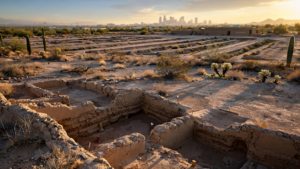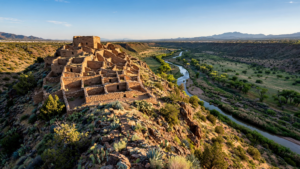
From a distance, Great Zimbabwe’s curved stone walls can look almost like part of the hillside: broad bands of granite tracing the contours of the land. Up close, their scale becomes clearer. The walls rise around courtyards and passages, forming one of the most remarkable surviving architectural landscapes in sub-Saharan Africa.
Great Zimbabwe was not a mysterious outpost or a single royal palace. It was a major settlement and political center built by ancestors of the Shona people in what is now southeastern Zimbabwe. Its surviving stone complexes are the most visible part of a much larger story—one involving communities, regional power and connections to trade networks that reached the Indian Ocean.
A city made of carefully fitted stone
The name “Great Zimbabwe” refers to a collection of ruins spread across a broad area. UNESCO identifies three main groups: the Hill Complex, the Great Enclosure and the Valley Ruins. Together, they preserve a built environment that developed over centuries, rather than a single structure erected all at once.
The stonework is the site’s most striking feature. Builders shaped and stacked granite blocks in courses, creating long, curved walls without mortar. The result is not simply a boundary: walls guide movement, frame spaces and respond to the uneven terrain. In some places, narrow passages open into larger enclosures; elsewhere, walls follow the slopes of the hills.
The Great Enclosure is especially imposing. Its high outer wall curves around a large space, with an interior passage and a distinctive conical stone structure. The precise purpose of every feature is not known. Archaeologists study the architecture alongside artifacts and the wider settlement, rather than treating one unusual building as a complete explanation of the site.
On the hill above the surrounding landscape, the Hill Complex includes stone structures built around rocky outcrops. Lower down, the Valley Ruins preserve further evidence of settlement. The relationship between these areas changed over time, and the site’s layout reflects a society with varied spaces and activities—not just a monument meant to be viewed from outside.
More than a monument
Great Zimbabwe flourished between the 11th and 15th centuries. Its buildings are evidence of skilled planning and labor, but the settlement was also part of a working economy. Archaeological finds, including imported objects, point to links with wider trade networks. Goods moving through the region connected inland communities with trading centers along the East African coast and, beyond it, the Indian Ocean world.
Those connections help explain why Great Zimbabwe matters beyond its walls. The site was a center of African political and economic life in a period when long-distance exchange linked communities across great distances. Its prominence rested on local society and regional networks; imported goods are one part of that history, not proof that the city’s builders came from somewhere else.
That distinction matters because Great Zimbabwe has been surrounded by false claims about its origins. Archaeological research identifies the site as the work of local African communities, not a lost civilization from another continent. The walls themselves are a powerful record of local expertise: builders understood the stone available to them and shaped it into complex structures that have endured for centuries.
Reading the landscape, not just the walls
A visit—or even a close look at a site plan—makes clear that Great Zimbabwe cannot be understood as a collection of isolated ruins. Its location, topography and different building groups all matter. The Hill Complex uses elevated ground; the Great Enclosure makes a substantial architectural statement; and the Valley Ruins show that life extended beyond the most dramatic stonework.
Nor can the surviving walls tell every part of the story. Much of the settlement was built using materials that do not survive as visibly as granite. Archaeologists combine the standing architecture with excavated evidence to interpret how the site developed. That leaves room for uncertainty about particular buildings and decisions, even while the broad picture of a major medieval center is well established.
UNESCO inscribed Great Zimbabwe on its World Heritage List in 1986, recognizing its importance as a major achievement of African architecture and as evidence of a powerful regional society. The designation also places the ruins in a wider conservation context: preserving the stonework means caring for a large archaeological landscape, not simply maintaining a few photogenic walls.
What the ruins still make visible
Great Zimbabwe’s walls invite questions about how people organized labor, created shared spaces and expressed authority through architecture. Their curves and carefully fitted stones are visually memorable, but the site’s significance is not only aesthetic. It is a reminder that the history of cities, engineering and international exchange includes powerful centers across Africa.
The ruins do not offer a complete account of the people who built and used them. They do something more grounded: they preserve the scale and skill of a society that shaped this landscape over generations. Seen that way, Great Zimbabwe is not a puzzle waiting for an exotic explanation. It is a historic place whose architecture, archaeology and setting make a substantial African past visible.