Modern Phoenix is a city of highways, subdivisions, office towers and broad canals. Beneath that familiar urban landscape is an older story: for centuries, people built homes, cultivated crops, organized communities and engineered water systems in the same desert valley. For related reading, see The Arizona State Capitol Museum: How a Territorial Building Kept Phoenix’s First Government in View.
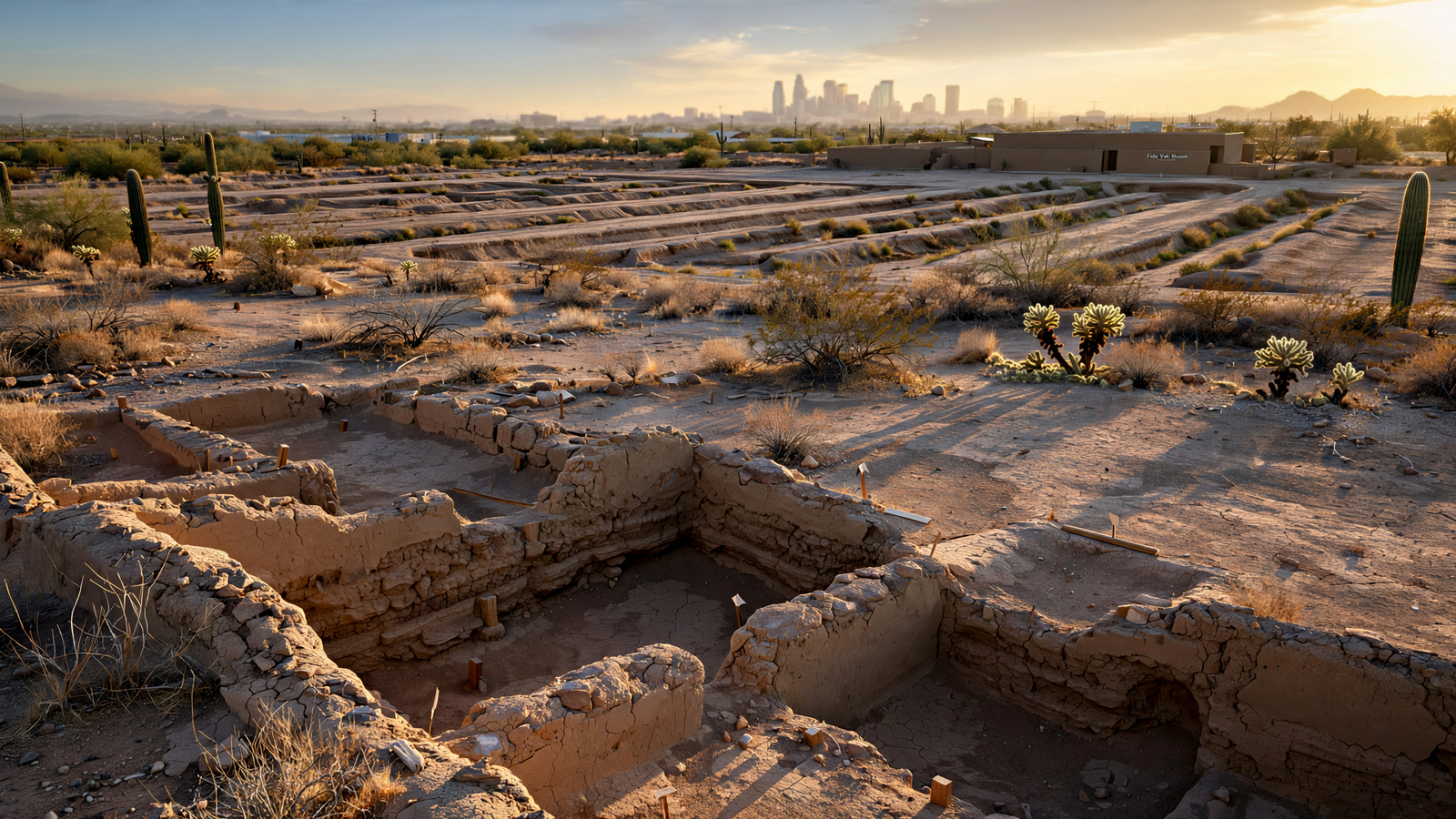
That story remains visible at S’edav Va’aki Museum, formerly known as Pueblo Grande Museum, near Phoenix Sky Harbor International Airport. The museum and archaeological park protect the remains of a major ancestral Sonoran Desert settlement, including a platform mound, a ballcourt, remnants of ancient structures and traces of the irrigation landscape that supported daily life. For related reading, see Montezuma Castle: How a Verde Valley Cliff Dwelling Keeps Ancient Ingenuity in View.
The site does not present the ancient desert as an empty wilderness waiting for modern development. It shows the Salt River Valley as a lived-in place—one shaped by knowledge, labor, farming, trade, ceremony and relationships among communities. For related reading, see Tuzigoot National Monument: How a Verde Valley Hilltop Keeps an Ancient Community in View.
A village preserved inside a growing city
S’edav Va’aki sits along Washington Street, close to one of the busiest transportation corridors in central Phoenix. The setting can make the archaeological park feel like an island of quiet inside a metropolitan landscape. That contrast is part of its meaning.
According to the City of Phoenix, the site was occupied for roughly a thousand years, from about A.D. 450 to 1450. Archaeologists have traditionally used the term “Hohokam” for the people associated with many of the ancient settlements of central and southern Arizona. Today, museums and researchers increasingly explain that the label is an archaeological classification rather than the name these communities used for themselves. Descendant Indigenous communities, including O’odham peoples, remain important to how the region’s past is understood.
The settlement that once stood here was not a small, isolated camp. It was part of a broad network of communities connected by farming, waterways, exchange and shared cultural practices. The park’s surviving features offer only a partial view, but they are substantial enough to make the scale of that earlier world legible.
Water was the foundation of the landscape
In the Sonoran Desert, the most important historical technology may have been the ability to move water. Ancient communities in the Salt and Gila river valleys developed extensive canal systems that carried river water toward agricultural fields. These channels made it possible to grow crops in an environment where rainfall alone could not reliably support farming.
The people associated with the S’edav Va’aki site cultivated crops such as maize, beans and squash, while also gathering wild plants and hunting animals. Farming was not simply a matter of digging a ditch and planting seeds. It required seasonal observation, maintenance, cooperation and an understanding of how river water moved through a flood-prone desert valley.
Some canals disappeared beneath later streets and buildings, while others were altered by modern water infrastructure. Their survival is therefore more than an archaeological curiosity. It helps explain why the Phoenix area became a place where large communities could persist long before the arrival of automobiles, electric pumps or modern reservoirs.
The ancient canal builders did not create a landscape separate from nature. They worked with the Salt River’s shifting waters, desert soils and intense heat. Their achievements challenge the idea that desert settlement is a recent response to modern engineering. People had already developed sophisticated ways to live with limited water many centuries ago.
The platform mound still changes the view
One of the park’s most recognizable features is its platform mound. Built over time, the raised structure would have stood above the surrounding settlement and served as a prominent architectural landmark. Archaeologists continue to study the exact roles such mounds played, but they were likely connected to community organization, public activity or ceremonial life.
Walking near the mound offers a different perspective on the valley. From a modern street, the city can seem almost entirely new. From the archaeological park, the mound establishes a much longer horizon. It becomes possible to imagine a settlement organized around earthen architecture, open spaces, agricultural work and waterways rather than concrete, asphalt and electrical grids.
The mound also demonstrates how much can survive when a community and its archaeological importance are recognized. Earthen structures are vulnerable to erosion, construction and neglect. Preserving one in the middle of a growing city requires continuing care, interpretation and public support.
A ballcourt connects the site to a wider world
S’edav Va’aki also preserves a large ancient ballcourt. Similar features have been identified at other sites across the Southwest and northwestern Mexico. Their presence suggests that communities were linked not only by farming systems but also by social, ceremonial and recreational traditions.
The ballcourt is especially useful for understanding the settlement as part of a regional network. It points beyond the boundaries of a single village toward movement and interaction across the desert. People, goods, stories and practices traveled. Archaeology cannot recover every detail of those encounters, but structures such as the ballcourt show that the ancient Salt River Valley was connected to a much larger cultural landscape.
At the same time, the site resists easy reconstruction. Visitors do not see a fully restored ancient town. Much of the settlement survives as low walls, foundations, mounds and traces in the ground. That partial quality is honest. Archaeological places are records of lives that can be studied but never completely recreated.
From Pueblo Grande to S’edav Va’aki
The museum’s name change reflects an effort to present the site with greater attention to Indigenous perspectives. In 2023, the City of Phoenix announced that Pueblo Grande Museum would become S’edav Va’aki Museum. The change was developed with input from O’odham community members and was intended to use a name connected to the ancestral landscape rather than one imposed through earlier archaeological terminology.
Renaming a museum does not resolve every question about how archaeology should be practiced or interpreted. It does, however, signal that the site’s meaning is not limited to the history of excavation. It is also part of the continuing cultural landscape of Indigenous peoples whose ancestors lived in the region.
That distinction matters in a place where the past can easily be presented as finished. The community that built the settlement is no longer present in the same form, but Indigenous history in Arizona did not end when the archaeological occupation of this particular site changed. Contemporary O’odham communities maintain cultural, historical and spiritual connections to the wider Sonoran Desert.
A museum that keeps research public
The museum’s work extends beyond the preserved ruins. Its collections include archaeological materials, documents, photographs and objects used to interpret the ancient and more recent history of the Phoenix area. Exhibits help connect individual artifacts to larger questions: How did people organize work? What did they eat? How did they build? How did they respond to changing water conditions? What can material remains reveal—and what can they not tell us?
That public role is important because archaeological knowledge is often created gradually. A single excavation rarely provides a complete answer. Researchers compare structures, soils, plant remains, tools and settlement patterns across many locations. Museums give visitors a way to see the evidence and the uncertainty together.
The result is less like a display of isolated ancient objects and more like an invitation to think about how landscapes preserve human choices. A cooking vessel, a wall fragment or a canal alignment becomes evidence of a broader system of life. The museum helps make that system visible without pretending that every part of it can be recovered.
An older definition of urban Arizona
Phoenix is often described through its modern growth: rapid development, sprawling neighborhoods, air-conditioning, freeways and a population shaped by migration from across the country and the world. S’edav Va’aki adds another layer to that identity.
It shows that the valley’s history of urban possibility began with people who understood how to make a demanding environment productive. Their settlement was not a primitive prelude to the modern city. It was a complex desert community with its own institutions, technologies and traditions.
The archaeological park also asks present-day visitors to consider what it means to live in the same watershed. Phoenix’s modern water systems are vastly different from ancient canals, but both reflect the central challenge of the valley: life depends on careful decisions about scarce and variable water.
That is why S’edav Va’aki is more than a preserved ruin or a museum stop near the airport. It is a place where Phoenix can see that its urban story did not begin with incorporation, railroads or postwar development. It began much earlier, when desert communities built a durable relationship with water, soil and one another—and left enough of that achievement behind for the city to remember.
Use: Museum history, archaeological features, occupation dates and the site’s role in Phoenix.
Use: Current museum identity, visitor information and institutional interpretation.
Use: National historical context and recognition of the archaeological site.
Use: Regional archaeological context concerning ancestral Sonoran Desert communities and material culture.
City of Phoenix, S’edav Va’aki Museum — https://www.phoenix.gov/parkssite/Documents/PKS_PuebloGrandeMuseum.pdf — Museum history, archaeological features, occupation dates and the site’s role in Phoenix.
City of Phoenix, S’edav Va’aki Museum official website — https://www.phoenix.gov/parkssite/sedav-vaaki-museum — Current museum identity, visitor information and institutional interpretation.
National Park Service, National Historic Landmarks Program: Pueblo Grande Archaeological Park — https://www.nps.gov/subjects/nationalhistoriclandmarks/index.htm — National historical context and recognition of the archaeological site.
Arizona State Museum, University of Arizona — https://statemuseum.arizona.edu/ — Regional archaeological context concerning ancestral Sonoran Desert communities and material culture.