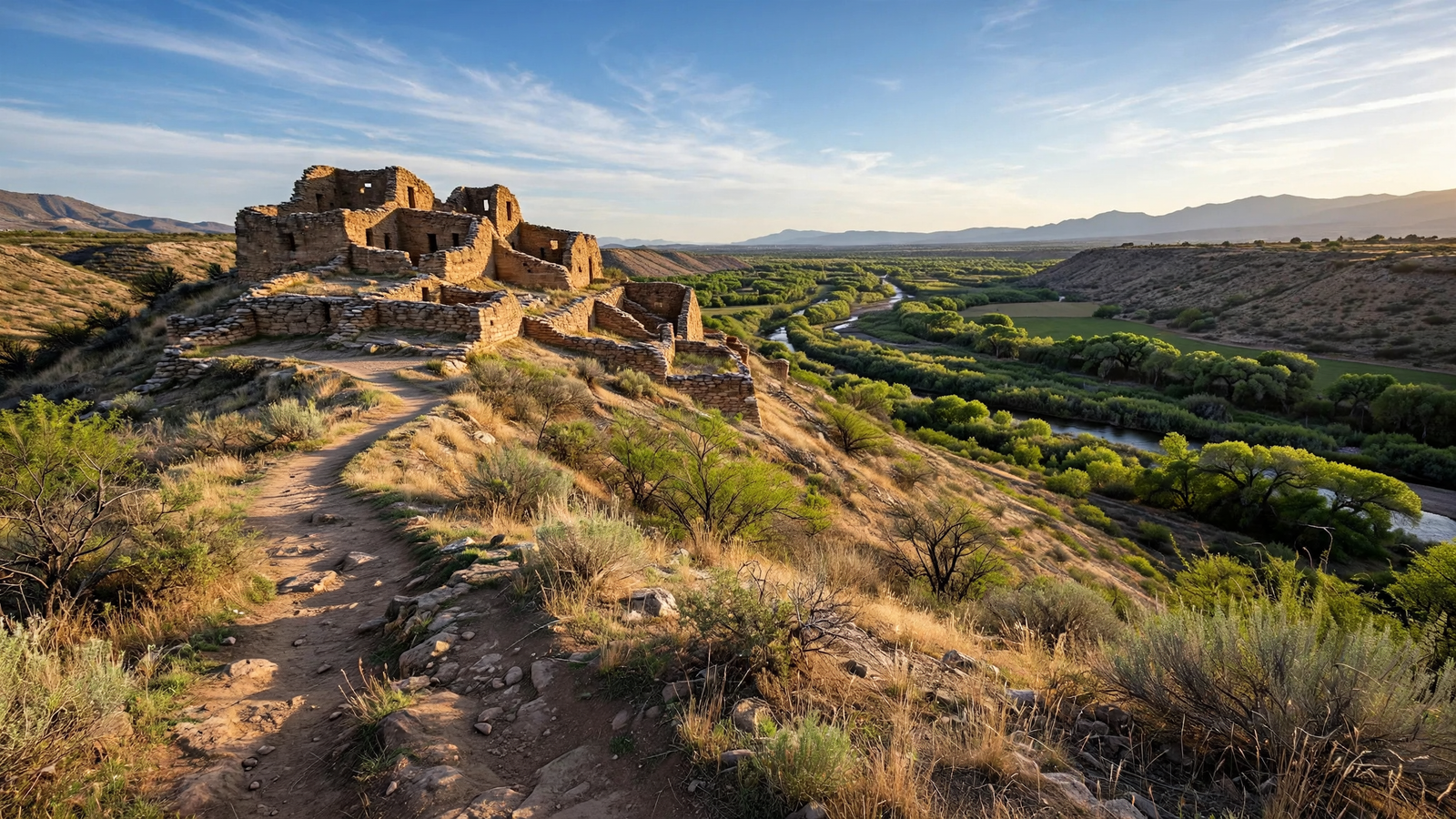
From a distance, Tuzigoot can look like a low, weathered ridge rising above the Verde Valley. Closer inspection reveals something more deliberate: walls built from local stone, rooms stacked up the hill, and a summit shaped by generations of people who made this place home. For related reading, see Tuzigoot: The Hilltop Pueblo That Keeps the Verde Valley in View.
Today, Tuzigoot National Monument is one of Yavapai County’s clearest places to encounter the long human history of central Arizona. The monument does not rely on a reconstructed village or a theatrical retelling. Its power comes from the surviving structure itself, the broad valley around it, and the evidence that remains in the rooms and landscape. For related reading, see Montezuma Castle: How a Verde Valley Cliff Dwelling Keeps Ancient Ingenuity in View.
The site is also a reminder that the Verde Valley was never an empty desert waiting for modern settlement. Long before roads, ranches, and towns, communities here farmed, traded, built, and adjusted to the rhythms of the Verde River and its surrounding uplands. For related reading, see S’edav Va’aki Museum: How Phoenix Keeps an Ancient Desert City in View.
A pueblo on a strategic rise
Tuzigoot sits on a limestone and sandstone ridge near the Verde River, not far from the modern communities of Cottonwood and Clarkdale. The elevation is modest, but the position is commanding. From the summit, the valley opens in several directions, with agricultural land, waterways, and distant mesas all visible from the higher rooms.
The settlement was built and occupied by people archaeologists commonly identify as the Sinagua. The name is a modern archaeological label, and the people who lived here were part of a complex network of ancestral communities across the Southwest. Their descendants are connected to living Indigenous nations, whose histories and relationships to these landscapes continue today.
According to the National Park Service, the main pueblo grew between roughly A.D. 1000 and 1400. At its height, the settlement included approximately 110 rooms, arranged across the hill in a form that rose several stories above the surrounding valley. Some rooms served as living spaces; others may have been used for storage, work, or communal activities.
The builders worked with materials close at hand. Stone, mud mortar, and timber came from the surrounding environment, while the design responded to the steep shape of the hill. Instead of spreading across a flat plain, the pueblo climbed upward, creating a compact settlement with views over the valley.
Life beyond the walls
The masonry is the most visible part of Tuzigoot, but the monument’s larger story lies in the relationship between the pueblo and the valley below it. The Verde River and nearby wetlands supported farming, wildlife, and travel. Seasonal water availability shaped what could be grown and when work had to be done.
People living in the region cultivated crops including corn, beans, and squash. They also gathered wild plants, hunted, made tools, produced pottery, and participated in exchange networks that reached beyond the immediate valley. The settlement’s position helped connect it to other communities along the Verde River and across the uplands of central Arizona.
That combination of agriculture and mobility is important to understanding ancient desert life. The residents of Tuzigoot were not simply surviving in a harsh environment. They were managing a landscape with multiple ecological zones: river bottoms, open desert, grasslands, and higher country. Each offered different resources at different times of year.
The monument’s setting still makes that pattern visible. A visitor standing on the pueblo can see why the hill was valuable, while trails below show how closely the community was tied to water and lowland habitat.
What happened after the pueblo was occupied?
By about A.D. 1400, Tuzigoot was no longer being used as a large permanent settlement. Archaeologists continue to study why ancestral communities in the Verde Valley changed where and how they lived. Climate shifts, resource pressures, social changes, and movement among communities may all have played roles. No single explanation should be treated as a complete answer for every ancient settlement in the region.
The people did not vanish from history simply because the pueblo was no longer occupied. Indigenous communities have continued to live in and maintain relationships with the Southwest for centuries. The change at Tuzigoot is better understood as part of a wider pattern of movement and reorganization, not as the disappearance of a people.
That distinction matters at a site where the word “ruin” can otherwise make the past sound finished. Tuzigoot is preserved as an archaeological place, but the histories connected to it remain part of a living region.
From excavation to national monument
The modern history of Tuzigoot brought a different kind of change. Archaeological excavation began in the 1930s, during a period when federal work programs were supporting major projects across the country. Excavators exposed rooms, walls, artifacts, and architectural details that had been covered by centuries of erosion and accumulated soil.
The work helped draw public attention to the site, but early twentieth-century archaeology was not conducted with all of the standards expected today. Modern preservation places greater emphasis on context, careful documentation, consultation, and respect for Indigenous perspectives. The monument’s current interpretation reflects an ongoing effort to present the site as more than an archaeological object.
President Franklin D. Roosevelt established Tuzigoot National Monument in 1939. Federal protection gave the pueblo a permanent place within the national park system and created a framework for preserving the remaining walls and associated landscape.
That protection is especially significant in a valley where development, transportation, agriculture, and recreation all meet. A national monument does not freeze the surrounding region in time, but it keeps an important portion of the valley available for study, public access, and long-term care.
A small monument with a wide view
Tuzigoot is not a vast park, and its compact size is part of its appeal. Visitors can walk through the pueblo, climb to higher rooms, and study how the buildings follow the hill. The museum and visitor facilities add archaeological context, helping connect the visible walls with pottery, tools, food systems, and daily work.
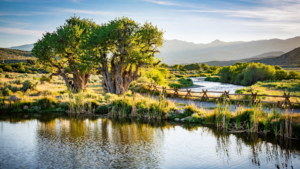
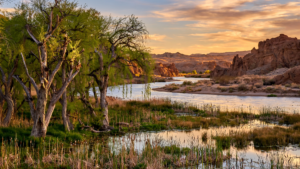
Outside the pueblo, trails lead through the surrounding landscape and toward Tavasci Marsh, one of the Verde Valley’s important wetland areas. The marsh provides a striking contrast to the dry hills around it. Its presence helps explain why people chose to live in this part of the valley and why the monument is valuable as both a cultural and natural place.
The result is a layered experience. A short walk can move from masonry to wetland, from a high desert view to evidence of river-supported life. The landscape is not merely a backdrop for the pueblo; it is part of the explanation for the settlement itself.
Why Tuzigoot still matters
Places like Tuzigoot offer a useful correction to the way Arizona is sometimes described. The state’s deserts can appear timeless, but they are full of change: rivers shift, vegetation responds to drought, communities relocate, and buildings weather under intense sun and seasonal rain.
The pueblo also shows that ancient technology was often practical rather than spectacular. Its builders used nearby materials, organized space efficiently, and created a durable settlement without separating themselves from the surrounding environment. The remaining walls are evidence of planning, cooperation, and accumulated knowledge.
For present-day visitors, the monument provides a rare chance to see those decisions in place. The rooms are not isolated artifacts in a case. They remain attached to the ridge, the river corridor, the marsh, and the larger geography that shaped life in the Verde Valley.
Tuzigoot’s continuing value lies in that connection. It preserves a community without reducing it to a single date or mystery. It protects an ancient architectural record while keeping the surrounding landscape visible. And it gives Yavapai County a place where the past is not hidden behind a label—it is built into the ground, the horizon, and the path a visitor walks today.
Use: Official overview of the monument, its significance, location, and management.
Use: Background on the ancestral settlement, archaeology, preservation, and cultural context.
Use: Current visitor information, facilities, trails, and access details.
Use: Information about the monument’s landscape, wetland resources, and natural setting.
National Park Service — Tuzigoot National Monument — https://www.nps.gov/tuzi/index.htm — Official overview of the monument, its significance, location, and management.
National Park Service — History and Culture at Tuzigoot — https://www.nps.gov/tuzi/learn/historyculture/index.htm — Background on the ancestral settlement, archaeology, preservation, and cultural context.
National Park Service — Plan Your Visit to Tuzigoot — https://www.nps.gov/tuzi/planyourvisit/index.htm — Current visitor information, facilities, trails, and access details.
National Park Service — Nature at Tuzigoot — https://www.nps.gov/tuzi/learn/nature/index.htm — Information about the monument’s landscape, wetland resources, and natural setting.