In the Verde Valley, the most striking architecture is not always the newest. A few miles from Interstate 17, a limestone cliff rises above Beaver Creek with a human-made surprise tucked into its face: a five-story dwelling built into a sheltered alcove more than 600 years ago. For related reading, see Tuzigoot National Monument: How a Verde Valley Hilltop Keeps an Ancient Community in View.
Today, Montezuma Castle National Monument gives visitors a carefully managed view of that structure. The approach is short, the trail is accessible, and the building can be seen from below rather than entered. That distance is deliberate. It protects the masonry while allowing the public to encounter one of the best-preserved cliff dwellings in the American Southwest. For related reading, see Tuzigoot: The Hilltop Pueblo That Keeps the Verde Valley in View.
The result is a place that feels both dramatic and restrained. Montezuma Castle does not depend on spectacle alone. Its importance comes from the questions it raises about engineering, water, community life and the long human history of Yavapai County. For related reading, see S’edav Va’aki Museum: How Phoenix Keeps an Ancient Desert City in View.
A cliff made into a neighborhood
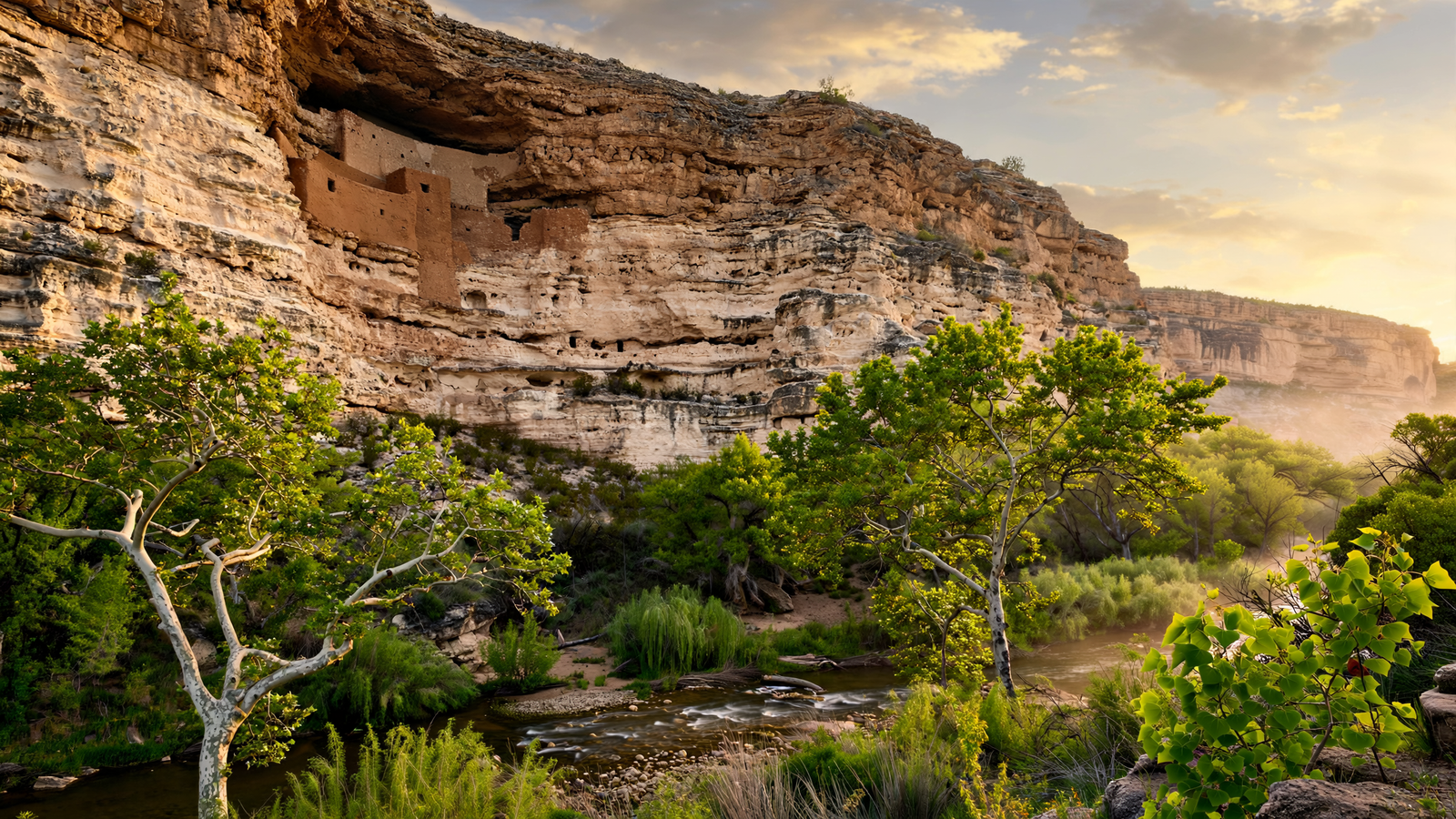
Montezuma Castle was constructed by people archaeologists associate with the Sinagua, a regional culture whose communities occupied parts of central Arizona between roughly A.D. 500 and 1425. The dwelling visible today was built primarily between about A.D. 1100 and 1300, using locally available limestone, mud mortar and timbers.
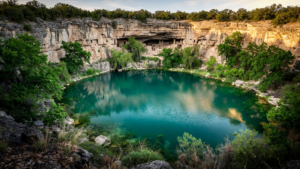
The building contains approximately 20 rooms arranged across several levels. From the ground, its size can be difficult to read. The alcove folds inward, the rock overhang hides portions of the structure, and the walls blend into the cliff’s warm gray and tan surfaces. Only when visitors notice the openings, stacked rooms and remaining beams does the scale become clear.
This was not a solitary lookout. It was part of a larger settlement landscape shaped by access to Beaver Creek and the surrounding valley. The location offered shelter, a defensible position and a vantage point over an important water corridor. The cliff also helped protect the structure from some of the intense weather that affects exposed desert buildings.
Those advantages required substantial planning. Builders had to move materials upward, fit stone into irregular spaces and create floors and roofs within the limits of the alcove. The result is a reminder that ancient communities in Arizona were not simply adapting to difficult terrain. They were designing with it.
The name tells a story of mistaken identity
The monument’s name is one of its least accurate features. Early non-Indigenous visitors gave the dwelling the name Montezuma Castle because they assumed that a large cliff structure in the Southwest must have been connected to the Aztec ruler Moctezuma. There is no evidence that he or the Aztec Empire had a connection to the site.
The name remained even as archaeological understanding changed. It now stands as part of the monument’s interpretive responsibility: visitors encounter not only an ancient building, but also a record of how outsiders misunderstood the people who made it.
That distinction matters. Calling the builders “Sinagua” can also conceal complexity. The term was created by archaeologists, and the descendants of ancient communities across the Southwest—including Hopi and other Indigenous peoples—remain part of the broader conversation about ancestral sites, cultural continuity and stewardship.
The National Park Service presents Montezuma Castle as an ancestral place rather than an abandoned curiosity. That approach shifts the emphasis from the romance of ruins to the lives of the people who built, used and maintained the settlement.
A national monument before modern tourism
President Theodore Roosevelt proclaimed Montezuma Castle a national monument in 1906 under the Antiquities Act. It was among the first places protected through that new federal authority, which was created to safeguard archaeological sites, historic structures and other significant resources on public lands.
Protection came at a time when archaeological sites across the Southwest faced collecting, vandalism and uncontrolled visitation. Montezuma Castle had already attracted attention, and its location near routes through central Arizona made it vulnerable to damage. Federal designation gave the site a permanent public status and established preservation as a central responsibility.
That decision still shapes the visitor experience. People do not climb through the rooms or walk along the cliff face. Instead, a paved loop leads to viewing areas below the dwelling. The arrangement may feel less intimate than entering a historic building, but it reflects a basic conservation truth: some places survive because access is limited.
The monument’s current work includes protecting masonry, monitoring environmental conditions and interpreting the site without encouraging visitors to treat it as an ordinary ruin. Preservation here is not a single repair project. It is an ongoing effort to slow the effects of weather, biological growth, vibration, human contact and time.
Why Beaver Creek matters
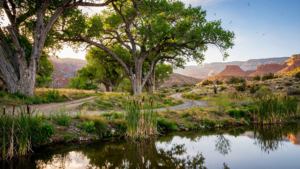
Montezuma Castle is often remembered as a building suspended in stone, but the surrounding waterway is just as important to understanding why people lived here. Beaver Creek runs through a narrow, green corridor in a landscape that can appear dry and open only a short distance away.
Water supported farming, travel and wildlife. It also connected communities across the Verde Valley. The creek’s presence helps explain why a cliff dwelling was more than a shelter: it was part of a place where agriculture, gathering, movement and social life could be organized around a reliable environmental feature.
That relationship remains visible today. Cottonwoods and other plants occupy the riparian zone, creating a marked contrast with the surrounding uplands. The monument therefore protects more than archaeological masonry. It also preserves a cultural landscape in which geology, water and human settlement are closely connected.
For visitors, this is one of the site’s quiet strengths. The castle is the visual destination, but the walk toward it encourages attention to the creek, the trees, the cliff’s geology and the distance between the dwelling and the valley floor. The setting supplies context that a photograph of the rooms alone cannot provide.
A place designed for looking carefully
Montezuma Castle rewards a slower kind of tourism. It is not a site that visitors can fully understand by checking off a viewpoint and moving on. The structure is compact enough to examine closely, but complex enough to keep changing as the light moves across the cliff.
From the trail, small details become evidence: the angle of a surviving wall, the dark openings where rooms once connected, the way timbers extend from the masonry and the sheer amount of rock surrounding the dwelling. Each feature points to choices made by people working with limited tools but considerable knowledge of materials and place.
The monument’s scale also helps make the past approachable. Visitors do not need to imagine an entire city to begin asking useful questions. How were supplies carried? How were rooms assigned? How did residents reach upper levels? What made the settlement viable for generations? Archaeology cannot answer every question, but the surviving structure gives those questions a physical starting point.
Preservation as a form of access
Modern public lands often face a difficult balance. People protect places partly by sharing them, yet visitation can also accelerate damage. Montezuma Castle offers a clear example of how interpretation and restriction can work together.
The monument remains publicly accessible, but the public encounter is carefully framed. Visitors see the dwelling, learn about the people connected to it and move through a landscape where the most fragile resources are kept out of reach. The experience is not diminished by the absence of interior access. In many ways, the boundary makes the structure easier to read as an artifact rather than a backdrop for recreation.
That balance is especially relevant in Yavapai County, where rapid growth, heavy travel corridors and rising interest in outdoor destinations bring more people into contact with archaeological landscapes. A protected site must serve visitors without allowing popularity to become a threat.
What Montezuma Castle still gives the Verde Valley
More than a century after its designation, Montezuma Castle remains valuable because it makes several histories visible at once. It preserves the achievements of ancestral builders. It reveals the limits of early twentieth-century interpretation. It records the development of federal archaeological protection. And it gives present-day visitors a direct encounter with the environmental intelligence embedded in the Verde Valley.
The dwelling does not need to be restored into a new-looking building to remain powerful. Its weathered walls are part of the evidence. They show what has endured and, just as importantly, what careful stewardship is trying to keep from disappearing.
Seen from below, Montezuma Castle can look almost impossible: a multi-level home set high inside a cliff, above a creek and beyond the reach of ordinary walking. Seen as part of its landscape, it becomes more understandable. The builders found opportunity in stone, water and shade, then made a community within those limits.
That is the enduring lesson of this Yavapai County place. Ancient ingenuity is not preserved only in objects behind glass. Sometimes it remains in a cliff face, still connected to the creek, the trees and the living landscape that made it possible.
Use: Official overview of the monument, its resources, location and visitor experience.
Use: Historical and archaeological background on the cliff dwelling, its builders and the monument’s interpretation.
Use: Official information about the accessible viewing trail, visitor access and site protections.
National Park Service — Montezuma Castle National Monument — https://www.nps.gov/moca/index.htm — Official overview of the monument, its resources, location and visitor experience.
National Park Service — Montezuma Castle History and Culture — https://www.nps.gov/moca/learn/historyculture/index.htm — Historical and archaeological background on the cliff dwelling, its builders and the monument’s interpretation.
National Park Service — Plan Your Visit to Montezuma Castle National Monument — https://www.nps.gov/moca/planyourvisit/index.htm — Official information about the accessible viewing trail, visitor access and site protections.