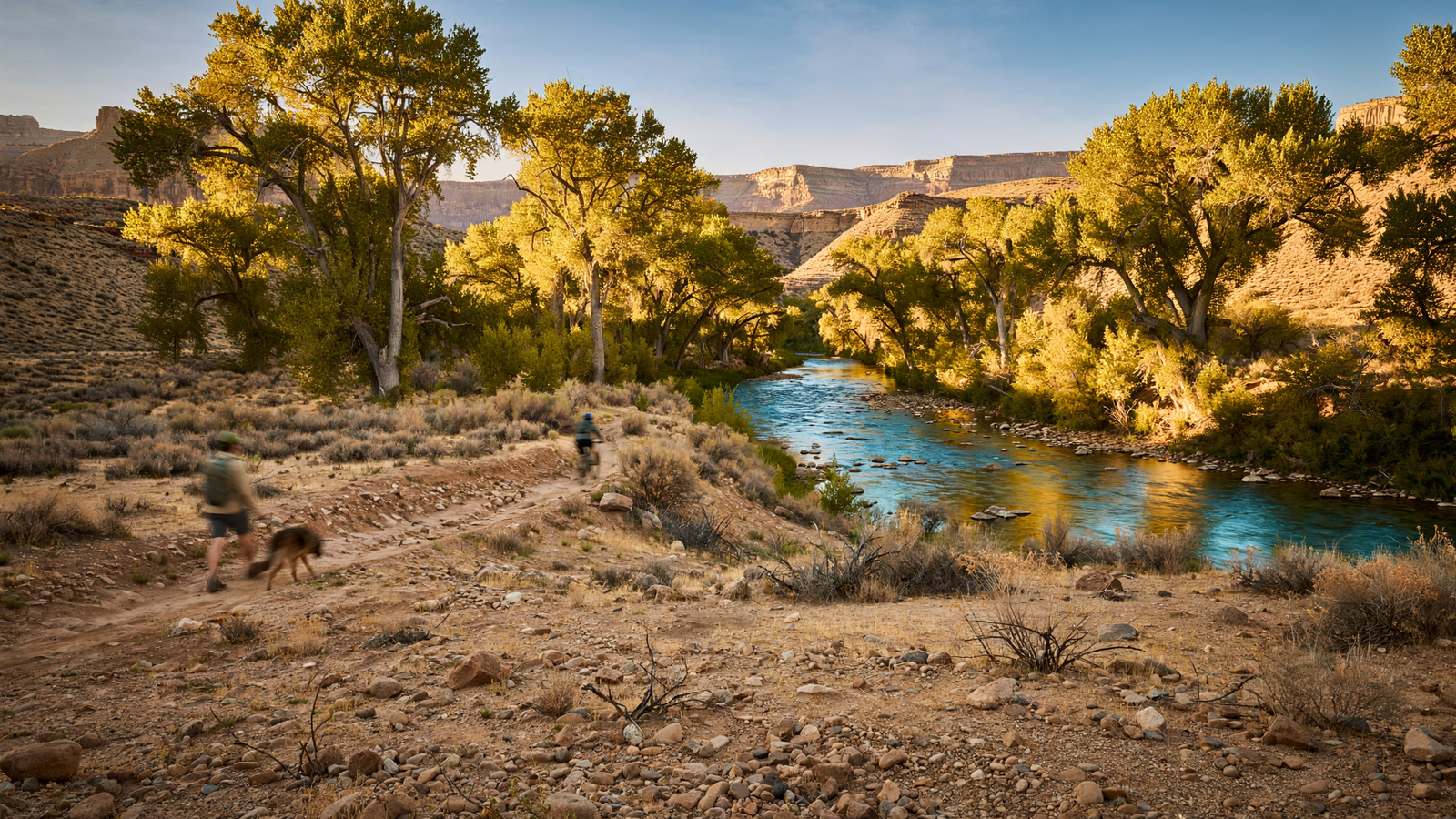
In the high desert of central Arizona, water does not have to be abundant to be decisive. A river can be narrow, seasonal in places, and surrounded by dry hills, yet still shape where people walk, where wildlife finds shelter, and where a community imagines its future. For related reading, see Havasu National Wildlife Refuge: The Arizona River Landscape That Keeps a Desert Passage Open.
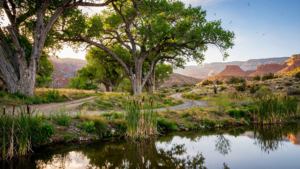
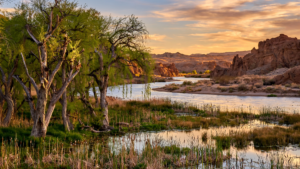
That is the role of the Verde River Greenway in Cottonwood, a protected corridor along one of Arizona’s most important desert rivers. The greenway is not a grand engineered park or a manicured urban waterfront. Its character comes from the contrast: cottonwood and willow shade beside open desert, muddy banks beside smooth paths, and a living river moving through a landscape that can appear almost still from a distance. For related reading, see The Verde River Greenway: How a Yavapai County Riverfront Became a Shared Landscape.
The place offers a useful lesson in what conservation can look like in a working community. Protecting the river does not mean separating it from daily life. At the Verde River Greenway, walking, birdwatching, environmental education, habitat protection, and local recreation occupy the same landscape. For related reading, see S’edav Va’aki Museum: How Phoenix Keeps an Ancient Desert City in View.
A green ribbon through the Verde Valley
The Verde River Greenway State Natural Area follows approximately six miles of riverfront near Cottonwood and encompasses about 480 acres, according to Arizona State Parks. Its most recognizable feature is the riparian forest: tall cottonwoods, willows, mesquite, and other plants that depend on the river’s comparatively reliable water.
In central Arizona, that forest is more than scenery. Riparian corridors are among the most productive habitats in the Southwest. They provide nesting places, cover, food, and migration routes for birds and other wildlife. They also moderate the heat near the river, hold soil in place, and create a distinct ecological zone that can be surprisingly narrow.
That narrowness is part of the greenway’s importance. The Verde Valley is a place where communities, farms, roads, trails, tourism, and open land meet. The river corridor gives those competing uses a shared reference point. A visitor may come for a short walk, while a biologist sees habitat, a teacher sees an outdoor classroom, and a resident sees one of the few places nearby where desert and water can be experienced together.
The river is the attraction—and the responsibility
The Verde River is one of Arizona’s major perennial rivers, but “perennial” does not mean limitless. Its flow varies with snowpack, monsoon rainfall, groundwater conditions, and water use across the watershed. The river’s health is therefore connected to decisions far beyond the greenway’s trails.
That larger watershed perspective is central to the work of organizations such as The Nature Conservancy and the Verde River Watershed Restoration Coalition. Their efforts have included protecting river lands, improving riparian habitat, supporting more resilient water management, and bringing local communities into conversations about the river’s future.
Such work is rarely dramatic. It may involve removing invasive vegetation, restoring streambanks, improving grazing practices, monitoring water quality, or coordinating landowners and public agencies. Yet these incremental projects matter because a river corridor is a system. A healthier bank upstream can reduce erosion downstream. A protected floodplain can give high water somewhere to spread. A connected stretch of habitat can be more valuable than isolated patches of green.
The greenway makes that broader work visible. Visitors do not need to understand every hydrological process to notice that the river supports a different world from the surrounding uplands. The shade is cooler. The vegetation is denser. Birdsong is more persistent. The landscape’s texture changes within a few steps.
A place built for a slower kind of recreation
The greenway’s appeal is deliberately modest. It is a place for walking, observing, and lingering rather than rushing through a list of attractions. Paths lead visitors through the cottonwood forest and along the river, offering changing views of water, sandbars, vegetation, and distant hills.
That accessibility gives the area an important civic function. Not everyone can plan a backcountry trip or spend a day traveling to a national park. A river corridor close to town allows families, students, older residents, and visitors with limited time to encounter a functioning desert ecosystem without leaving the community.
It also offers a different way to understand the Verde Valley. The region is often associated with red-rock scenery, wineries, historic sites, and outdoor adventure. The greenway adds another dimension: a place where the valley’s natural systems are not merely a backdrop for recreation but the central subject.
Walking beside the river encourages attention to details that are easy to miss from a road. Cottonwood leaves flash silver in the wind. Tracks appear in damp sand. A hawk circles above the treeline. The river’s edge changes after a storm, while fallen branches and new growth reveal that the corridor is always being remade.
Conservation in a populated landscape
The Verde River Greenway also demonstrates why protecting nature in Arizona often requires cooperation rather than isolation. The river passes through a landscape shaped by towns, agriculture, roads, private property, and long-standing water needs. Conservation must therefore work with the realities of human settlement.
State parks provide public access and stewardship at the greenway, while watershed groups, scientists, municipalities, tribal communities, landowners, and state and federal agencies contribute knowledge and management across the wider river system. No single organization controls the river’s future, and no single project can solve every challenge.
That may sound less satisfying than a simple success story, but it is also why the greenway is encouraging. Its existence reflects a form of progress that depends on continued care. A protected corridor is not a guarantee that drought, invasive species, wildfire, development pressure, or reduced flows will disappear. It is a decision to give the river room, public attention, and a better chance to recover when conditions improve.
In a warming and increasingly crowded Southwest, that decision has practical value. Healthy riparian areas can provide shade and habitat, reduce the severity of erosion, and preserve ecological connections that may become more important as temperatures rise. They also maintain a sense of place—an understanding that the Verde Valley is not only land around a river, but a valley shaped by it.
Why this Yavapai County place matters now
The greenway’s importance is not based on a single new building or one headline-making announcement. It comes from the steady work of keeping a living corridor available to both people and wildlife while the surrounding region changes.
That is a timely kind of development. Across the West, communities are rethinking what public infrastructure includes. It can mean a road or a water-treatment plant, but it can also mean a restored floodplain, a shaded trail, or a protected riverbank. These places support public health, recreation, education, tourism, and ecological resilience at the same time.
The Verde River Greenway shows how that overlapping value can be made tangible. A resident can use it for an evening walk. A visitor can experience the Verde Valley without a long drive. A student can study desert adaptation beside the water. Wildlife can use the same corridor as cover and habitat. Those benefits do not compete as much as they might appear to; they reinforce the argument for keeping the river accessible and cared for.
The best way to visit is with the expectations of a natural area rather than an amusement park. Stay on established routes, respect wildlife, avoid disturbing nests or riverbank vegetation, and prepare for heat and changing conditions. The river is beautiful partly because it remains a living system, not a display arranged for visitors.
In Cottonwood, the Verde River does something that desert rivers have always done: it gathers life around itself. The greenway simply makes that relationship easier to see. Its lasting achievement is not turning the river into a spectacle. It is allowing a community to remain close to the water while giving the water—and the habitat it sustains—room to remain itself.
Use: Official information on the greenway’s location, size, riverfront setting, recreation, and state stewardship.
Use: Background on the Verde River watershed, riparian conservation, and the river’s ecological importance in Arizona.
Use: Information on collaborative watershed restoration and community-based conservation work in the Verde River basin.
Use: State wildlife-conservation context for Arizona rivers, riparian habitat, native species, and watershed stewardship.
Arizona State Parks — Verde River Greenway State Natural Area — https://azstateparks.com/verde-river-greenway — Official information on the greenway’s location, size, riverfront setting, recreation, and state stewardship.
The Nature Conservancy — Verde River — https://www.nature.org/en-us/about-us/where-we-work/united-states/arizona/stories-in-arizona/verde-river/ — Background on the Verde River watershed, riparian conservation, and the river’s ecological importance in Arizona.
Verde River Watershed Restoration Coalition — https://www.vrwc.org/ — Information on collaborative watershed restoration and community-based conservation work in the Verde River basin.
Arizona Game and Fish Department — Verde River Basin — https://www.azgfd.com/wildlife/conservation/ — State wildlife-conservation context for Arizona rivers, riparian habitat, native species, and watershed stewardship.